

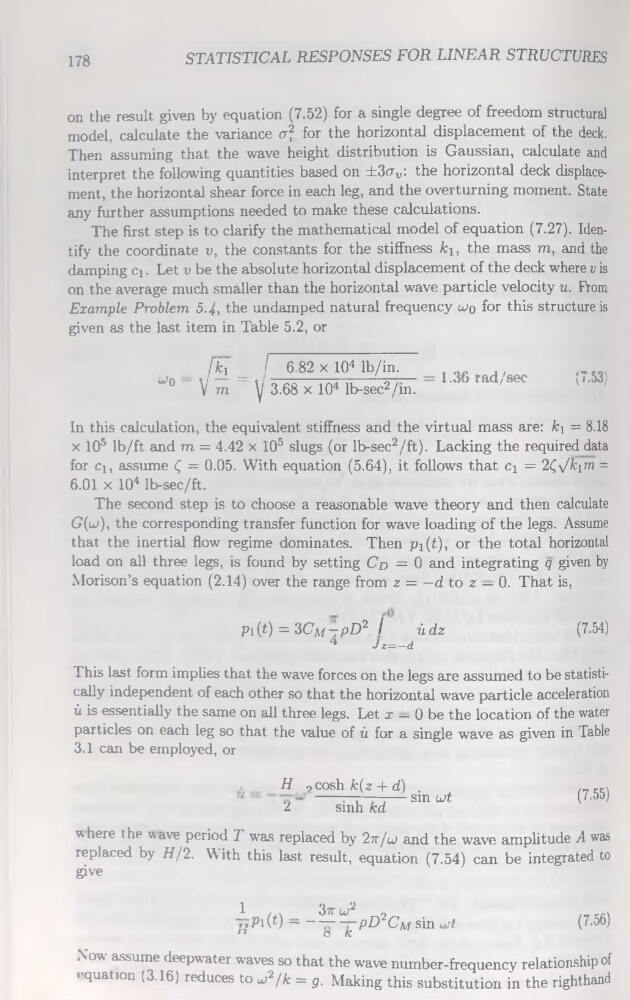
178
STATISTICAL RESPONSES FOR LINEAR STRUCTURES
on the resuit given by équation (7.52) for a single degree of freedom structural
model, calculate the variance <7? for the horizontal displacement of the deck.
Then assuming that the wave height distribution is Gaussian, calculate and
interpret the following quantities based on ±3rrv: the horizontal deck displacement, the horizontal shear force in each leg, and the overturning moment. State
any further assumptions needed to make these calculations.
The first step is to clarify the mathematical model of équation (7.27). Identify the coordinate u, the constants for the stiffness k^, the mass m, and the
damping Ci. Let v be the absolute horizontal displacement of the deck where v is
on the average much smaller than the horizontal wave particle velocity u. From
Example Problem 5-4, the undamped natural frequency w0 for this structure is
given as the last item in Table 5.2, or
«♦'O —
[ki
I 6.82 x 10⁴ Ib/in.
,
« I — = .1----------------------- Ht-— = l .36 rad/sec
V m
y 3.68 x 10⁴ lb-sec2/in.
(7.53)
In this calculation, the équivalent stiffness and the virtual mass are: ki = 8.18
x 105 Ib/ft and m = 4.42 x 10⁵ slugs (or lb-sec2/ft). Lacking the required data
for Cj, assume £ = 0.05. With équation (5.64), it follows that Cj = 2/vTim =
6.01 x 10⁴ Ib-sec/ft.
The second step is to choose a reasonable wave theory and then calculate
G(u), the corresponding transfer function for wave loading of the legs. Assume
that the inertial flow régime dominâtes. Then Pi(t), or the total horizontal
load on ail three legs, is found by setting Cd = 0 and integrating q given by
Morison’s équation (2.14) over the range from z = —d to z — 0. That is,
pdt)=3CM-pD2 I
4
Jz=-d
ùdz
(7.54)
This last form implies that the wave forces on the legs are assumed to be statistically independent of each other so that the horizontal wave particle accélération
ù is essentially the same on ail three legs. Let x - 0 be the location of the water
particles on each leg so that the value of ii for a single wave as given in Table
3.1 can be employed, or
H 2cosh/c(z + d)
' ■
----- —;
sin Lût
2
sinh kd
(7.55)
where the wave period T was replaced by 2tt/w and the wave amplitude A was
replaced by H/2. With this last resuit, équation (7.54) can be integrated to
give
1
37TW2
„
..Pi(t) — — ——pD2Cw sin urt
(7-56)
11
o K
Now assume deepwater waves so that the wave number-frequency relationship of
•■quation (3.16) reduces to ^/k = g. Making this substitution in the righthand
STATISTICAL RESPONSES FOR LINEAR STRUCTURES
on the resuit given by équation (7.52) for a single degree of freedom structural
model, calculate the variance <7? for the horizontal displacement of the deck.
Then assuming that the wave height distribution is Gaussian, calculate and
interpret the following quantities based on ±3rrv: the horizontal deck displacement, the horizontal shear force in each leg, and the overturning moment. State
any further assumptions needed to make these calculations.
The first step is to clarify the mathematical model of équation (7.27). Identify the coordinate u, the constants for the stiffness k^, the mass m, and the
damping Ci. Let v be the absolute horizontal displacement of the deck where v is
on the average much smaller than the horizontal wave particle velocity u. From
Example Problem 5-4, the undamped natural frequency w0 for this structure is
given as the last item in Table 5.2, or
«♦'O —
[ki
I 6.82 x 10⁴ Ib/in.
,
« I — = .1----------------------- Ht-— = l .36 rad/sec
V m
y 3.68 x 10⁴ lb-sec2/in.
(7.53)
In this calculation, the équivalent stiffness and the virtual mass are: ki = 8.18
x 105 Ib/ft and m = 4.42 x 10⁵ slugs (or lb-sec2/ft). Lacking the required data
for Cj, assume £ = 0.05. With équation (5.64), it follows that Cj = 2/vTim =
6.01 x 10⁴ Ib-sec/ft.
The second step is to choose a reasonable wave theory and then calculate
G(u), the corresponding transfer function for wave loading of the legs. Assume
that the inertial flow régime dominâtes. Then Pi(t), or the total horizontal
load on ail three legs, is found by setting Cd = 0 and integrating q given by
Morison’s équation (2.14) over the range from z = —d to z — 0. That is,
pdt)=3CM-pD2 I
4
Jz=-d
ùdz
(7.54)
This last form implies that the wave forces on the legs are assumed to be statistically independent of each other so that the horizontal wave particle accélération
ù is essentially the same on ail three legs. Let x - 0 be the location of the water
particles on each leg so that the value of ii for a single wave as given in Table
3.1 can be employed, or
H 2cosh/c(z + d)
' ■
----- —;
sin Lût
2
sinh kd
(7.55)
where the wave period T was replaced by 2tt/w and the wave amplitude A was
replaced by H/2. With this last resuit, équation (7.54) can be integrated to
give
1
37TW2
„
..Pi(t) — — ——pD2Cw sin urt
(7-56)
11
o K
Now assume deepwater waves so that the wave number-frequency relationship of
•■quation (3.16) reduces to ^/k = g. Making this substitution in the righthand