

166
STATISTICAL RESPONSES FOR LINEAR STRUCTURES
and for stationary wave excitation. The derived structural responses are analogous to the steady - State time domain responses considered previously. Closed
form solutions are derived by two statistical methods: the classical stationary stochastic analysis of Khintchine (1934) and Weiner (1949), and covariance
propagation analysis originally applied by Bryson and Hu (1975) to electrical
control Systems. In both methods, the structural response spectrum is predicted
in terms of the wave force spectrum on the structure, and the resuit leads to
the root-mean-square (rms) structural displacement response and its probability of exceedence. These statistical ideas lay the mathematical Framework for
Chapters 9 and 10 in which statistical responses are deduced for multi-degree
of freedom structures and for continuons structural éléments.
7.1 AVERAGES AND PROBABILITIES
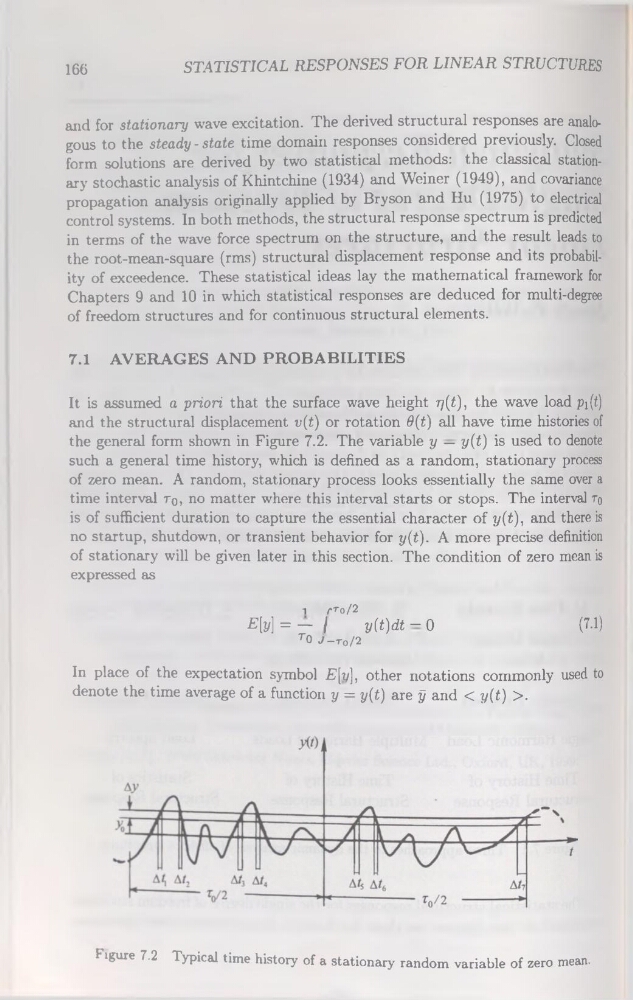
It is assumed a priori that the surface wave height 7y(i) T the wave load pi(t)
and the structural displacement v(t) or rotation 0(t) ail hâve time historiés of
the general form shown in Figure 7.2. The variable y — y(t) is used to dénoté
such a general time history, which is defined as a random, stationary process
of zéro mean. A random, stationary process looks essentially the same over a
time interval Tq, no matter where this interval starts or stops. The interval To
is of sufficient duration to capture the essential character of y(t), and there is
no startup, shutdown, or transient behavior for y(t). A more précisé définition
of stationary will be given later in this section. The condition of zéro mean is
expressed as
1 cTo/ï
E[y] = — I
y(t)dt - o
(7.1)
T0 J—tq/2
In place of the expectation Symbol E'ft/], other notations commonly used to
dénoté the time average of a function y = y(t) are ÿ and < y(t) >.
Figure 7.2 Typical time history of a stationary random variable of zéro mean.
STATISTICAL RESPONSES FOR LINEAR STRUCTURES
and for stationary wave excitation. The derived structural responses are analogous to the steady - State time domain responses considered previously. Closed
form solutions are derived by two statistical methods: the classical stationary stochastic analysis of Khintchine (1934) and Weiner (1949), and covariance
propagation analysis originally applied by Bryson and Hu (1975) to electrical
control Systems. In both methods, the structural response spectrum is predicted
in terms of the wave force spectrum on the structure, and the resuit leads to
the root-mean-square (rms) structural displacement response and its probability of exceedence. These statistical ideas lay the mathematical Framework for
Chapters 9 and 10 in which statistical responses are deduced for multi-degree
of freedom structures and for continuons structural éléments.
7.1 AVERAGES AND PROBABILITIES
It is assumed a priori that the surface wave height 7y(i) T the wave load pi(t)
and the structural displacement v(t) or rotation 0(t) ail hâve time historiés of
the general form shown in Figure 7.2. The variable y — y(t) is used to dénoté
such a general time history, which is defined as a random, stationary process
of zéro mean. A random, stationary process looks essentially the same over a
time interval Tq, no matter where this interval starts or stops. The interval To
is of sufficient duration to capture the essential character of y(t), and there is
no startup, shutdown, or transient behavior for y(t). A more précisé définition
of stationary will be given later in this section. The condition of zéro mean is
expressed as
1 cTo/ï
E[y] = — I
y(t)dt - o
(7.1)
T0 J—tq/2
In place of the expectation Symbol E'ft/], other notations commonly used to
dénoté the time average of a function y = y(t) are ÿ and < y(t) >.
Figure 7.2 Typical time history of a stationary random variable of zéro mean.