

158
STATISTICAL DESCRIPTIONS OF OFFSHORE WAVES
probability of occurrence of waves of a given intensity at the chosen site. This
information is normally developed from hindcast studies in which the paths of
ail known storms that might hâve caused waves at the site are determined. From
the data available on each of the storms, beginning usually with a knowledge of
the wind field, estimâtes can be made of the intensity, duration, and direction
of the wind-generated waves that reach the site. From this meteorological information, the lengths, periods, and heights of waves at the site can be determined.
This approach is not exactly the way it is done in practice, but it does explain
the basic methodology.
In practice, the way to forecast (or hindcast) waves is to forecast (or hindcast) the spectra of waves. From a spectrum one can obtain many of the properties of a wave such as height, average period, and average wavelength. Thus,
one begins with a deepwater wave spectrum at a location that is not necessarily
the same as the particular site for the structure. Then, using transformations
which dépend on the distance, direction, hydrography, and spectral and storm
properties, one can détermine the wave spectrum to be expected at the site
under considération. The well-known work by Pierson, Neumann, and James
(1955) is highly recommended as an excellent introduction to the subject.
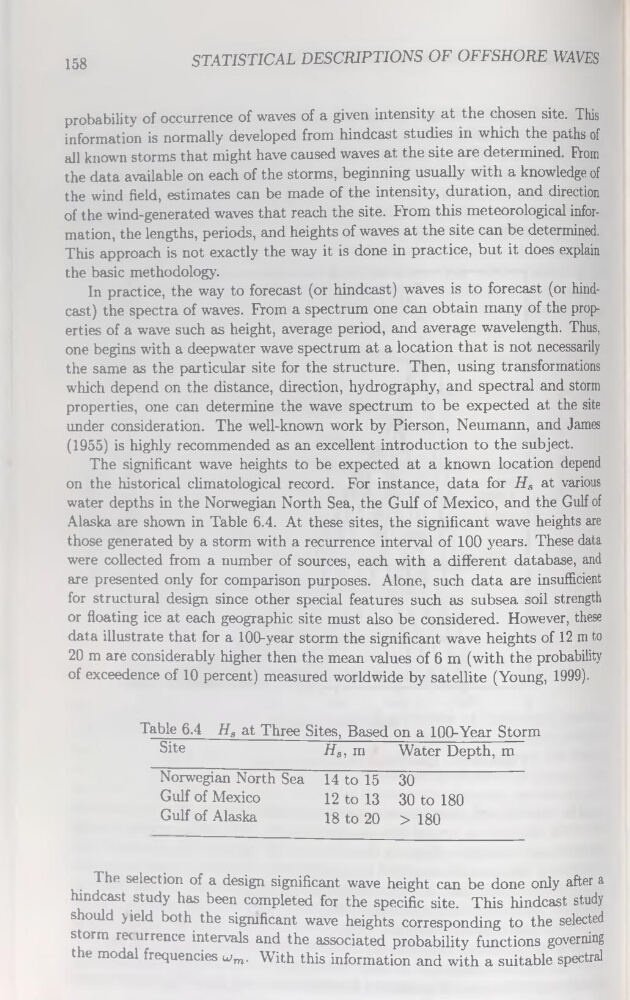
The significant wave heights to be expected at a known location dépend
on the historical climatological record. For instance, data for Hs at varions
water depths in the Norwegian North Sea, the Gulf of Mexico, and the Gulf of
Alaska are shown in Table 6.4. At these sites, the significant wave heights are
those generated by a storm with a récurrence interval of 100 years. These data
were collected from a number of sources, each with a different database, and
are presented only for comparison purposes. Alone, such data are insufficient
for structural design since other spécial features such as subsea soil strength
or floating ice at each géographie site must also be considered. However, these
data illustrate that for a 100-year storm the significant wave heights of 12 m to
20 m are considerably higher then the mean values of 6 m (with the probability
of exceedence of 10 percent) measured worldwide by satellite (Young, 1999).
Table 6.4 Hs at Three Sites, Based on a 100-Year Storm
Site
Hs, m
Water Depth, m
Norwegian North Sea 14 to 15 30
Gulf of Mexico
12 to 13 30 to 180
Gulf of Alaska
18 to 20 > 180
The sélection of a design significant wave height can be done only after a
hindcast study has been completed for the spécifie site. This hindcast study
should yield bot h the significant wave heights corresponding to the selected
storm récurrence intervals and the associated probability functions governing
the modal frequencies wm. With this information and with a suitable spectral
STATISTICAL DESCRIPTIONS OF OFFSHORE WAVES
probability of occurrence of waves of a given intensity at the chosen site. This
information is normally developed from hindcast studies in which the paths of
ail known storms that might hâve caused waves at the site are determined. From
the data available on each of the storms, beginning usually with a knowledge of
the wind field, estimâtes can be made of the intensity, duration, and direction
of the wind-generated waves that reach the site. From this meteorological information, the lengths, periods, and heights of waves at the site can be determined.
This approach is not exactly the way it is done in practice, but it does explain
the basic methodology.
In practice, the way to forecast (or hindcast) waves is to forecast (or hindcast) the spectra of waves. From a spectrum one can obtain many of the properties of a wave such as height, average period, and average wavelength. Thus,
one begins with a deepwater wave spectrum at a location that is not necessarily
the same as the particular site for the structure. Then, using transformations
which dépend on the distance, direction, hydrography, and spectral and storm
properties, one can détermine the wave spectrum to be expected at the site
under considération. The well-known work by Pierson, Neumann, and James
(1955) is highly recommended as an excellent introduction to the subject.
The significant wave heights to be expected at a known location dépend
on the historical climatological record. For instance, data for Hs at varions
water depths in the Norwegian North Sea, the Gulf of Mexico, and the Gulf of
Alaska are shown in Table 6.4. At these sites, the significant wave heights are
those generated by a storm with a récurrence interval of 100 years. These data
were collected from a number of sources, each with a different database, and
are presented only for comparison purposes. Alone, such data are insufficient
for structural design since other spécial features such as subsea soil strength
or floating ice at each géographie site must also be considered. However, these
data illustrate that for a 100-year storm the significant wave heights of 12 m to
20 m are considerably higher then the mean values of 6 m (with the probability
of exceedence of 10 percent) measured worldwide by satellite (Young, 1999).
Table 6.4 Hs at Three Sites, Based on a 100-Year Storm
Site
Hs, m
Water Depth, m
Norwegian North Sea 14 to 15 30
Gulf of Mexico
12 to 13 30 to 180
Gulf of Alaska
18 to 20 > 180
The sélection of a design significant wave height can be done only after a
hindcast study has been completed for the spécifie site. This hindcast study
should yield bot h the significant wave heights corresponding to the selected
storm récurrence intervals and the associated probability functions governing
the modal frequencies wm. With this information and with a suitable spectral