

INTRODUCTION TO WAVE SPECTRA
145
8
6
g______ ,______ ,______ ,
, ______
0
20
40
60
80
100
TIME t, seconds
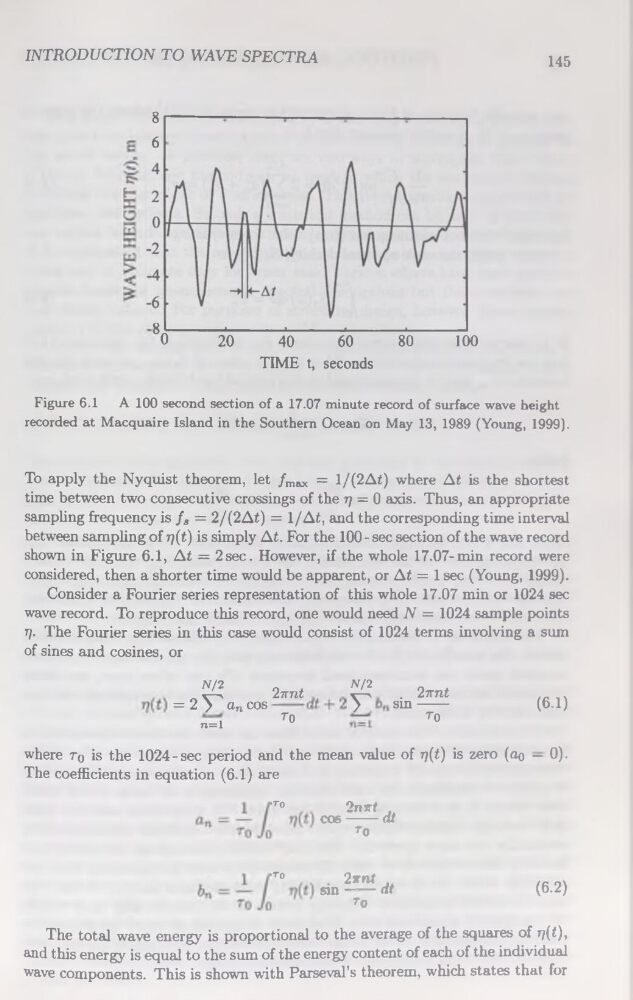
Figure 6.1 A 100 second section of a 17.07 minute record of surface wave height
recorded at Macquaire Island in the Southern Océan on May 13, 1989 (Young, 1999).
To apply the Nyquist theorem, let fmax = l/(2At) where At is the shortest
time between two consecutive crossings of the 77 = 0 axis. Thus, an appropriate
sampling frequency is f8 = 2/(2At) = 1/At, and the corresponding time interval
between sampling of r)(t) is simply At. For the 100 - sec section of the wave record
shown in Figure 6.1, At = 2 sec. However, if the whole 17.07-min record were
considered, then a shorter time would be apparent, or At = 1 sec (Young, 1999).
Consider a Fourier sériés représentation of this whole 17.07 min or 1024 sec
wave record. To reproduce this record, one would need N = 1024 sample points
T). The Fourier sériés in this case would consist of 1024 terms involving a sum
of sines and cosines, or
N/2
= 2 F an cos
n=l
2ivnt
r0
N/2
. 27rnt
sm-----To
(6.1)
where tq is the 1024-sec period and the mean value of rj(t) is zéro (oq — 0).
The coefficients in équation (6.1) are
2nxt
cos-----T0
dt
• 2vnt m
sm------ dt
To
(6-2)
The total wave energy is proportional to the average of the squares of T?(t),
and this energy is equal to the sum of the energy content of each of the individual
wave components. This is shown with Parseval’s theorem, which States that for
145
8
6
g______ ,______ ,______ ,
, ______
0
20
40
60
80
100
TIME t, seconds
Figure 6.1 A 100 second section of a 17.07 minute record of surface wave height
recorded at Macquaire Island in the Southern Océan on May 13, 1989 (Young, 1999).
To apply the Nyquist theorem, let fmax = l/(2At) where At is the shortest
time between two consecutive crossings of the 77 = 0 axis. Thus, an appropriate
sampling frequency is f8 = 2/(2At) = 1/At, and the corresponding time interval
between sampling of r)(t) is simply At. For the 100 - sec section of the wave record
shown in Figure 6.1, At = 2 sec. However, if the whole 17.07-min record were
considered, then a shorter time would be apparent, or At = 1 sec (Young, 1999).
Consider a Fourier sériés représentation of this whole 17.07 min or 1024 sec
wave record. To reproduce this record, one would need N = 1024 sample points
T). The Fourier sériés in this case would consist of 1024 terms involving a sum
of sines and cosines, or
N/2
= 2 F an cos
n=l
2ivnt
r0
N/2
. 27rnt
sm-----To
(6.1)
where tq is the 1024-sec period and the mean value of rj(t) is zéro (oq — 0).
The coefficients in équation (6.1) are
2nxt
cos-----T0
dt
• 2vnt m
sm------ dt
To
(6-2)
The total wave energy is proportional to the average of the squares of T?(t),
and this energy is equal to the sum of the energy content of each of the individual
wave components. This is shown with Parseval’s theorem, which States that for