

RESPONSE OF NONLINEAR STRUCTURES
127
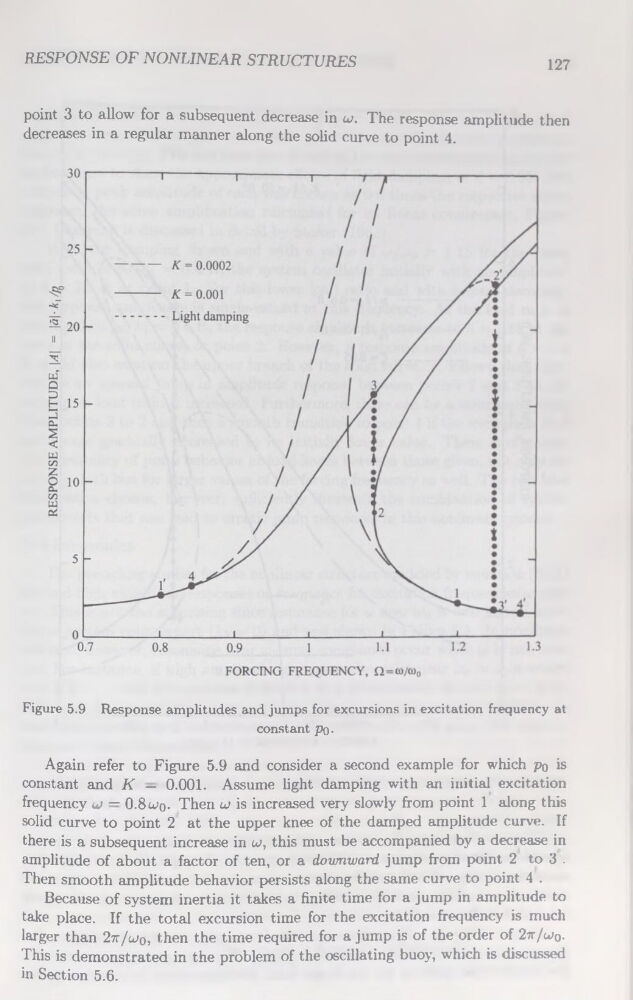
point 3 to allow for a subséquent decrease in uz. The response amplitude then
decreases in a regular manner along the solid curve to point 4.
Figure 5.9 Response amplitudes and jumps for excursions in excitation frequency at
constant Pq.
Again refer to Figure 5.9 and consider a second example for which po is
constant and K — 0.001. Assume light damping with an initial excitation
frequency u — 0.8u>o- Then uz is increased very slowly from point 1 along this
solid curve to point 2 at the upper knee of the damped amplitude curve. If
there is a subséquent increase in uz, this must be accompanied by a decrease in
amplitude of about a factor of ten, or a downward jump from point 2 to 3 .
Then smooth amplitude behavior persists along the same curve to point 4 .
Because of System inertia it takes a finite time for a jump in amplitude to
take place. If the total excursion time for the excitation frequency is much
larger than 27r/az0, then the time required for a jump is of the order of 27r/uz0.
This is demonstrated in the problem of the oscillating buoy, which is discussed
in Section 5.6.
127
point 3 to allow for a subséquent decrease in uz. The response amplitude then
decreases in a regular manner along the solid curve to point 4.
Figure 5.9 Response amplitudes and jumps for excursions in excitation frequency at
constant Pq.
Again refer to Figure 5.9 and consider a second example for which po is
constant and K — 0.001. Assume light damping with an initial excitation
frequency u — 0.8u>o- Then uz is increased very slowly from point 1 along this
solid curve to point 2 at the upper knee of the damped amplitude curve. If
there is a subséquent increase in uz, this must be accompanied by a decrease in
amplitude of about a factor of ten, or a downward jump from point 2 to 3 .
Then smooth amplitude behavior persists along the same curve to point 4 .
Because of System inertia it takes a finite time for a jump in amplitude to
take place. If the total excursion time for the excitation frequency is much
larger than 27r/az0, then the time required for a jump is of the order of 27r/uz0.
This is demonstrated in the problem of the oscillating buoy, which is discussed
in Section 5.6.