

RESPONSE FUNCTIONS FOR LINEAR STRUCTURES
115
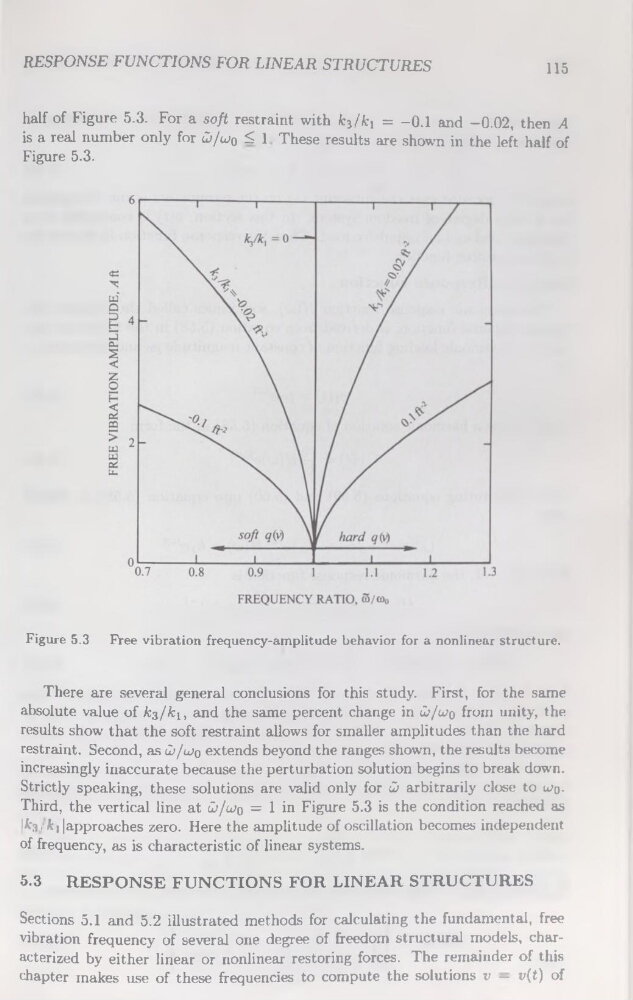
half of Figure 5.3. For a soft restraint with k3/k{ = -0.1 and -0.02, then A
is a real number only for ü/ojq $ 1 These résulta are shown in the left half of
Figure 5.3.
Figure 5.3 Free vibration frequency-amplitude behavior for a nonlinear structure.
There are several general conclusions for this study. First, for the same
absolute value of k$/k\, and the same percent change in û/cuq from unity, the
results show that the soft restraint allows for smaller amplitudes than the hard
restraint. Second, as Cj/uq extends beyond the ranges shown, the results become
increasingly inaccurate because the perturbation solution begins to break down.
Strictly speaking, these solutions are valid only for û arbitrarily close to u/q.
Third, the vertical line at û/ujq = 1 in Figure 5.3 is the condition reached as
1^3 ,'Â ] |approaches zéro. Here the amplitude of oscillation becomes independent
of frequency, as is characteristic of linear Systems.
5.3
RESPONSE FUNCTIONS FOR LINEAR STRUCTURES
Sections 5.1 and 5.2 illustrated methods for calculating the fundamental, free
vibration frequency of several one degree of freedom structural models, characterized by either linear or nonlinear restoring forces. The remainder of this
chapter makes use of these frequencies to compute the solutions v — v(t) of
115
half of Figure 5.3. For a soft restraint with k3/k{ = -0.1 and -0.02, then A
is a real number only for ü/ojq $ 1 These résulta are shown in the left half of
Figure 5.3.
Figure 5.3 Free vibration frequency-amplitude behavior for a nonlinear structure.
There are several general conclusions for this study. First, for the same
absolute value of k$/k\, and the same percent change in û/cuq from unity, the
results show that the soft restraint allows for smaller amplitudes than the hard
restraint. Second, as Cj/uq extends beyond the ranges shown, the results become
increasingly inaccurate because the perturbation solution begins to break down.
Strictly speaking, these solutions are valid only for û arbitrarily close to u/q.
Third, the vertical line at û/ujq = 1 in Figure 5.3 is the condition reached as
1^3 ,'Â ] |approaches zéro. Here the amplitude of oscillation becomes independent
of frequency, as is characteristic of linear Systems.
5.3
RESPONSE FUNCTIONS FOR LINEAR STRUCTURES
Sections 5.1 and 5.2 illustrated methods for calculating the fundamental, free
vibration frequency of several one degree of freedom structural models, characterized by either linear or nonlinear restoring forces. The remainder of this
chapter makes use of these frequencies to compute the solutions v — v(t) of