

NATURAL FREQUENCES OF LINEAR SYSTEMS
105
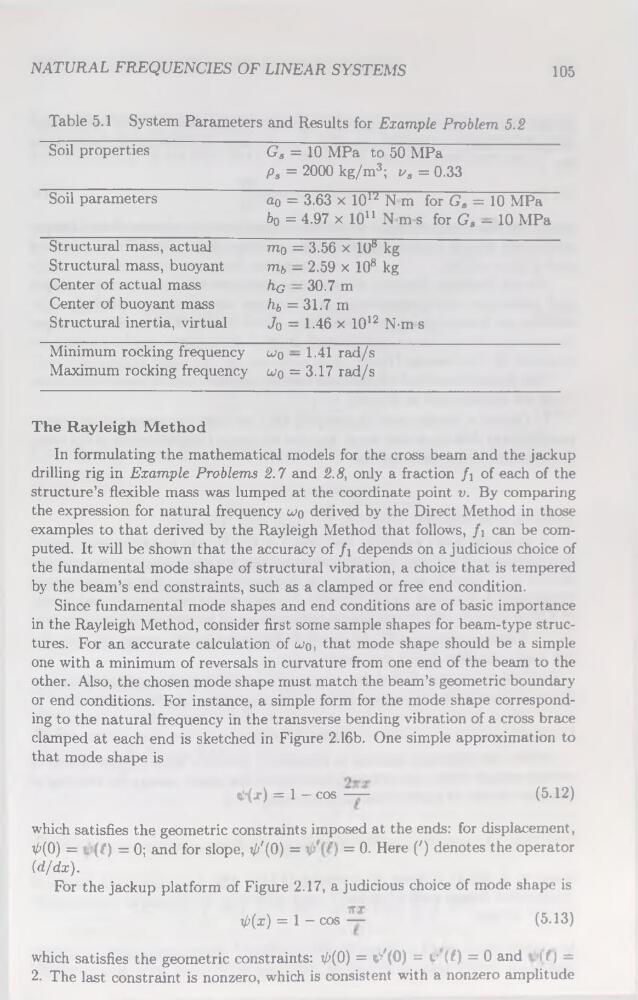
Table 5.1 System Parameters and Results for Example Problem 5.2
Soil properties
G„ = 10 MPa to 50 MPa
ps = 2000 kg/m3; us = 0.33
Soil parameters
ao = 3.63 x 10¹² N m for Gs = 10 MPa
i>o = 4.97 x 10¹¹ N m s for G, — 10 MPa
Structural mass, actual
Structural mass, buoyant
Center of actual mass
Center of buoyant mass
Structural inertia, virtual
mo = 3.56 x lu8 kg
mb — 2.59 x 10⁸ kg
hç 30.7 m
hb = 31.7 m
Jo = 1.46 x 10¹² N-m s
Minimum rocking frequency
Maximum rocking frequency
Wo — 1.41 rad/s
wq = 3.17 rad/s
The Rayleigh Method
In formulating the mathematical models for the cross beam and the jackup
drilling rig in Example Problems 2.7 and 2.8, only a fraction /i of each of the
structure’s flexible mass was lumped at the coordinate point v. By comparing
the expression for natural frequency wq derived by the Direct Method in those
examples to that derived by the Rayleigh Method that follows, fi can be computed. It will be shown that the accuracy of /i dépends on a judicious choice of
the fondamental mode shape of structural vibration, a choice that is tempered
by the beam’s end constraints, such as a clamped or free end condition.
Since fondamental mode shapes and end conditions are of basic importance
in the Rayleigh Method, consider first some sample shapes for beam-type structures. For an accurate calculation of wq, that mode shape should be a simple
one with a minimum of reversais in curvature from one end of the beam to the
other. Also, the chosen mode shape must match the beam’s géométrie boundary
or end conditions. For instance, a simple form for the mode shape corresponding to the natural frequency in the transverse bending vibration of a cross brace
clamped at each end is sketched in Figure 2.16b. One simple approximation to
that mode shape is
«:-(j) = 1 - cos —
(5.12)
which satisfies the géométrie constraints imposed at the ends: for displacement,
V>(0) = (f) = 0; and for slope, V'(0) =
= 0. Here (') dénotés the operator
(d/dx).
For the jackup platform of Figure 2.17, a judicious choice of mode shape is
v>(x) = 1 - cos —
(5.13)
which satisfies the géométrie constraints: 4>(0) = V*(0) = v (f) = 0 and if) =
2. The last constraint is nonzero, which is consistent with a nonzero amplitude
105
Table 5.1 System Parameters and Results for Example Problem 5.2
Soil properties
G„ = 10 MPa to 50 MPa
ps = 2000 kg/m3; us = 0.33
Soil parameters
ao = 3.63 x 10¹² N m for Gs = 10 MPa
i>o = 4.97 x 10¹¹ N m s for G, — 10 MPa
Structural mass, actual
Structural mass, buoyant
Center of actual mass
Center of buoyant mass
Structural inertia, virtual
mo = 3.56 x lu8 kg
mb — 2.59 x 10⁸ kg
hç 30.7 m
hb = 31.7 m
Jo = 1.46 x 10¹² N-m s
Minimum rocking frequency
Maximum rocking frequency
Wo — 1.41 rad/s
wq = 3.17 rad/s
The Rayleigh Method
In formulating the mathematical models for the cross beam and the jackup
drilling rig in Example Problems 2.7 and 2.8, only a fraction /i of each of the
structure’s flexible mass was lumped at the coordinate point v. By comparing
the expression for natural frequency wq derived by the Direct Method in those
examples to that derived by the Rayleigh Method that follows, fi can be computed. It will be shown that the accuracy of /i dépends on a judicious choice of
the fondamental mode shape of structural vibration, a choice that is tempered
by the beam’s end constraints, such as a clamped or free end condition.
Since fondamental mode shapes and end conditions are of basic importance
in the Rayleigh Method, consider first some sample shapes for beam-type structures. For an accurate calculation of wq, that mode shape should be a simple
one with a minimum of reversais in curvature from one end of the beam to the
other. Also, the chosen mode shape must match the beam’s géométrie boundary
or end conditions. For instance, a simple form for the mode shape corresponding to the natural frequency in the transverse bending vibration of a cross brace
clamped at each end is sketched in Figure 2.16b. One simple approximation to
that mode shape is
«:-(j) = 1 - cos —
(5.12)
which satisfies the géométrie constraints imposed at the ends: for displacement,
V>(0) = (f) = 0; and for slope, V'(0) =
= 0. Here (') dénotés the operator
(d/dx).
For the jackup platform of Figure 2.17, a judicious choice of mode shape is
v>(x) = 1 - cos —
(5.13)
which satisfies the géométrie constraints: 4>(0) = V*(0) = v (f) = 0 and if) =
2. The last constraint is nonzero, which is consistent with a nonzero amplitude