

102
SINGLE DEGREE OF FREEDOM STRUCTURES
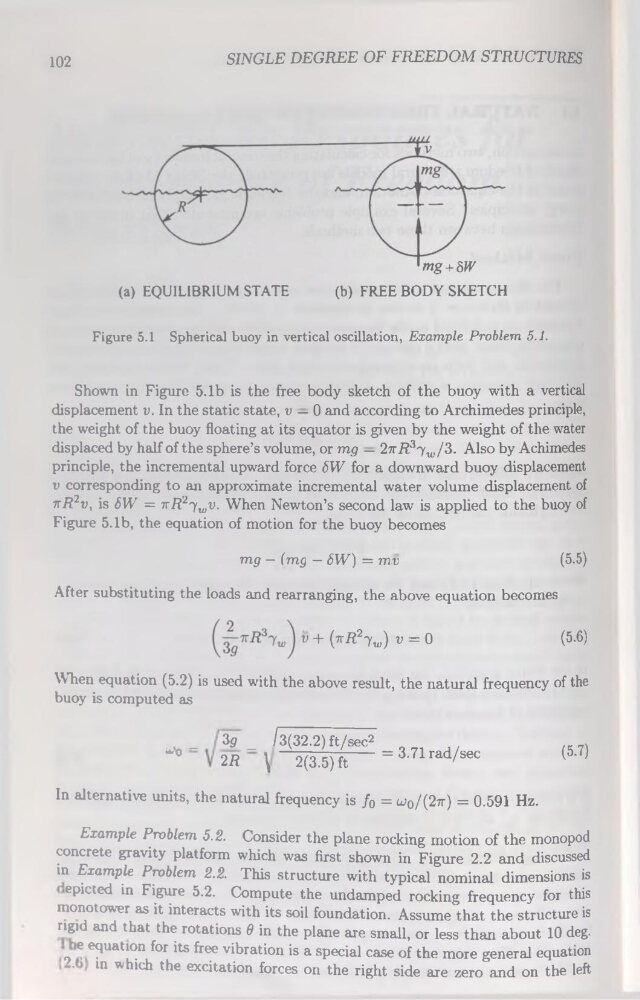
Figure 5.1 Spherical buoy in vertical oscillation, Example Problem 5.1.
Shown in Figure 5.1b is the free body sketch of the buoy with a vertical
displacement v. In the static State, v — 0 and according to Archimedes principle,
the weight of the buoy floating at its equator is given by the weight of the water
displaced by half of the sphere’s volume, or mg — < 2iïRi’yVi)/3. Also by Achimedes
principle, the incrémental upward force 6W for a downward buoy displacement
v corresponding to an approximate incrémental water volume displacement of
7rÆ2u, is f)W = ît.R27wv. When Newton’s second law is applied to the buoy of
Figure 5.1b, the équation of motion for the buoy becomes
mg — (mg — <5W) = mv
(5-5)
After substituting the loads and rearranging, the above équation becomes
V + (7T#27W) v = 0
(5-6)
When équation (5.2) is used with the above resuit, the natural frequency of the
buoy is computed as
u.'q =■
Sg _ /3(32.2) ft/sec2
2R
\
2(3.5) ft
= 3.71 rad/sec
(5.7)
In alternative units, the natural frequency is f0 = cj0/(2tt) = 0.591 Hz.
Eiample Problem 5.2. Consider the plane rocking motion of the monopod
concrète gravity platform which was first shown in Figure 2.2 and discussed
in Example Problem 2.2. This structure with typical nominal dimensions is
epicted in Figure 5.2. Compute the undamped rocking frequency for this
monotower as it interacts with its soil foundation. Assume that the structure is
ngid and that the rotations 0 in the plane are small, or less than about 10 deg.
9 ® ®3uatl?n for its free vibration is a spécial case of the more general équation
- in which the excitation forces on the right side are zéro and on the left
SINGLE DEGREE OF FREEDOM STRUCTURES
Figure 5.1 Spherical buoy in vertical oscillation, Example Problem 5.1.
Shown in Figure 5.1b is the free body sketch of the buoy with a vertical
displacement v. In the static State, v — 0 and according to Archimedes principle,
the weight of the buoy floating at its equator is given by the weight of the water
displaced by half of the sphere’s volume, or mg — < 2iïRi’yVi)/3. Also by Achimedes
principle, the incrémental upward force 6W for a downward buoy displacement
v corresponding to an approximate incrémental water volume displacement of
7rÆ2u, is f)W = ît.R27wv. When Newton’s second law is applied to the buoy of
Figure 5.1b, the équation of motion for the buoy becomes
mg — (mg — <5W) = mv
(5-5)
After substituting the loads and rearranging, the above équation becomes
V + (7T#27W) v = 0
(5-6)
When équation (5.2) is used with the above resuit, the natural frequency of the
buoy is computed as
u.'q =■
Sg _ /3(32.2) ft/sec2
2R
\
2(3.5) ft
= 3.71 rad/sec
(5.7)
In alternative units, the natural frequency is f0 = cj0/(2tt) = 0.591 Hz.
Eiample Problem 5.2. Consider the plane rocking motion of the monopod
concrète gravity platform which was first shown in Figure 2.2 and discussed
in Example Problem 2.2. This structure with typical nominal dimensions is
epicted in Figure 5.2. Compute the undamped rocking frequency for this
monotower as it interacts with its soil foundation. Assume that the structure is
ngid and that the rotations 0 in the plane are small, or less than about 10 deg.
9 ® ®3uatl?n for its free vibration is a spécial case of the more general équation
- in which the excitation forces on the right side are zéro and on the left