

WAVE LOADING OF FLEXIBLE CYLINDERS
85
accounts for both cylinder flexibility and the effects of the water wave length A
can be written as follows:
Q = Cmi~pD2ù + CM2 — pD2(ù — ü) + Co~pD(u — v) |u — v|
(4.1)
The flow coefficients recommended by Moan et al. (1975) are given by
Cm = Cm\ + Cmï
(4.2a)
Cmi = 1-0.12—
(4.2b)
tvD
Cm2 = 1-0, for — < 0.5
(4.2c)
A
CM2 = 1.54 - 1.08—, for ^>0.5
(4.2d)
A
A
The following two example problems are applications of this formulation.
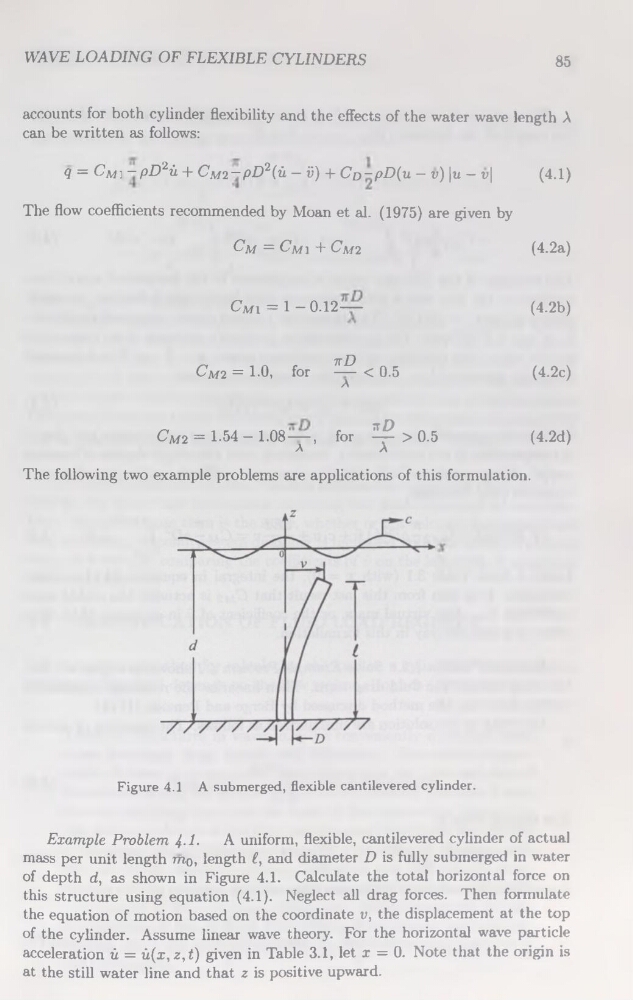
Figure 4.1 A submerged, flexible cantilevered cylinder.
Example Problem 4.1.
A uniform, flexible, cantilevered cylinder of actual
mass per unit length m0, length £, and diameter D is fully submerged in water
of depth d, as shown in Figure 4.1. Calculate the total horizontal force on
this structure using équation (4.1). Neglect ail drag forces. Then formulate
the équation of motion based on the coordinate v, the displacement at the top
of the cylinder. Assume linear wave theory. For the horizontal wave particle
accélération û = û(x,z,t) given in Table 3.1, let x = 0. Note that the origin is
at the still water line and that z is positive upward.
85
accounts for both cylinder flexibility and the effects of the water wave length A
can be written as follows:
Q = Cmi~pD2ù + CM2 — pD2(ù — ü) + Co~pD(u — v) |u — v|
(4.1)
The flow coefficients recommended by Moan et al. (1975) are given by
Cm = Cm\ + Cmï
(4.2a)
Cmi = 1-0.12—
(4.2b)
tvD
Cm2 = 1-0, for — < 0.5
(4.2c)
A
CM2 = 1.54 - 1.08—, for ^>0.5
(4.2d)
A
A
The following two example problems are applications of this formulation.
Figure 4.1 A submerged, flexible cantilevered cylinder.
Example Problem 4.1.
A uniform, flexible, cantilevered cylinder of actual
mass per unit length m0, length £, and diameter D is fully submerged in water
of depth d, as shown in Figure 4.1. Calculate the total horizontal force on
this structure using équation (4.1). Neglect ail drag forces. Then formulate
the équation of motion based on the coordinate v, the displacement at the top
of the cylinder. Assume linear wave theory. For the horizontal wave particle
accélération û = û(x,z,t) given in Table 3.1, let x = 0. Note that the origin is
at the still water line and that z is positive upward.