

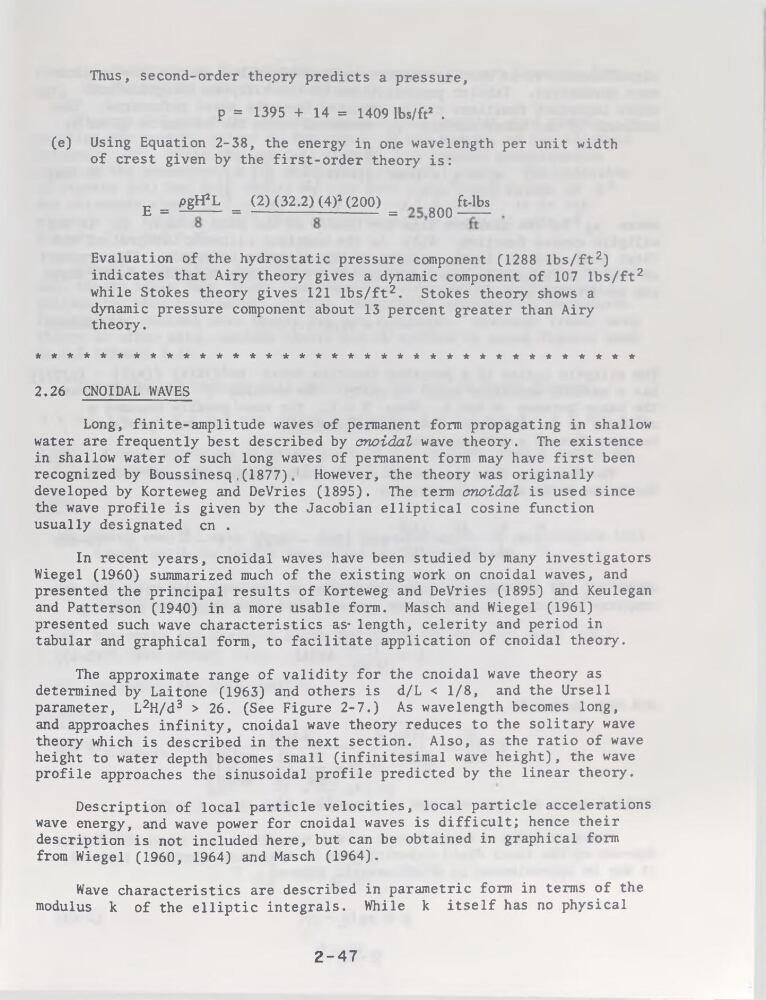
Thus, second-order the.ory predicts a pressure,
p = 1395 + 14 = 1409 lbs/ft2 .
(e) Using Equation 2-38, the energy in one wavelength per unit width
of crest given by the first-order theory is:
E = pgtfL = (2) (32.2) (4)2(200) =
gQQ ft-lbs
Evaluation of the hydrostatic pressure component (1288 lbs/ft2)
indicates that Airy theory gives a dynamic component of 107 lbs/ft2
while Stokes theory gives 121 lbs/ft2. Stokes theory shows a
dynamic pressure component about 13 percent greater than Airy
theory.
*************************************
2.26 CNOIDAL WAVES
Long, finite-amplitude waves of permanent form propagating in shallow
water are frequently best described by cnoidal wave theory. The existence
in shallow water of such long waves of permanent form may hâve first been
recognized by Boussinesq , (1877)However, the theory was originally
developed by Korteweg and DeVries (1895). The term cnoidal is used since
the wave profile is given by the Jacobian elliptical cosine function
usually designated en .
In recent years, cnoidal waves hâve been studied by many investigators
Wiegel (1960) summarized much of the existing work on cnoidal waves, and
presented the principal results of Korteweg and DeVries (1895) and Keulegan
and Patterson (1940) in a more usable form. Masch and Wiegel (1961)
presented such wave characteristics as- length, celerity and period in
tabular and graphical form, to facilitate application of cnoidal theory.
The approximate range of validity for the cnoidal wave theory as
determined by Laitone (1963) and others is d/L < 1/8, and the Ursell
parameter, L2H/d3 > 26. (See Figure 2-7.) As wavelength becomes long,
and approaches infinity, cnoidal wave theory reduces to the solitary wave
theory which is described in the next section. Also, as the ratio of wave
height to water depth becomes small (infinitésimal wave height), the wave
profile approaches the sinusoidal profile predicted by the linear theory.
Description of local particle velocities, local particle accélérations
wave energy, and wave power for cnoidal waves is difficult; hence their
description is not included here, but can be obtained in graphical form
from Wiegel (1960, 1964) and Masch (1964).
Wave characteristics are described in parametric form in ternis of the
modulus k of the elliptic intégrais. While k itself has no physical
2-47
p = 1395 + 14 = 1409 lbs/ft2 .
(e) Using Equation 2-38, the energy in one wavelength per unit width
of crest given by the first-order theory is:
E = pgtfL = (2) (32.2) (4)2(200) =
gQQ ft-lbs
Evaluation of the hydrostatic pressure component (1288 lbs/ft2)
indicates that Airy theory gives a dynamic component of 107 lbs/ft2
while Stokes theory gives 121 lbs/ft2. Stokes theory shows a
dynamic pressure component about 13 percent greater than Airy
theory.
*************************************
2.26 CNOIDAL WAVES
Long, finite-amplitude waves of permanent form propagating in shallow
water are frequently best described by cnoidal wave theory. The existence
in shallow water of such long waves of permanent form may hâve first been
recognized by Boussinesq , (1877)However, the theory was originally
developed by Korteweg and DeVries (1895). The term cnoidal is used since
the wave profile is given by the Jacobian elliptical cosine function
usually designated en .
In recent years, cnoidal waves hâve been studied by many investigators
Wiegel (1960) summarized much of the existing work on cnoidal waves, and
presented the principal results of Korteweg and DeVries (1895) and Keulegan
and Patterson (1940) in a more usable form. Masch and Wiegel (1961)
presented such wave characteristics as- length, celerity and period in
tabular and graphical form, to facilitate application of cnoidal theory.
The approximate range of validity for the cnoidal wave theory as
determined by Laitone (1963) and others is d/L < 1/8, and the Ursell
parameter, L2H/d3 > 26. (See Figure 2-7.) As wavelength becomes long,
and approaches infinity, cnoidal wave theory reduces to the solitary wave
theory which is described in the next section. Also, as the ratio of wave
height to water depth becomes small (infinitésimal wave height), the wave
profile approaches the sinusoidal profile predicted by the linear theory.
Description of local particle velocities, local particle accélérations
wave energy, and wave power for cnoidal waves is difficult; hence their
description is not included here, but can be obtained in graphical form
from Wiegel (1960, 1964) and Masch (1964).
Wave characteristics are described in parametric form in ternis of the
modulus k of the elliptic intégrais. While k itself has no physical
2-47