

hence the group and phase velocities are equal. Thus in shallow water,
because wave celerity is fully determined by the depth, ail component waves
in a wave train will travel at the same speed precluding the altemate
reinforcing and cancelling of components. In deep and transitional water,
wave celerity dépends on the wavelength; hence slightly longer waves travel
slightly faster, and produce the small phase différences resulting in wave
groups. These waves are said to be dispersive or propagating in a
dispersive medium, i.e. in a medium where their celerity is dépendent on
wavelength.
Outside of shallow water, the phase velocity of gravity waves is
greater than the group velocity, and an observer moving along with a group
of waves at the group velocity will see' waves that originate at the rear
of the group move forward through the group traveling at the phase velocity
and disappear at the front of the wave group.
Group velocity is important because it is with this velocity that wave
energy is propagated.
Although mathematically, the group velocity can be shown rigorously
from the interférence of two or more waves (Lamb, 1932), the physical
significance is not as obvious as it is in the method based on the considération of wave energy. Therefore an additional explanation of group
velocity is provided on wave energy and energy transmission.
2.238 Wave Energy and Power. The total energy of a wave System is the
sum of its kinetic energy and its potential energy. The kinetic energy is
that part of the total energy due to water particle velocities associated
with wave motion. Potential energy is that part of the energy resulting
from part of the fluid mass being above the trough - the wave crest.
According to the Airy theory, if the potential energy is determined
relative to mean water level, and ail waves are propagated in the same
direction, potential and kinetic energy components are equal, and the
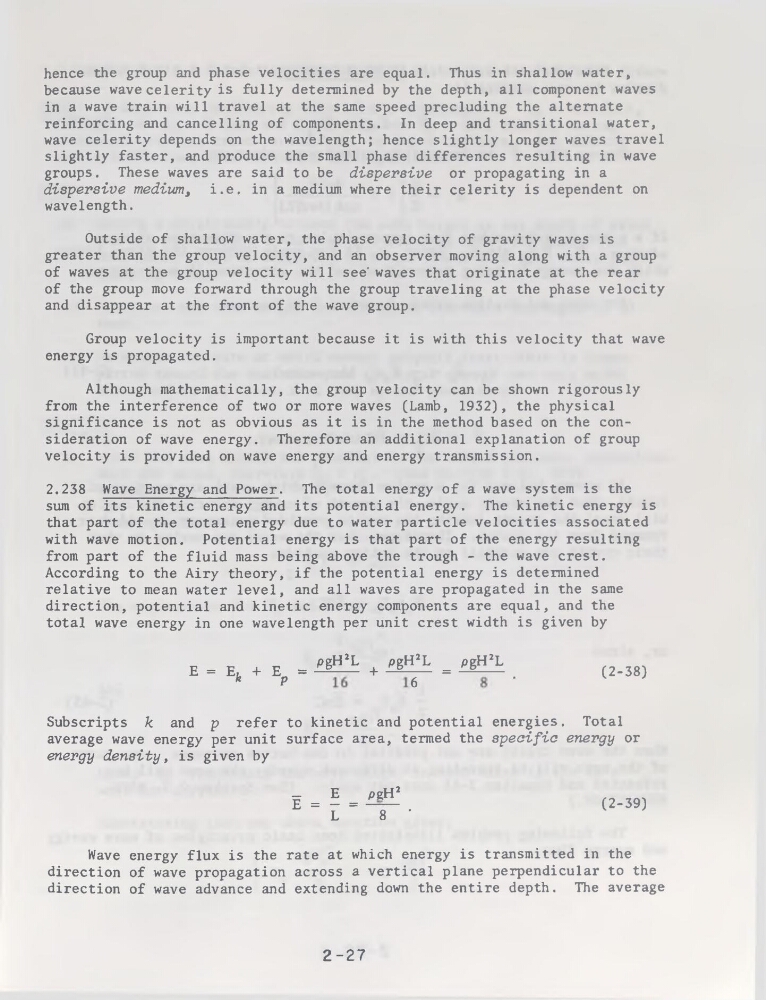
total wave energy in one wavelength per unit crest width is given by
E _ F + F - pgH!L + pgH2L - pSH’L
r? w
E - Efe + Ep -
+ —6-------------■
<2-38’
Subscripts k and p refer to kinetic and potential energies. Total
average wave energy per unit surface area, termed the spécifie energy or
energy density, is given by
-
E
pgH2
E = — =
.
(2-39)
L
8
Wave energy flux is the rate at which energy is transmitted in the
direction of wave propagation across a vertical plane perpendicular to the
direction of wave advance and extending down the entire depth. The average
2-27
because wave celerity is fully determined by the depth, ail component waves
in a wave train will travel at the same speed precluding the altemate
reinforcing and cancelling of components. In deep and transitional water,
wave celerity dépends on the wavelength; hence slightly longer waves travel
slightly faster, and produce the small phase différences resulting in wave
groups. These waves are said to be dispersive or propagating in a
dispersive medium, i.e. in a medium where their celerity is dépendent on
wavelength.
Outside of shallow water, the phase velocity of gravity waves is
greater than the group velocity, and an observer moving along with a group
of waves at the group velocity will see' waves that originate at the rear
of the group move forward through the group traveling at the phase velocity
and disappear at the front of the wave group.
Group velocity is important because it is with this velocity that wave
energy is propagated.
Although mathematically, the group velocity can be shown rigorously
from the interférence of two or more waves (Lamb, 1932), the physical
significance is not as obvious as it is in the method based on the considération of wave energy. Therefore an additional explanation of group
velocity is provided on wave energy and energy transmission.
2.238 Wave Energy and Power. The total energy of a wave System is the
sum of its kinetic energy and its potential energy. The kinetic energy is
that part of the total energy due to water particle velocities associated
with wave motion. Potential energy is that part of the energy resulting
from part of the fluid mass being above the trough - the wave crest.
According to the Airy theory, if the potential energy is determined
relative to mean water level, and ail waves are propagated in the same
direction, potential and kinetic energy components are equal, and the
total wave energy in one wavelength per unit crest width is given by
E _ F + F - pgH!L + pgH2L - pSH’L
r? w
E - Efe + Ep -
+ —6-------------■
<2-38’
Subscripts k and p refer to kinetic and potential energies. Total
average wave energy per unit surface area, termed the spécifie energy or
energy density, is given by
-
E
pgH2
E = — =
.
(2-39)
L
8
Wave energy flux is the rate at which energy is transmitted in the
direction of wave propagation across a vertical plane perpendicular to the
direction of wave advance and extending down the entire depth. The average
2-27