

Thus the maximum displacement of the particle is 0.45 feet which is small
when compared with the deepwater height,
= 10.45 feet.
*************************************
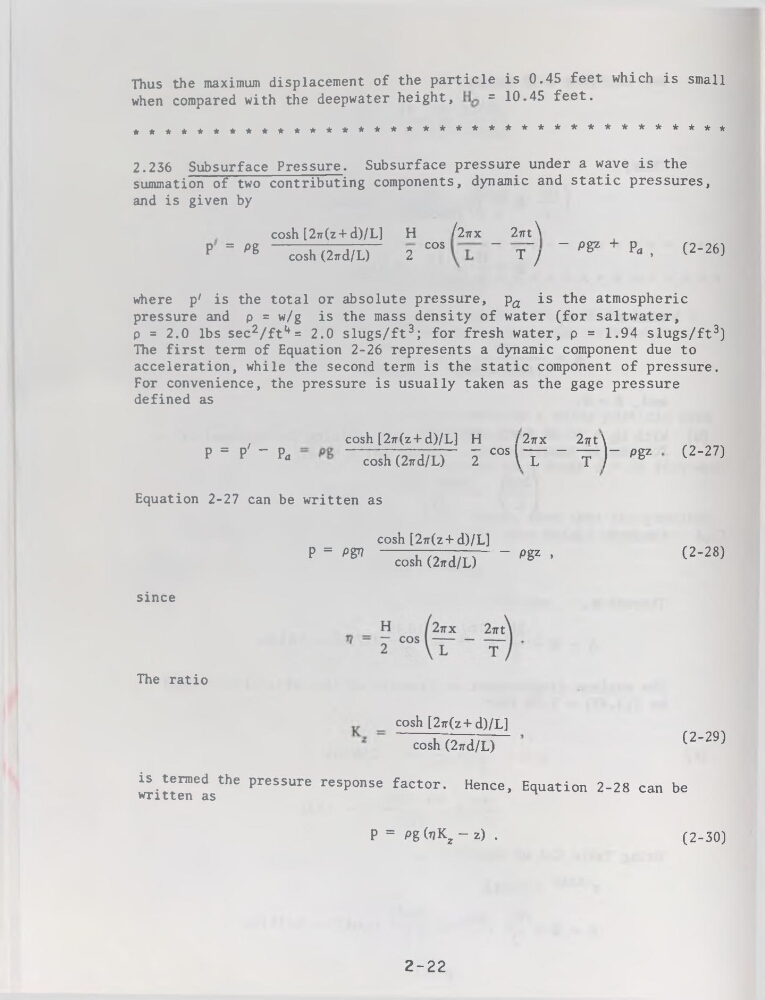
2.236 Subsurface Pressure. Subsurface pressure under a wave is the
summation of two contributing components, dynamic and static pressures,
and is given by
cosh [2tt(z +d)/L] H
/2nx
2nt\
P = pg
cosh (2,d/ÏF
2 C“
~ T-/ “ PgZ + P‘ .
(2'26’
where p' is the total or absolute pressure, pa is the atmospheric
pressure and p = w/g is the mass density of water (for saltwater,
p = 2.0 Ibs sec2/ftu= 2.0 slugs/ft3; for fresh water, p = 1.94 slugs/ft3)
The first term of Equation 2-26 represents a dynamic component due to
accélération, while the second term is the static component of pressure.
For convenience, the pressure is usually taken as the gage pressure
defined as
P = PZ “ Pa
cosh [2n(z + d)/L]
cosh (27rd/L)
H
12-nx
2'nt\
— cos |----- — ---- | — pgz
2
\ L
T /
5
(2-27)
Equation 2-27 can be written as
cosh [2zr(z4- d)/L]
P = PP!
cosh (2,d/L)
" PgZ ’
(2-28)
since
The ratio
cosh [2n(z + d)/L]
cosh (27rd/L)
(2-29)
is termed the pressure response factor,
written as
Hence, Equation 2-28 can be
p = Pg (tîKz - z) .
(2-30)
2-22
when compared with the deepwater height,
= 10.45 feet.
*************************************
2.236 Subsurface Pressure. Subsurface pressure under a wave is the
summation of two contributing components, dynamic and static pressures,
and is given by
cosh [2tt(z +d)/L] H
/2nx
2nt\
P = pg
cosh (2,d/ÏF
2 C“
~ T-/ “ PgZ + P‘ .
(2'26’
where p' is the total or absolute pressure, pa is the atmospheric
pressure and p = w/g is the mass density of water (for saltwater,
p = 2.0 Ibs sec2/ftu= 2.0 slugs/ft3; for fresh water, p = 1.94 slugs/ft3)
The first term of Equation 2-26 represents a dynamic component due to
accélération, while the second term is the static component of pressure.
For convenience, the pressure is usually taken as the gage pressure
defined as
P = PZ “ Pa
cosh [2n(z + d)/L]
cosh (27rd/L)
H
12-nx
2'nt\
— cos |----- — ---- | — pgz
2
\ L
T /
5
(2-27)
Equation 2-27 can be written as
cosh [2zr(z4- d)/L]
P = PP!
cosh (2,d/L)
" PgZ ’
(2-28)
since
The ratio
cosh [2n(z + d)/L]
cosh (27rd/L)
(2-29)
is termed the pressure response factor,
written as
Hence, Equation 2-28 can be
p = Pg (tîKz - z) .
(2-30)
2-22