

Equation 2-21 is the équation of an ellipse with a major (horizontal)
semiaxis equal to A, and a minor (vertical) semiaxis equal to B. The
lengths of A and B are measures of the horizontal and vertical displacements of the water particles. Thus, the water particles are predicted
to move in closed orbits by linear wave theory: i.e., each particle returns
to its initial position after each wave cycle. Morison and Crooke (1953),
compared laboratory measurements of particle orbits with wave theory and
found, as had others, that particle orbits were not completely closed. This
différence between linear theory and observations is due to the mass transport phenomenon which is discussed in a subséquent section.
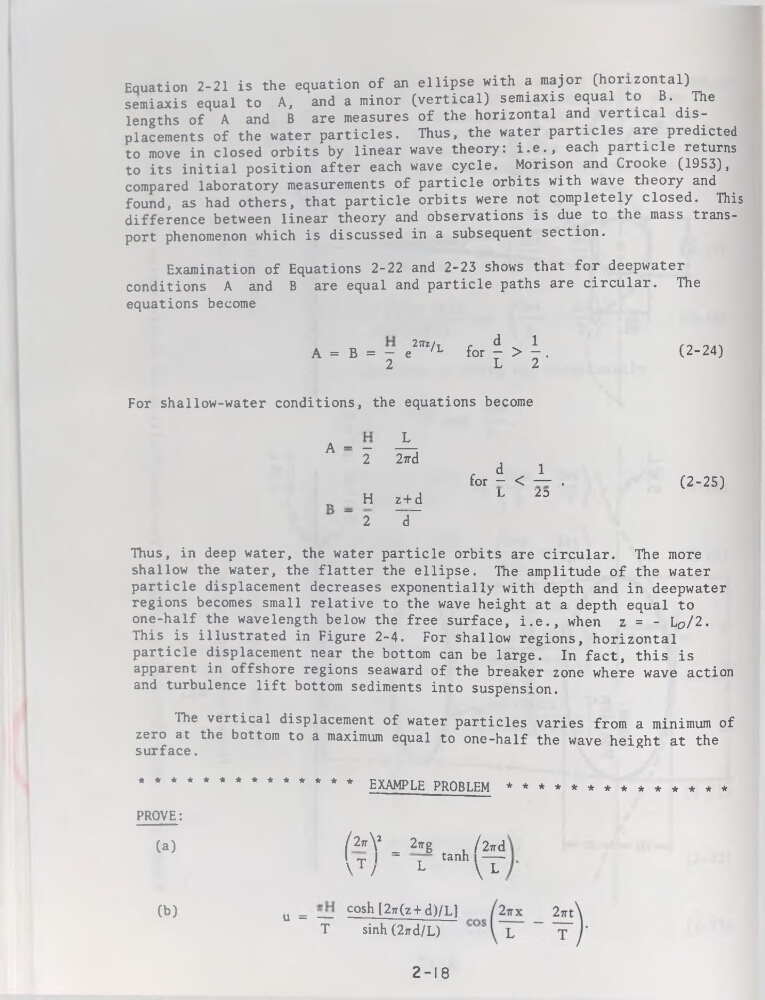
Examination of Equations 2-22 and 2-23 shows that for deepwater
conditions A and B are equal and particle paths are circular. The
équations become
r d
1
for - < — .
(2-2S)
.L/
2* O
A = B = - e2!B/L
for|>|.
(2-24)
2
L
2
For shallow-water conditions, the équations become
a - —
-k2
2rrd
„
H
z+d
" 2 ~d~
Thus, in deep water, the water particle orbits are circular. The more
shallow the water, the flatter the ellipse. The amplitude of the water
particle displacement decreases exponentially with depth and in deepwater
régions becomes small relative to the wave height at a depth equal to
one-half the wavelength below the free surface, i.e., when z = - Lo/2.
This is illustrated in Figure 2-4. For shallow régions, horizontal
particle displacement near the bottom can be large. In fact, this is
apparent in offshore régions seaward of the breaker zone where wave action
and turbulence lift bottom sédiments into suspension.
The vertical displacement of water particles varies from a minimum of
zéro at the bottom to a maximum equal to one-half the wave height at the
surface.
************** EXAMPLE PROBLEM **************
PROVE:
(a)
M2 _ 2^g
,/27rd
I ~ I ~
tanh ---\T/
L
\L
(b)
u = — cosh[27r(z+d)/L]
T
sinh (27rd/L)
2-18
semiaxis equal to A, and a minor (vertical) semiaxis equal to B. The
lengths of A and B are measures of the horizontal and vertical displacements of the water particles. Thus, the water particles are predicted
to move in closed orbits by linear wave theory: i.e., each particle returns
to its initial position after each wave cycle. Morison and Crooke (1953),
compared laboratory measurements of particle orbits with wave theory and
found, as had others, that particle orbits were not completely closed. This
différence between linear theory and observations is due to the mass transport phenomenon which is discussed in a subséquent section.
Examination of Equations 2-22 and 2-23 shows that for deepwater
conditions A and B are equal and particle paths are circular. The
équations become
r d
1
for - < — .
(2-2S)
.L/
2* O
A = B = - e2!B/L
for|>|.
(2-24)
2
L
2
For shallow-water conditions, the équations become
a - —
-k2
2rrd
„
H
z+d
" 2 ~d~
Thus, in deep water, the water particle orbits are circular. The more
shallow the water, the flatter the ellipse. The amplitude of the water
particle displacement decreases exponentially with depth and in deepwater
régions becomes small relative to the wave height at a depth equal to
one-half the wavelength below the free surface, i.e., when z = - Lo/2.
This is illustrated in Figure 2-4. For shallow régions, horizontal
particle displacement near the bottom can be large. In fact, this is
apparent in offshore régions seaward of the breaker zone where wave action
and turbulence lift bottom sédiments into suspension.
The vertical displacement of water particles varies from a minimum of
zéro at the bottom to a maximum equal to one-half the wave height at the
surface.
************** EXAMPLE PROBLEM **************
PROVE:
(a)
M2 _ 2^g
,/27rd
I ~ I ~
tanh ---\T/
L
\L
(b)
u = — cosh[27r(z+d)/L]
T
sinh (27rd/L)
2-18