

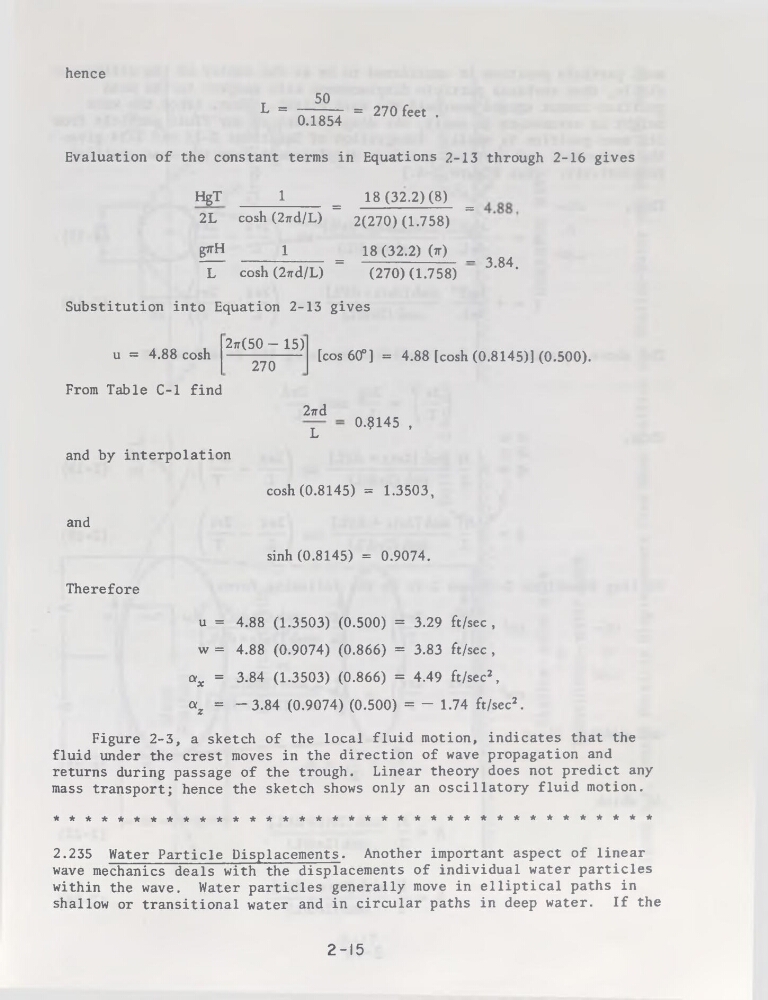
hence
t
50
L = 3^4 “ 270feet •
Evaluation of the constant terms in Equations 2-13 through 2-16 gives
HgT
1
=
18 (32.2) (8) =
2L cosh (27rd/L)
2(270) (1.758)
g*H
1
18(32.2) (n)
----- ----------------- = ------------------- — 3 84
L
cosh (27rd/L)
(270) (1.758)
' ’
Substitution into Equation 2-13 gives
u = 4.88 cosh
2tt(50 - 15)
270
[cos 6(T] = 4.88 [cosh (0.8145)] (0.500).
From Table C-l find
2nd
L
0.Ç145 ,
and by interpolation
cosh (0.8145) = 1.3503,
and
sinh (0.8145) = 0.9074.
Therefore
u = 4.88 (1.3503) (0.500) = 3.29 ft/sec ,
w = 4.88 (0.9074) (0.866) = 3.83 ft/sec ,
ax = 3.84 (1.3503) (0.866) = 4.49 ft/sec2,
az = -3.84 (0.9074) (0.500) = - 1.74 ft/sec2.
Figure 2-3, a sketch of the local fluid motion, indicates that the
fluid under the crest moves in the direction of wave propagation and
returns during passage of the trough. Linear theory does not predict any
mass transport; hence the sketch shows only an oscillatory fluid motion.
*********** **************************
2.235 Water Particle Displacements. Another important aspect of linear
wave mechanics deals with the displacements of individual water particles
within the wave. Water particles generally move in elliptical paths in
shallow or transitional water and in circular paths in deep water. If the
2-15
t
50
L = 3^4 “ 270feet •
Evaluation of the constant terms in Equations 2-13 through 2-16 gives
HgT
1
=
18 (32.2) (8) =
2L cosh (27rd/L)
2(270) (1.758)
g*H
1
18(32.2) (n)
----- ----------------- = ------------------- — 3 84
L
cosh (27rd/L)
(270) (1.758)
' ’
Substitution into Equation 2-13 gives
u = 4.88 cosh
2tt(50 - 15)
270
[cos 6(T] = 4.88 [cosh (0.8145)] (0.500).
From Table C-l find
2nd
L
0.Ç145 ,
and by interpolation
cosh (0.8145) = 1.3503,
and
sinh (0.8145) = 0.9074.
Therefore
u = 4.88 (1.3503) (0.500) = 3.29 ft/sec ,
w = 4.88 (0.9074) (0.866) = 3.83 ft/sec ,
ax = 3.84 (1.3503) (0.866) = 4.49 ft/sec2,
az = -3.84 (0.9074) (0.500) = - 1.74 ft/sec2.
Figure 2-3, a sketch of the local fluid motion, indicates that the
fluid under the crest moves in the direction of wave propagation and
returns during passage of the trough. Linear theory does not predict any
mass transport; hence the sketch shows only an oscillatory fluid motion.
*********** **************************
2.235 Water Particle Displacements. Another important aspect of linear
wave mechanics deals with the displacements of individual water particles
within the wave. Water particles generally move in elliptical paths in
shallow or transitional water and in circular paths in deep water. If the
2-15