

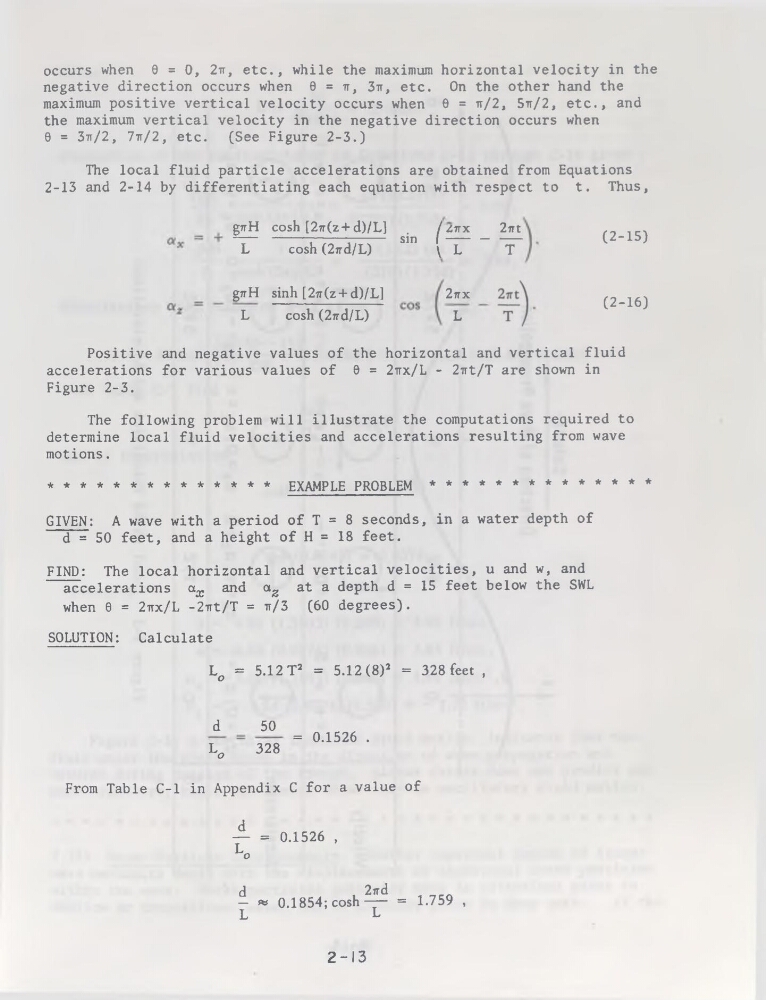
occurs when 0=0, 2tt, etc., while the maximum horizontal velocity in the
négative direction occurs when 0 = tt, 3tt, etc. On the other hand the
maximum positive vertical velocity occurs when 0 = tt/2, 5tt/2, etc., and
the maximum vertical velocity in the négative direction occurs when
0 = 3tt/2, 7tt/2, etc. (See Figure 2-3.)
The local fluid particle accélérations are obtained from Equations
2-13 and 2-14 by differentiating each équation with respect to t. Thus,
gîrH sinh [27r(z + d)/L]
L
cosh (2?rd/L)
g;rH cosh [27r(z + d)/L] .
/zttx
2îrt
----- ------------------ —— sin । ----- — ---L
cosh (2ttd/L)
\ L
T
2irx
L
(2-15)
(2-16)
Positive and négative values of the horizontal and vertical fluid
accélérations for various values of 0 = 2ïïx/L - 2irt/T are shown in
Figure 2-3.
The following problem will illustrate the computations required to
détermine local fluid velocities and accélérations resulting from wave
motions.
************** EXAMPLE PROBLEM **************
GIVEN: A wave with a period of T = 8 seconds, in a water depth of
d = 50 feet, and a height of H = 18 feet.
FIND: The local horizontal and vertical velocities, u and w, and
accélérations aæ and az at a depth d = 15 feet below the SWL
when 0 = 2kx/L -2irt/T = tt/3 (60 degrees).
SOLUTION: Calculate
Lo = 5.12 T2 = 5.12 (8)2 = 328 feet ,
d
Lo
50
328
= 0.1526 .
From Table C-l in Appendix C for a value of
d
— = 0.1526 ,
Lo
d
2nd
— « 0.1854; cosh---- = 1.759 ,
L
L
2-13
négative direction occurs when 0 = tt, 3tt, etc. On the other hand the
maximum positive vertical velocity occurs when 0 = tt/2, 5tt/2, etc., and
the maximum vertical velocity in the négative direction occurs when
0 = 3tt/2, 7tt/2, etc. (See Figure 2-3.)
The local fluid particle accélérations are obtained from Equations
2-13 and 2-14 by differentiating each équation with respect to t. Thus,
gîrH sinh [27r(z + d)/L]
L
cosh (2?rd/L)
g;rH cosh [27r(z + d)/L] .
/zttx
2îrt
----- ------------------ —— sin । ----- — ---L
cosh (2ttd/L)
\ L
T
2irx
L
(2-15)
(2-16)
Positive and négative values of the horizontal and vertical fluid
accélérations for various values of 0 = 2ïïx/L - 2irt/T are shown in
Figure 2-3.
The following problem will illustrate the computations required to
détermine local fluid velocities and accélérations resulting from wave
motions.
************** EXAMPLE PROBLEM **************
GIVEN: A wave with a period of T = 8 seconds, in a water depth of
d = 50 feet, and a height of H = 18 feet.
FIND: The local horizontal and vertical velocities, u and w, and
accélérations aæ and az at a depth d = 15 feet below the SWL
when 0 = 2kx/L -2irt/T = tt/3 (60 degrees).
SOLUTION: Calculate
Lo = 5.12 T2 = 5.12 (8)2 = 328 feet ,
d
Lo
50
328
= 0.1526 .
From Table C-l in Appendix C for a value of
d
— = 0.1526 ,
Lo
d
2nd
— « 0.1854; cosh---- = 1.759 ,
L
L
2-13