

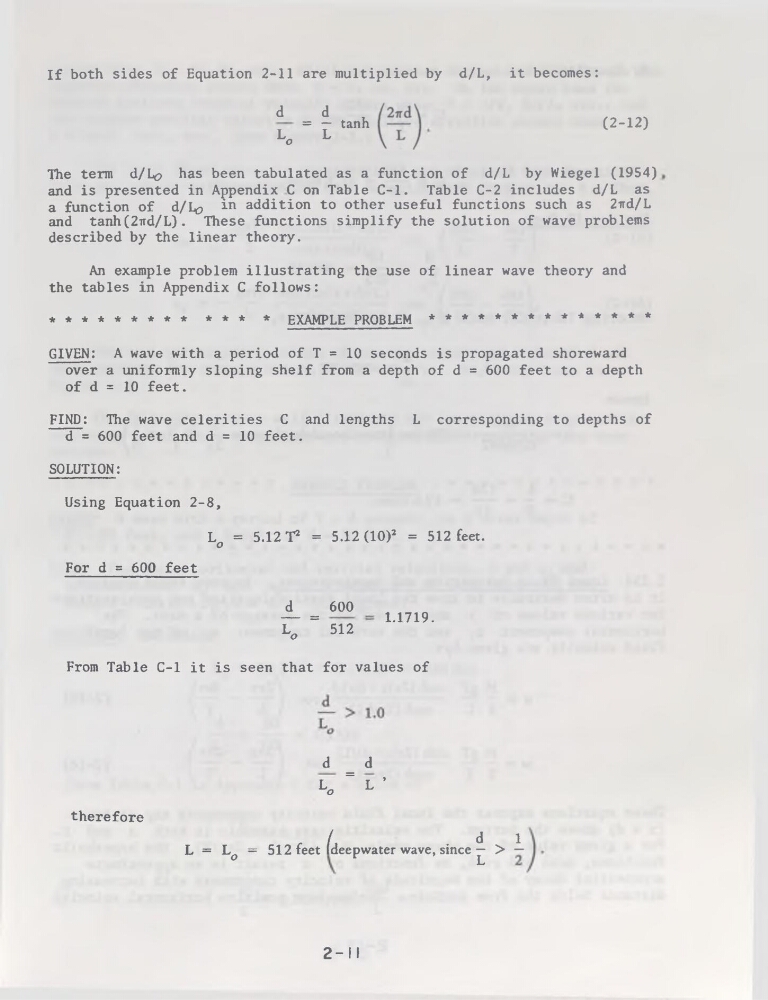
If both sides of Equation 2-11 are multiplied by d/L, it becomes:
d
Lo
d
= — tanh
L
(2-12)
The term d/L^ has been tabulated as a function of d/L by Wiegel (1954)
and is presented in Appendix C on Table C-l. Table C-2 includes d/L as
a function of d/L^ in addition to other useful fonctions such as 2ird/L
and tanh(2ird/L). These functions simplify the solution of wave problems
described by the linear theory.
An example problem illustrating the use of
the tables in Appendix C follows:
linear wave theory and
********* *** * EXAMPLE PROBLEM **************
GIVEN: A wave with a period of T = 10 seconds is propagated shoreward
over a uniformly sloping shelf from a depth of d = 600 feet to a depth
of d = 10 feet.
FIND: The wave celerities C and lengths L corresponding to depths of
d = 600 feet and d = 10 feet.
SOLUTION:
Using Equation 2-8,
Lo = 5.12 T2 = 5.12 (10)2 = 512 feet.
For d = 600 feet
d _ 600
Ç " 512
1.1719.
From Table C-l it is seen that for values of
d _ d
Lo ” L ’
therefore
L = Lo =
, L
<1
1
512 feet Ideepwater wave, since £ > —
2-11
d
Lo
d
= — tanh
L
(2-12)
The term d/L^ has been tabulated as a function of d/L by Wiegel (1954)
and is presented in Appendix C on Table C-l. Table C-2 includes d/L as
a function of d/L^ in addition to other useful fonctions such as 2ird/L
and tanh(2ird/L). These functions simplify the solution of wave problems
described by the linear theory.
An example problem illustrating the use of
the tables in Appendix C follows:
linear wave theory and
********* *** * EXAMPLE PROBLEM **************
GIVEN: A wave with a period of T = 10 seconds is propagated shoreward
over a uniformly sloping shelf from a depth of d = 600 feet to a depth
of d = 10 feet.
FIND: The wave celerities C and lengths L corresponding to depths of
d = 600 feet and d = 10 feet.
SOLUTION:
Using Equation 2-8,
Lo = 5.12 T2 = 5.12 (10)2 = 512 feet.
For d = 600 feet
d _ 600
Ç " 512
1.1719.
From Table C-l it is seen that for values of
d _ d
Lo ” L ’
therefore
L = Lo =
, L
<1
1
512 feet Ideepwater wave, since £ > —
2-11