

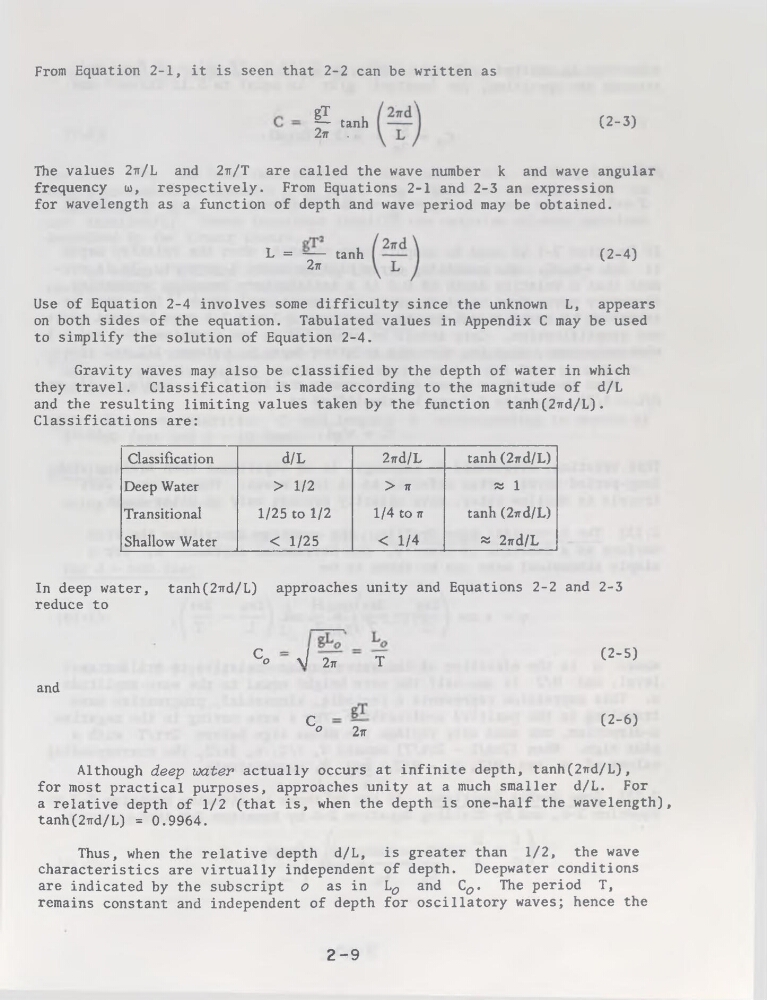
From Equation 2-1, it is seen that 2-2 can be written as
ftanh
2n .
(2-3)
The values 2ti/L and 2tt/T are called the wave number k and wave angular
frequency œ, respectively. From Equations 2-1 and 2-3 an expression
for wavelength as a function of depth and wave period may be obtained.
L = ---- tanh
2n
(2-4)
Use of Equation 2-4 involves some difficulty since the unknown L, appears
on both sides of the équation. Tabulated values in Appendix C may be used
to simplify the solution of Equation 2-4.
Gravity waves may also be classified by the depth of water in which
they travel. Classification is made according to the magnitude of d/L
and the resulting limiting values taken by the function tanh(2ird/L).
Classifications are:
Classification
d/L
2nd/L
tanh (27rd/L)
Deep Water
Transitional
Shallow Water
> 1/2
1/25 to 1/2
< 1/25
> 7T
1/4 tO TT
< 1/4
a 1
tanh (2k d/L)
a 2nd/L
In deep water, tanh(2ird/L) approaches unity and Equations 2-2 and 2-3
reduce to
CO
J 2n
T
(2-5)
and
Co
2w
(2-6)
Although deep water actually occurs at infinité depth, tanh(2ird/L) ,
for most practical purposes, approaches unity at a much smaller d/L. For
a relative depth of 1/2 (that is, when the depth is one-half the wavelength),
tanh(2ird/L) = 0.9964.
Thus, when the relative depth d/L, is greater than 1/2, the wave
characteristics are Virtually independent of depth. Deepwater conditions
are indicated by the subscript o as in L& and Qo. The period T,
remains constant and independent of depth for oscillatory waves; hence the
2-9
ftanh
2n .
(2-3)
The values 2ti/L and 2tt/T are called the wave number k and wave angular
frequency œ, respectively. From Equations 2-1 and 2-3 an expression
for wavelength as a function of depth and wave period may be obtained.
L = ---- tanh
2n
(2-4)
Use of Equation 2-4 involves some difficulty since the unknown L, appears
on both sides of the équation. Tabulated values in Appendix C may be used
to simplify the solution of Equation 2-4.
Gravity waves may also be classified by the depth of water in which
they travel. Classification is made according to the magnitude of d/L
and the resulting limiting values taken by the function tanh(2ird/L).
Classifications are:
Classification
d/L
2nd/L
tanh (27rd/L)
Deep Water
Transitional
Shallow Water
> 1/2
1/25 to 1/2
< 1/25
> 7T
1/4 tO TT
< 1/4
a 1
tanh (2k d/L)
a 2nd/L
In deep water, tanh(2ird/L) approaches unity and Equations 2-2 and 2-3
reduce to
CO
J 2n
T
(2-5)
and
Co
2w
(2-6)
Although deep water actually occurs at infinité depth, tanh(2ird/L) ,
for most practical purposes, approaches unity at a much smaller d/L. For
a relative depth of 1/2 (that is, when the depth is one-half the wavelength),
tanh(2ird/L) = 0.9964.
Thus, when the relative depth d/L, is greater than 1/2, the wave
characteristics are Virtually independent of depth. Deepwater conditions
are indicated by the subscript o as in L& and Qo. The period T,
remains constant and independent of depth for oscillatory waves; hence the
2-9