

by a number of methods. Radioactive material has been placed in holes
drilled in a large pebble. It has been incorporated in molten glass
which, when hardened, is crushed and resized (Sato, et al., 1962; and
Taney, 1963). Radioactive material has been plated on the surface of
natural sédiments.
(Stephens, et al., 1968.) Radioactive gas (krypton
85 and xénon 133) has been absorbed into quartz sand. (Chleck, et al.,
1963; and Acree, et al., 1969.)
In 1966, the Coastal Engineering Research Center, in coopération
with the Atomic Energy Commission, initiated a multiagency program to
create a workable radioisotopic sand tracing (RIST) program, for use in
the littoral zone. (Duane and Judge, 1969.) Tagging procedures (by
surface plating with gold 198-199), instrumentation, field surveys and
data handling techniques were developed which permit collection and
analysis of over 12,000 bits of information per hour over a survey track
about 18,000 feet long.
These recent developments in radioactive tracing permit in situ
observations and faster data collection over much larger areas (Duane,
1970) than has been possible using fluorescent or stable isotope tracers.
However, operational and equipment costs of radionuclide tracer programs
can be high.
Accurate détermination of long-term sédiment transport volume is not
yet possible from a tracer study, but qualitative data on sédiment movement useful for engineering purposes can be obtained.
Expérience has shown that tracer tests can give information on
direction of movement, dispersion, shoaling sources, relative velocity
and movement in various areas of the littoral zone, means of natural bypassing, and structure efficiency. Reasonably quantitative data on movement or shoaling rates can be obtained for short-time intervals. It
should be emphasized that this type of information must be interpreted
with care, since the data are generally determined by short-term littoral
transport phenomena. However, tracer studies conducted repeatedly over
several years at the same location could resuit in estimâtes of longer
term littoral transport.
4.83 SEDIMENT TRANSPORT CALCULATIONS
4.831 Longshore Transport Rate. The example calculation of a sédiment
budget in Section 4.76 is typical in that the magnitude of the longshore
transport rate exceeds by a considérable margin any other element in the
budget. For this reason, it is essential to hâve a good estimate of the
longshore transport rate in an engineering study of littoral processes.
A complété description of the longshore transport rate requires
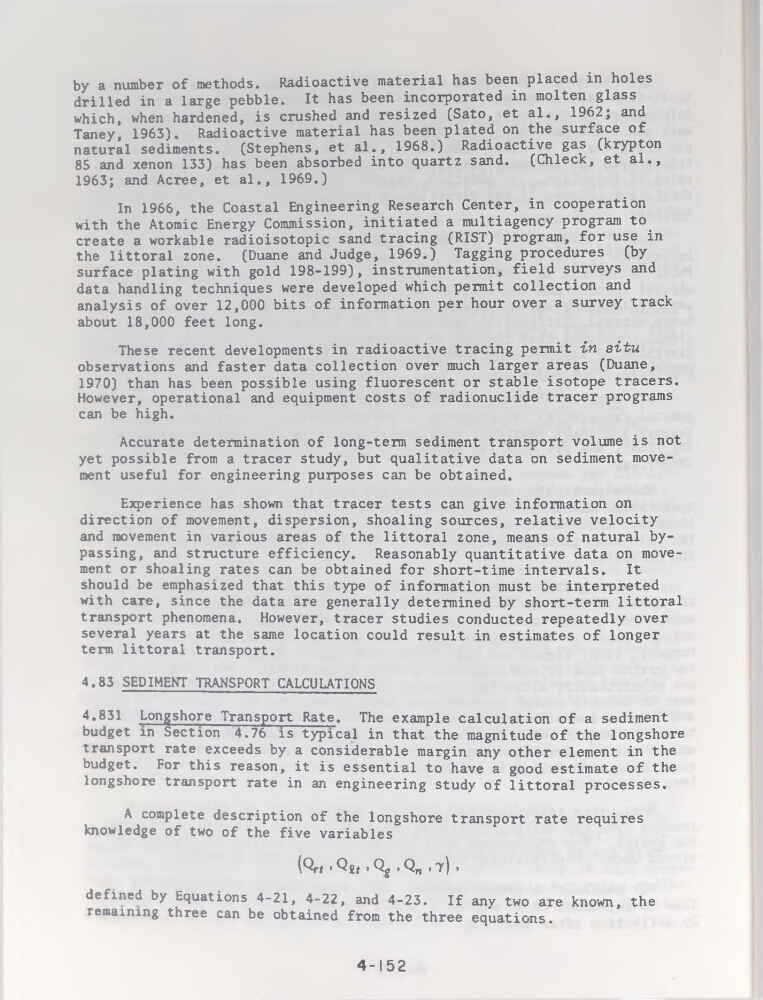
knowledge of two of the five variables
(^.Qn.Qf.Qn.T).
defined by Equations 4-21, 4-22, and 4-23. If any two are known, the
remaining three can be obtained from the three équations.
4-152
drilled in a large pebble. It has been incorporated in molten glass
which, when hardened, is crushed and resized (Sato, et al., 1962; and
Taney, 1963). Radioactive material has been plated on the surface of
natural sédiments.
(Stephens, et al., 1968.) Radioactive gas (krypton
85 and xénon 133) has been absorbed into quartz sand. (Chleck, et al.,
1963; and Acree, et al., 1969.)
In 1966, the Coastal Engineering Research Center, in coopération
with the Atomic Energy Commission, initiated a multiagency program to
create a workable radioisotopic sand tracing (RIST) program, for use in
the littoral zone. (Duane and Judge, 1969.) Tagging procedures (by
surface plating with gold 198-199), instrumentation, field surveys and
data handling techniques were developed which permit collection and
analysis of over 12,000 bits of information per hour over a survey track
about 18,000 feet long.
These recent developments in radioactive tracing permit in situ
observations and faster data collection over much larger areas (Duane,
1970) than has been possible using fluorescent or stable isotope tracers.
However, operational and equipment costs of radionuclide tracer programs
can be high.
Accurate détermination of long-term sédiment transport volume is not
yet possible from a tracer study, but qualitative data on sédiment movement useful for engineering purposes can be obtained.
Expérience has shown that tracer tests can give information on
direction of movement, dispersion, shoaling sources, relative velocity
and movement in various areas of the littoral zone, means of natural bypassing, and structure efficiency. Reasonably quantitative data on movement or shoaling rates can be obtained for short-time intervals. It
should be emphasized that this type of information must be interpreted
with care, since the data are generally determined by short-term littoral
transport phenomena. However, tracer studies conducted repeatedly over
several years at the same location could resuit in estimâtes of longer
term littoral transport.
4.83 SEDIMENT TRANSPORT CALCULATIONS
4.831 Longshore Transport Rate. The example calculation of a sédiment
budget in Section 4.76 is typical in that the magnitude of the longshore
transport rate exceeds by a considérable margin any other element in the
budget. For this reason, it is essential to hâve a good estimate of the
longshore transport rate in an engineering study of littoral processes.
A complété description of the longshore transport rate requires
knowledge of two of the five variables
(^.Qn.Qf.Qn.T).
defined by Equations 4-21, 4-22, and 4-23. If any two are known, the
remaining three can be obtained from the three équations.
4-152