

of a convergent nodal zone. (Watson, 1971.) Nodal zones of divergence
are more comraon than nodal zones of convergence, because longshore transport commonly diverges at exposed shores and converges toward major gaps
in the océan shore, such as the openings of New York Harbor, Delaware Bay,
and Chesapeake Bay.
Nodal zones are usually defined by long-term average transport directions, but because of insufficient data, the location of the mid-point of
the nodal zone may be uncertain by up to 10’s of miles. In addition, the
short-term nodal zone most probably shifts along the coast with changes
in wave climate.
The existence, location, and planform of inlets can be used to interpret the littoral processes of the région. Inlets occur where tidal flow
is sufficient to maintain the openings against longshore transport which
acts to close them. (e.g., Bruun and Gerritsen, 1959.) The size of the
inlet opening dépends on the tidal prism available to maintain it. (0’Brien,
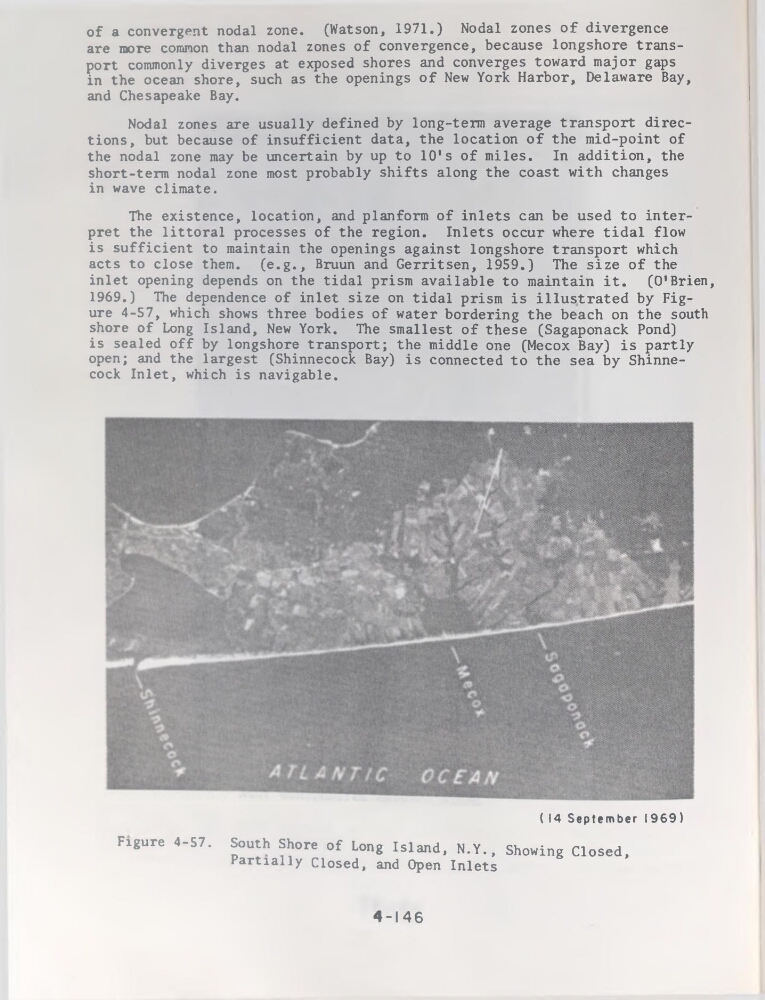
1969.) The dependence of inlet size on tidal prism is illustrated by Figure 4-57, which shows three bodies of water bordering the beach on the south
shore of Long Island, New York. The smallest of these (Sagaponack Pond)
is sealed off by longshore transport; the middle one (Mecox Bay) is partly
open; and the largest (Shinnecock Bay) is connected to the sea by Shinnecock Inlet, which is navigable.
( 14 September 1969)
Figure 4-57. South Shore of Long Island, N.Y., Showing Closed,
Partially Closed, and Open Inlets
4-146
are more comraon than nodal zones of convergence, because longshore transport commonly diverges at exposed shores and converges toward major gaps
in the océan shore, such as the openings of New York Harbor, Delaware Bay,
and Chesapeake Bay.
Nodal zones are usually defined by long-term average transport directions, but because of insufficient data, the location of the mid-point of
the nodal zone may be uncertain by up to 10’s of miles. In addition, the
short-term nodal zone most probably shifts along the coast with changes
in wave climate.
The existence, location, and planform of inlets can be used to interpret the littoral processes of the région. Inlets occur where tidal flow
is sufficient to maintain the openings against longshore transport which
acts to close them. (e.g., Bruun and Gerritsen, 1959.) The size of the
inlet opening dépends on the tidal prism available to maintain it. (0’Brien,
1969.) The dependence of inlet size on tidal prism is illustrated by Figure 4-57, which shows three bodies of water bordering the beach on the south
shore of Long Island, New York. The smallest of these (Sagaponack Pond)
is sealed off by longshore transport; the middle one (Mecox Bay) is partly
open; and the largest (Shinnecock Bay) is connected to the sea by Shinnecock Inlet, which is navigable.
( 14 September 1969)
Figure 4-57. South Shore of Long Island, N.Y., Showing Closed,
Partially Closed, and Open Inlets
4-146