

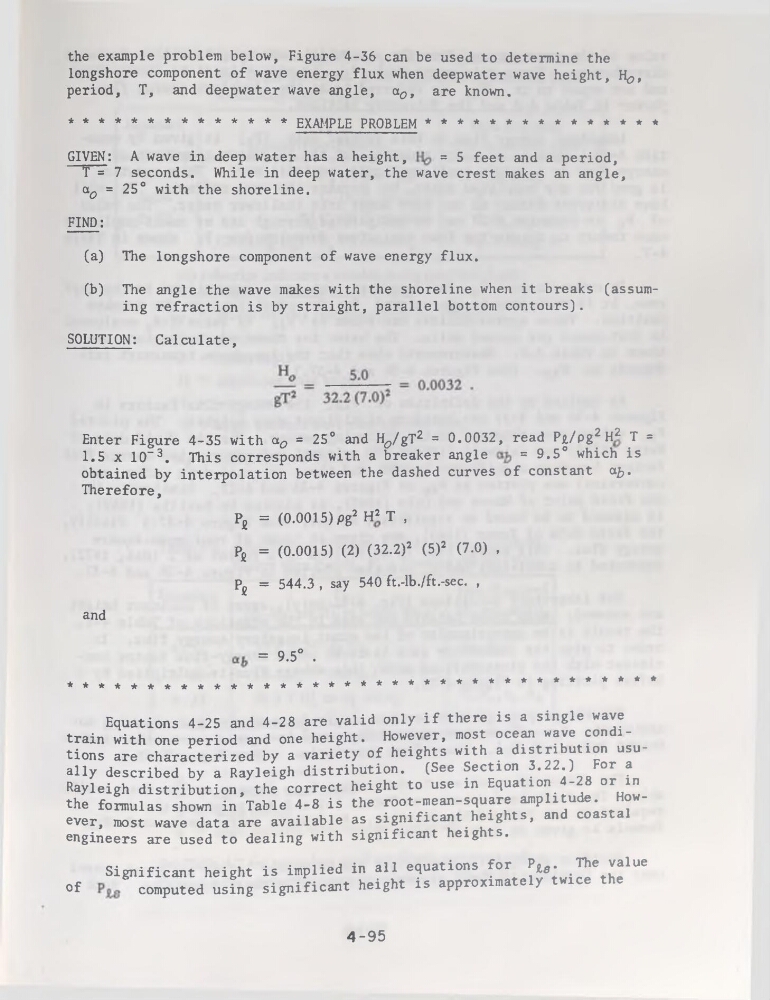
the example problem below, Figure 4-36 can be used to détermine the
longshore component of wave energy flux when deepwater wave height, H^,
period, T, and deepwater wave angle, a0, are known.
************** example problem ***************
GIVEN: A wave in deep water has a height,
= 5 feet and a period,
T = 7 seconds. While in deep water, the wave crest makes an angle,
a0 = 25° with the shoreline.
FIND:
(a) The longshore component of wave energy flux.
(b) The angle the wave makes with the shoreline when it breaks (assuming refraction is by straight, parallel bottom contours).
SOLUTION: C al eu1at e,
Enter Figure 4-35 with ao = 25° and H^/gT2 = 0.0032, read Pfc/pg2H2 T =
1.5 x 10⁻³. This corresponds with a breaker angle
= 9.5° which is
obtained by interpolation between the dashed curves of constant afr.
Therefore,
Pfi = (0.0015) pg2 H2 T ,
Pg = (0.0015) (2) (32.2)2 (5)2 (7.0) ,
Pg = 544.3 , say 540 ft.-lb./ft.-sec. ,
and
= 9.5° .
*************************************
Equations 4-25 and 4-28 are valid only if there is a single wave
train with one period and one height. However, most océan wave conditions are characterized by a variety of heights with a distribution usually described by a Rayleigh distribution. (See Section 3.22.) For a
Rayleigh distribution, the correct height to use in Equation 4-28 or in
the formulas shown in Table 4-8 is the root-mean-square amplitude. However, most wave data are available as significant heights, and Coastal
engineers are used to dealing with significant heights.
of
in ail équations for P^ô, The value
height is approximately twice the
Significant height is implied
computed using significant
4-95
longshore component of wave energy flux when deepwater wave height, H^,
period, T, and deepwater wave angle, a0, are known.
************** example problem ***************
GIVEN: A wave in deep water has a height,
= 5 feet and a period,
T = 7 seconds. While in deep water, the wave crest makes an angle,
a0 = 25° with the shoreline.
FIND:
(a) The longshore component of wave energy flux.
(b) The angle the wave makes with the shoreline when it breaks (assuming refraction is by straight, parallel bottom contours).
SOLUTION: C al eu1at e,
Enter Figure 4-35 with ao = 25° and H^/gT2 = 0.0032, read Pfc/pg2H2 T =
1.5 x 10⁻³. This corresponds with a breaker angle
= 9.5° which is
obtained by interpolation between the dashed curves of constant afr.
Therefore,
Pfi = (0.0015) pg2 H2 T ,
Pg = (0.0015) (2) (32.2)2 (5)2 (7.0) ,
Pg = 544.3 , say 540 ft.-lb./ft.-sec. ,
and
= 9.5° .
*************************************
Equations 4-25 and 4-28 are valid only if there is a single wave
train with one period and one height. However, most océan wave conditions are characterized by a variety of heights with a distribution usually described by a Rayleigh distribution. (See Section 3.22.) For a
Rayleigh distribution, the correct height to use in Equation 4-28 or in
the formulas shown in Table 4-8 is the root-mean-square amplitude. However, most wave data are available as significant heights, and Coastal
engineers are used to dealing with significant heights.
of
in ail équations for P^ô, The value
height is approximately twice the
Significant height is implied
computed using significant
4-95