

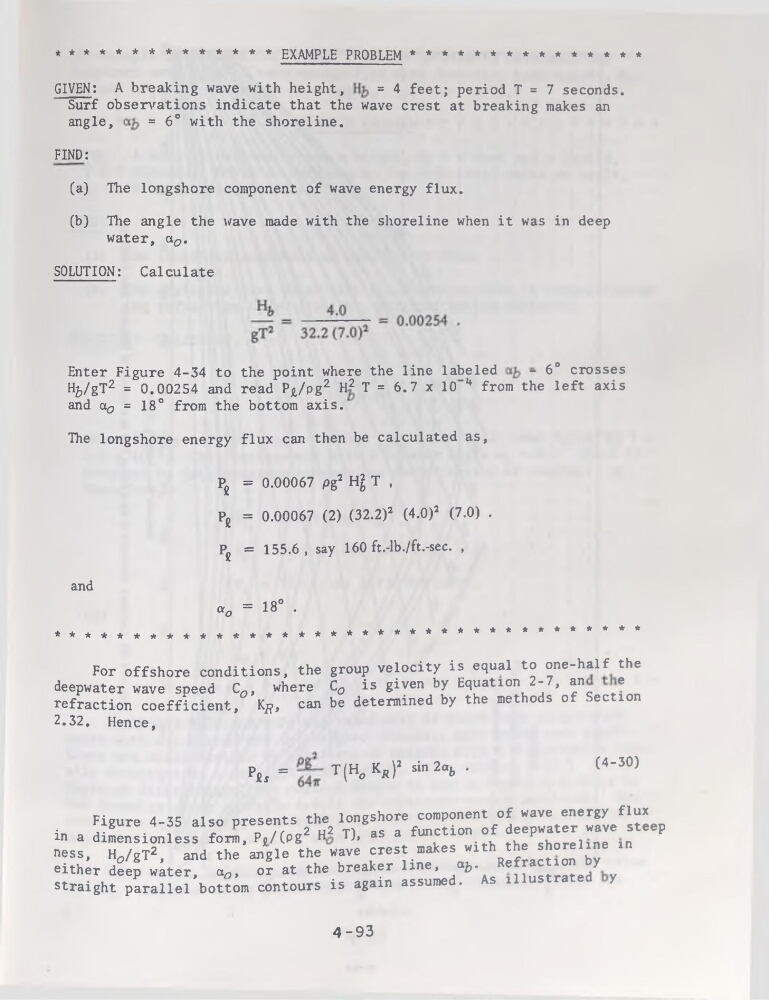
************** EXAMPLE problem ***************
GIVEN: A breaking wave with height,
= 4 feet; period T = 7 seconds.
Surf observations indicate that the wave crest at breaking makes an
angle,
= 6° with the shoreline.
FIND:
(a) The longshore component of wave energy flux.
(b) The angle the wave made with the shoreline when it was in deep
water, ao,
SOLUTION: Calculate
Enter Figure 4-34 to the point where the line labeled
- 6° crosses
Hh/gT2 = 0.00254 and read P£/pg2 H2 T = 6.7 x 10 4 from the left axis
and a0 = 18° from the bottom axis.
The longshore energy flux can then be calculated as,
Pg = 0.00067 pg2 HJ T ,
Pg = 0.00067 (2) (32.2)2 (4.0)2 (7.0) .
Pg = 155.6, say 160 ft.-lb./ft.-sec. ,
and
% = 18° .
*************************************
For offshore conditions, the group velocity is equal to one-half the
deepwater wave speed Co, where Co is given by Equation 2-7, an
e
refraction coefficient, Kr, can be determined by the methods of Section
2.32. Hence,
h, =
T(Ho Kk)« sin2O() .
(4-30)
Figure 4-35 also présents the longshore component of wave energy flux
in a dimensionless form, Pj/(pg2 H2 T), as a function of deepwater wave steep
ness, Ho/gT2, and the angle the wave crest makes with the shoreline in
either deep water, ao, or at the breaker line, aj,. Refraction by
straight parallel bottom contours is again assumed. As illustrated y
4-93
GIVEN: A breaking wave with height,
= 4 feet; period T = 7 seconds.
Surf observations indicate that the wave crest at breaking makes an
angle,
= 6° with the shoreline.
FIND:
(a) The longshore component of wave energy flux.
(b) The angle the wave made with the shoreline when it was in deep
water, ao,
SOLUTION: Calculate
Enter Figure 4-34 to the point where the line labeled
- 6° crosses
Hh/gT2 = 0.00254 and read P£/pg2 H2 T = 6.7 x 10 4 from the left axis
and a0 = 18° from the bottom axis.
The longshore energy flux can then be calculated as,
Pg = 0.00067 pg2 HJ T ,
Pg = 0.00067 (2) (32.2)2 (4.0)2 (7.0) .
Pg = 155.6, say 160 ft.-lb./ft.-sec. ,
and
% = 18° .
*************************************
For offshore conditions, the group velocity is equal to one-half the
deepwater wave speed Co, where Co is given by Equation 2-7, an
e
refraction coefficient, Kr, can be determined by the methods of Section
2.32. Hence,
h, =
T(Ho Kk)« sin2O() .
(4-30)
Figure 4-35 also présents the longshore component of wave energy flux
in a dimensionless form, Pj/(pg2 H2 T), as a function of deepwater wave steep
ness, Ho/gT2, and the angle the wave crest makes with the shoreline in
either deep water, ao, or at the breaker line, aj,. Refraction by
straight parallel bottom contours is again assumed. As illustrated y
4-93