

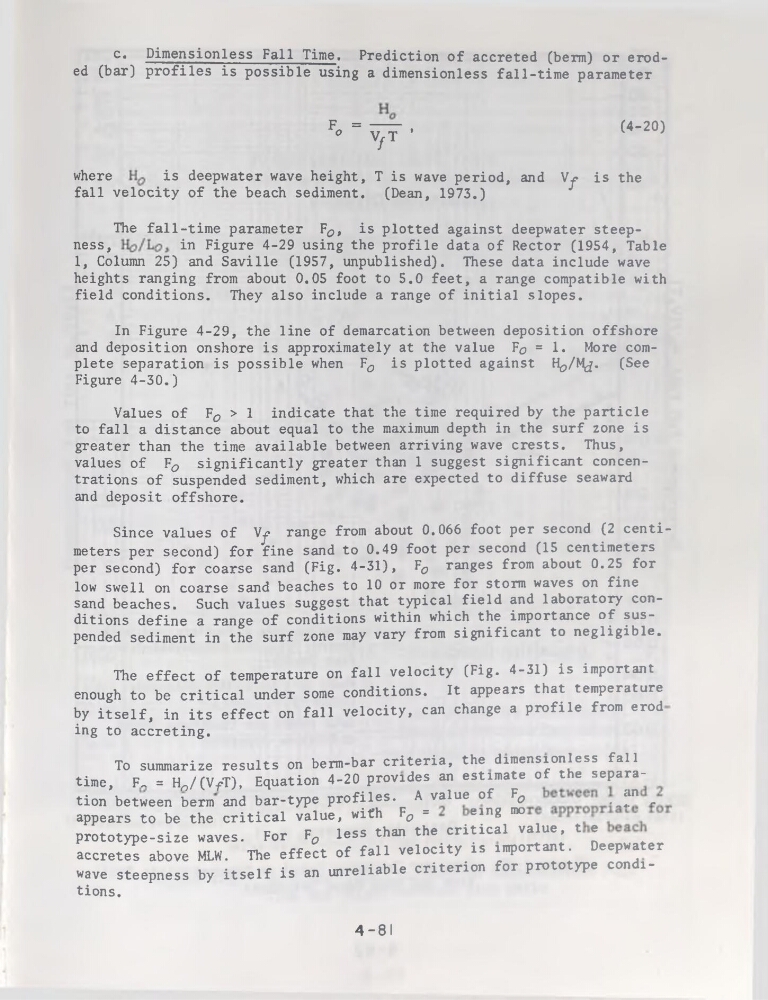
c. Dimensionless Fall Time. Prédiction of accreted (berm) or eroded (bar) profiles is possible using a dimensionless fall-time parameter
F = — ,
°
VyT
(4-20)
where
is deepwater wave height, T is wave period, and
fall velocity of the beach sédiment. (Dean, 1973.)
Vy is the
The fall-time parameter Fo, is plotted against deepwater steepness,
in Figure 4-29 using the profile data of Rector (1954, Table
1, Column 25) and Saville (1957, unpublished). These data include wave
heights ranging from about 0.05 foot to 5.0 feet, a range compatible with
field conditions. They also include a range of initial slopes.
In Figure 4-29, the line of démarcation between déposition offshore
and déposition onshore is approximately at the value Fo = 1. More complété séparation is possible when Fo is plotted against Hq/Mj. (See
Figure 4-30.)
Values of Fo > 1 indicate that the time required by the particle
to fall a distance about equal to the maximum depth in the surf zone is
greater than the time available between arriving wave crests. Thus,
values of Fo significantly greater than 1 suggest significant concentrations of suspended sédiment, which are expected to diffuse seaward
and deposit offshore.
Since values of Vy range from about 0.066 foot per second (2 centimeters per second) for fine sand to 0.49 foot per second (15 centimeters
per second) for coarse sand (Fig. 4-31), Fo ranges from about 0.25 for
low swell on coarse sand beaches to 10 or more for storm waves on fine
sand beaches. Such values suggest that typical field and laboratory conditions define a range of conditions within which the importance of suspended sédiment in the surf zone may vary from significant to negligible.
The effect of température on fall velocity (Fig. 4-31) is important
enough to be critical under some conditions. It appears that température
by itself, in its effect on fall velocity, can change a profile from erod
ing to accreting.
To summarize results on berm-bar criteria, the dimensionless fall
time, F. = Hn/(V/T), Equation 4-20 provides an estimate of the séparation between berm and bar-type profiles. A_value of F#
. J?” -
appears to be the critical value, with Fo -
ein$ 11)0
prototype-size waves. For Fo less than the critical value, t e
accretes above MLW. The effect of fall velocity is important. Deepwater
wave steepness by itself is an unreliable criterion for prototype conditions.
4-81
F = — ,
°
VyT
(4-20)
where
is deepwater wave height, T is wave period, and
fall velocity of the beach sédiment. (Dean, 1973.)
Vy is the
The fall-time parameter Fo, is plotted against deepwater steepness,
in Figure 4-29 using the profile data of Rector (1954, Table
1, Column 25) and Saville (1957, unpublished). These data include wave
heights ranging from about 0.05 foot to 5.0 feet, a range compatible with
field conditions. They also include a range of initial slopes.
In Figure 4-29, the line of démarcation between déposition offshore
and déposition onshore is approximately at the value Fo = 1. More complété séparation is possible when Fo is plotted against Hq/Mj. (See
Figure 4-30.)
Values of Fo > 1 indicate that the time required by the particle
to fall a distance about equal to the maximum depth in the surf zone is
greater than the time available between arriving wave crests. Thus,
values of Fo significantly greater than 1 suggest significant concentrations of suspended sédiment, which are expected to diffuse seaward
and deposit offshore.
Since values of Vy range from about 0.066 foot per second (2 centimeters per second) for fine sand to 0.49 foot per second (15 centimeters
per second) for coarse sand (Fig. 4-31), Fo ranges from about 0.25 for
low swell on coarse sand beaches to 10 or more for storm waves on fine
sand beaches. Such values suggest that typical field and laboratory conditions define a range of conditions within which the importance of suspended sédiment in the surf zone may vary from significant to negligible.
The effect of température on fall velocity (Fig. 4-31) is important
enough to be critical under some conditions. It appears that température
by itself, in its effect on fall velocity, can change a profile from erod
ing to accreting.
To summarize results on berm-bar criteria, the dimensionless fall
time, F. = Hn/(V/T), Equation 4-20 provides an estimate of the séparation between berm and bar-type profiles. A_value of F#
. J?” -
appears to be the critical value, with Fo -
ein$ 11)0
prototype-size waves. For Fo less than the critical value, t e
accretes above MLW. The effect of fall velocity is important. Deepwater
wave steepness by itself is an unreliable criterion for prototype conditions.
4-81