

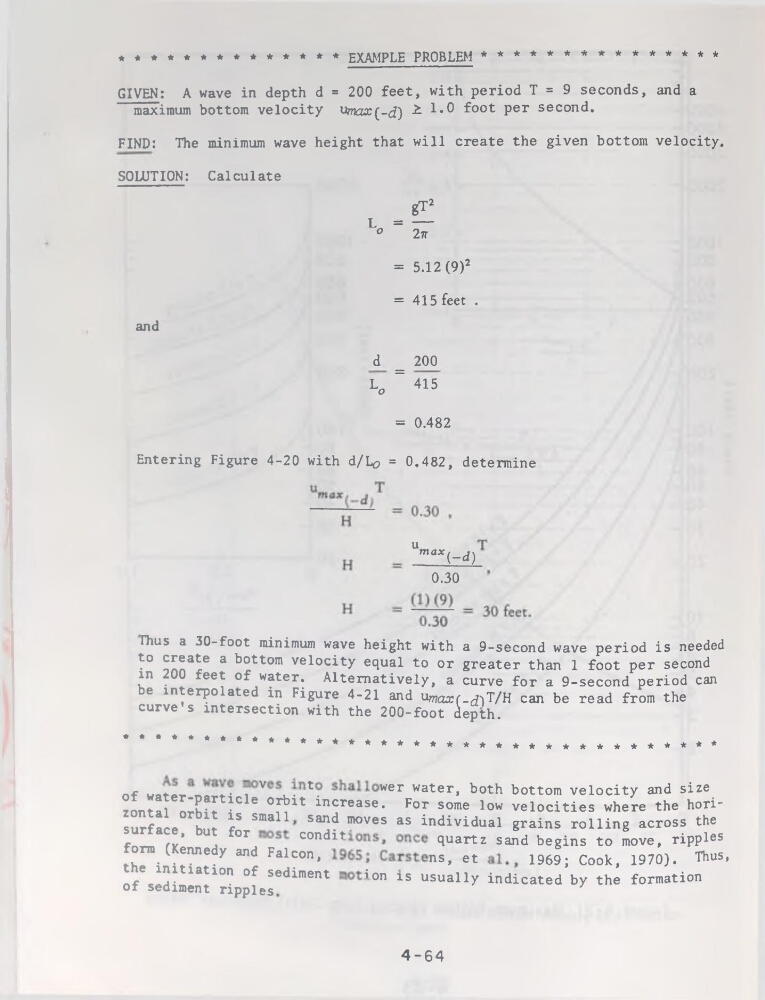
************** EXAMPLE problem ***************
GIVEN: A wave in depth d = 200 feet, with period T = 9 seconds, and a
maximum bottom velocity uztkzx(-J) 2 1.0 foot per second.
FIND: The minimum wave height that will create the given bottom velocity.
SOLUTION: Calculate
gT2
L = ---°
2rr
= 5.12 (9)2
= 415 feet .
and
d _ 200^
Lo ” 415
= 0.482
Entering Figure 4-20 with d/Lo = 0.482, détermine
u
max(-d)
0.30
rhus a 30-foot minimum wave height with a 9-second wave period is needed
to create a bottom velocity equal to or greater than 1 foot per second
in 200 feet of water. Altematively, a curve for a 9-second period can
be interpolated in Figure 4-21 and umax(-^T/H can be read from the
curve's intersection with the 200-foot depth.
*************************************
of water-particleVorbittinc^easeWe^FWate^, b°th bottom velocity and size
zontal orbit is small sand m
’
°? some low velocities where the horisurface, but for
cX™'’ " lndividual grains rolling across the
form (Kennedy and Falcon
quartz sand begins to move, ripples
the initiation of seli^t
i
nS’ et
1969; Cook- 1970^ ™US’
of sédiment ripples
°n 1S usua^X indicated by the formation
4-64
GIVEN: A wave in depth d = 200 feet, with period T = 9 seconds, and a
maximum bottom velocity uztkzx(-J) 2 1.0 foot per second.
FIND: The minimum wave height that will create the given bottom velocity.
SOLUTION: Calculate
gT2
L = ---°
2rr
= 5.12 (9)2
= 415 feet .
and
d _ 200^
Lo ” 415
= 0.482
Entering Figure 4-20 with d/Lo = 0.482, détermine
u
max(-d)
0.30
rhus a 30-foot minimum wave height with a 9-second wave period is needed
to create a bottom velocity equal to or greater than 1 foot per second
in 200 feet of water. Altematively, a curve for a 9-second period can
be interpolated in Figure 4-21 and umax(-^T/H can be read from the
curve's intersection with the 200-foot depth.
*************************************
of water-particleVorbittinc^easeWe^FWate^, b°th bottom velocity and size
zontal orbit is small sand m
’
°? some low velocities where the horisurface, but for
cX™'’ " lndividual grains rolling across the
form (Kennedy and Falcon
quartz sand begins to move, ripples
the initiation of seli^t
i
nS’ et
1969; Cook- 1970^ ™US’
of sédiment ripples
°n 1S usua^X indicated by the formation
4-64