

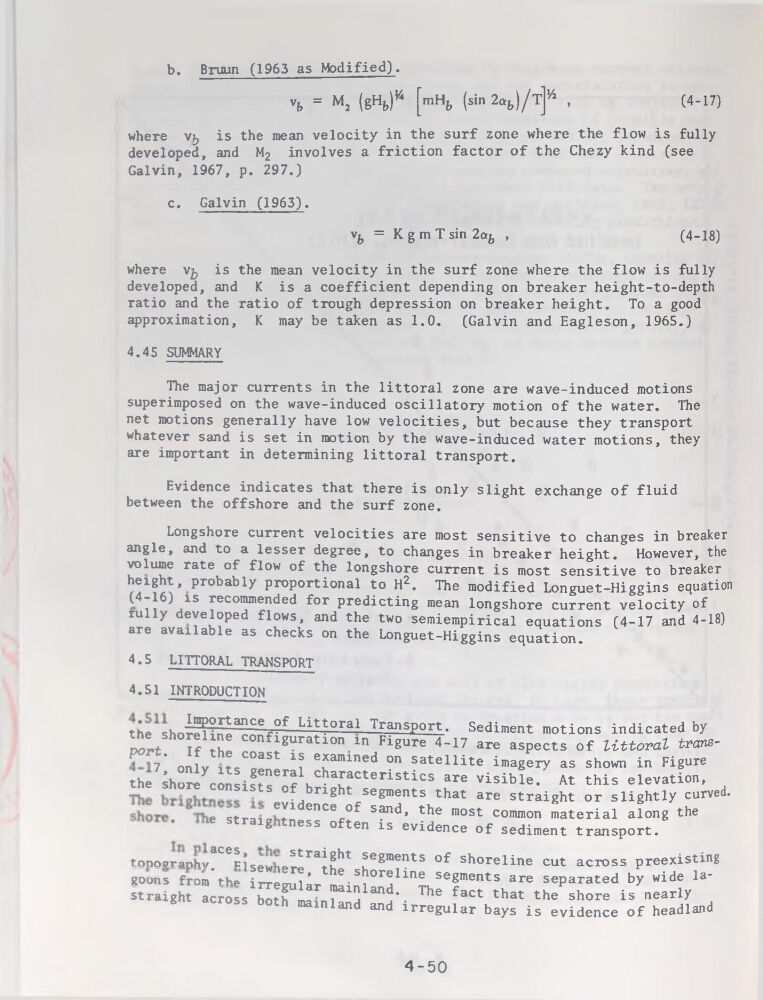
b. Bruun (1963 as Modified).
vfc = M2 (?H/' [mHb (sin 2%)/T]* •
(4-17)
where vj, is the mean velocity in the surf zone where the flow is fully
developed, and M2 involves a friction factor of the Chezy kind (see
Galvin, 1967, p. 297.)
c. Galvin (1963).
vb = K g m T sin 2a^ ,
(4-18)
where v^ is the mean velocity in the surf zone where the flow is fully
developed, and K is a coefficient depending on breaker height-to-depth
ratio and the ratio of trough dépréssion on breaker height. To a good
approximation, K may be taken as 1.0.
(Galvin and Eagleson, 1965.)
4.45 SUMMARY
The major currents in the littoral zone are wave-induced motions
superimposed on the wave-induced oscillatory motion of the water. The
net motions generally hâve low velocities, but because they transport
whatever sand is set in motion by the wave-induced water motions, they
are important in determining littoral transport.
Evidence indicates that there is only slight exchange of fluid
between the offshore and the surf zone.
Longshore current velocities are most sensitive to changes in breaker
angle, and to a lesser degree, to changes in breaker height. However, the
volume rate of flow of the longshore current is most sensitive to breaker
height, probably proportional to H2. The modified Longuet-Higgins équation
(4;}6) is recommended for predicting mean longshore current velocity of
rully developed flows, and the two semiempirical équations (4-17 and 4-18)
are available as checks on the Longuet-Higgins équation.
4.5 LITTORAL TRANSPORT
4.51 INTRODUCTION
Importance of Littoral Transport. Sédiment motions indicated by
the shoreline configuration in Figure 4-17 are aspects of littoral transport. If the coast is examined on satellite imagery as shown in Figure
Zk 7\°nly lts.general Characteristics are visible. At this élévation,
the shore consists of bright segments that are straight or slightly curved.
évidence of sand, the most common material along the
e straig tness often is evidence of sédiment transport.
tonoffranhv306^!
stra^gIlt segments of shoreline eut across preexisting
soons fro™'rhA1r'< 'er?' the. shoreline segments are separated by wide lastraicht L™ TT’" malnland- The fact that the shore is nearly
straight across both mamland and irregular bays is evidence of headland
4-50
vfc = M2 (?H/' [mHb (sin 2%)/T]* •
(4-17)
where vj, is the mean velocity in the surf zone where the flow is fully
developed, and M2 involves a friction factor of the Chezy kind (see
Galvin, 1967, p. 297.)
c. Galvin (1963).
vb = K g m T sin 2a^ ,
(4-18)
where v^ is the mean velocity in the surf zone where the flow is fully
developed, and K is a coefficient depending on breaker height-to-depth
ratio and the ratio of trough dépréssion on breaker height. To a good
approximation, K may be taken as 1.0.
(Galvin and Eagleson, 1965.)
4.45 SUMMARY
The major currents in the littoral zone are wave-induced motions
superimposed on the wave-induced oscillatory motion of the water. The
net motions generally hâve low velocities, but because they transport
whatever sand is set in motion by the wave-induced water motions, they
are important in determining littoral transport.
Evidence indicates that there is only slight exchange of fluid
between the offshore and the surf zone.
Longshore current velocities are most sensitive to changes in breaker
angle, and to a lesser degree, to changes in breaker height. However, the
volume rate of flow of the longshore current is most sensitive to breaker
height, probably proportional to H2. The modified Longuet-Higgins équation
(4;}6) is recommended for predicting mean longshore current velocity of
rully developed flows, and the two semiempirical équations (4-17 and 4-18)
are available as checks on the Longuet-Higgins équation.
4.5 LITTORAL TRANSPORT
4.51 INTRODUCTION
Importance of Littoral Transport. Sédiment motions indicated by
the shoreline configuration in Figure 4-17 are aspects of littoral transport. If the coast is examined on satellite imagery as shown in Figure
Zk 7\°nly lts.general Characteristics are visible. At this élévation,
the shore consists of bright segments that are straight or slightly curved.
évidence of sand, the most common material along the
e straig tness often is evidence of sédiment transport.
tonoffranhv306^!
stra^gIlt segments of shoreline eut across preexisting
soons fro™'rhA1r'< 'er?' the. shoreline segments are separated by wide lastraicht L™ TT’" malnland- The fact that the shore is nearly
straight across both mamland and irregular bays is evidence of headland
4-50