

passes. The rate of this advance is the mass transport velocity; (Equation 2-55, Section 2.253). This velocity becomes important for sédiment
transport, especially for sédiment suspended above ripples seaward of the
breaker.
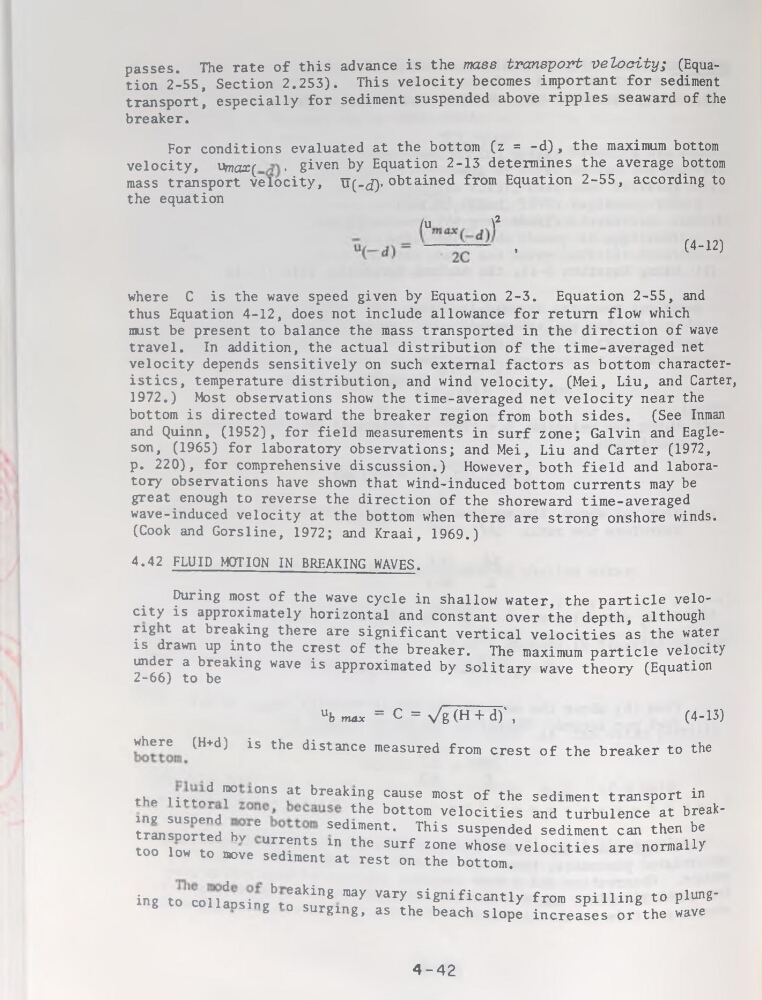
For conditions evaluated at the bottom (z = -d) , the maximum bottom
velocity, umaa:(
. given by Equation 2-13 détermines the average bottom
mass transport velocity, ü(-^). obtained from Equation 2-55, according to
the équation
/u
\2
—(4’12)
where C is the wave speed given by Equation 2-3. Equation 2-55, and
thus Equation 4-12, does not include allowance for retum flow which
must be présent to balance the mass transported in the direction of wave
travel. In addition, the actual distribution of the time-averaged net
velocity dépends sensitively on such extemal factors as bottom characteristics, température distribution, and wind velocity. (Mei, Liu, and Carter,
1972.) Most observations show the time-averaged net velocity near the
bottom is directed toward the breaker région from both sides.
(See Inman
and Quinn, (1952), for field measurements in surf zone; Galvin and Eagleson, (1965) for laboratory observations; and Mei, Liu and Carter (1972,
p. 220), for comprehensive discussion.) However, both field and laboratory observations hâve shown that wind-induced bottom currents may be
great enough to reverse the direction of the shoreward time-averaged
wave-induced velocity at the bottom when there are strong onshore winds.
(Cook and Gorsline, 1972; and Kraai, 1969.)
4.42 FLUID MOTION IN BREAKING WAVES.
During most of the wave cycle in shallow water, the particle velocity is approximately horizontal and constant over the depth, although
nght at breaking there are significant vertical velocities as the water
is drawn UP into the crest of the breaker. The maximum particle velocity
under a breaking wave is approximated by solitary wave theory (Equation
2-66) to be
ub max = C = Vg (H + d)' ,
(4-13)
where (H+d) is the distance measured from crest of the breaker to the
the littnl ?° °nS J* breaklng cause most of the sédiment transport in
inc sisnend
the b°ttom vel°cities and turbulence at breaktransoorted hv *
sédiment. This suspended sédiment can then be
too low to move Ur^ents ln the surf zone whose velocities are normally
too low to move sédiment at rest on the bottom.
ing tolcolllDsinobteakin8 niay Vary s^^cantly from spilling to plungR o surging, as the beach slope increases or the wave
4-42
transport, especially for sédiment suspended above ripples seaward of the
breaker.
For conditions evaluated at the bottom (z = -d) , the maximum bottom
velocity, umaa:(
. given by Equation 2-13 détermines the average bottom
mass transport velocity, ü(-^). obtained from Equation 2-55, according to
the équation
/u
\2
—(4’12)
where C is the wave speed given by Equation 2-3. Equation 2-55, and
thus Equation 4-12, does not include allowance for retum flow which
must be présent to balance the mass transported in the direction of wave
travel. In addition, the actual distribution of the time-averaged net
velocity dépends sensitively on such extemal factors as bottom characteristics, température distribution, and wind velocity. (Mei, Liu, and Carter,
1972.) Most observations show the time-averaged net velocity near the
bottom is directed toward the breaker région from both sides.
(See Inman
and Quinn, (1952), for field measurements in surf zone; Galvin and Eagleson, (1965) for laboratory observations; and Mei, Liu and Carter (1972,
p. 220), for comprehensive discussion.) However, both field and laboratory observations hâve shown that wind-induced bottom currents may be
great enough to reverse the direction of the shoreward time-averaged
wave-induced velocity at the bottom when there are strong onshore winds.
(Cook and Gorsline, 1972; and Kraai, 1969.)
4.42 FLUID MOTION IN BREAKING WAVES.
During most of the wave cycle in shallow water, the particle velocity is approximately horizontal and constant over the depth, although
nght at breaking there are significant vertical velocities as the water
is drawn UP into the crest of the breaker. The maximum particle velocity
under a breaking wave is approximated by solitary wave theory (Equation
2-66) to be
ub max = C = Vg (H + d)' ,
(4-13)
where (H+d) is the distance measured from crest of the breaker to the
the littnl ?° °nS J* breaklng cause most of the sédiment transport in
inc sisnend
the b°ttom vel°cities and turbulence at breaktransoorted hv *
sédiment. This suspended sédiment can then be
too low to move Ur^ents ln the surf zone whose velocities are normally
too low to move sédiment at rest on the bottom.
ing tolcolllDsinobteakin8 niay Vary s^^cantly from spilling to plungR o surging, as the beach slope increases or the wave
4-42