

Unified Soil Classification is the principal classification used by engineers. The Wentworth classification is the basis of a classification
widely used by geologists, but is becoming more widely used by engineers
designing beach fi 11 s.
For most shore protection design problems, typical littoral materials are sands with sizes between 0.1 and 1.0 millimeters or, in phi
units, between 3.3 and 0 phi. According to the Wentworth classification,
sand size is in the range between 0.0625 and 2.0 millimeters (4 and -1
phi); according to the Unified Soil Classification, it is between 0.074
and 4.76 millimeters (3.75 and -2.25 phi). Within these sand-size ranges,
engineers commonly distinguish size classes by médian grain size measured
in millimeters, based on sieve analyses.
Samples of typical beach sédiment usually hâve a few relatively
large particles covering a wide range of diameters, and many small particles within a small range of diameters. Thus, to distinguish one
sample from another, it is necessary to consider the small différences
(in absolute magnitude) among the finer sizes more than the same différences among the larger sizes. For this reason, ail sédiment size classifications exaggerate absolute différences in the finer sizes compared to
absolute différences in the coarser sizes.
As shown in Figure 4-7, limits of the size classes differ. The
Unified Soil Classification boundaries correspond to U.S. Standard Sieve
sizes. The Wentworth classification varies as powers of 2 millimeters;
that is, the size classes hâve limits, in millimeters, determined by the
relation 2n, where n is any positive or négative whole number, including
zéro. For example, the limits on sand size in the Wentworth_scale are
0.0625 millimeters and 2 millimeters, which correspond to 2 u and 2
millimeters.
,. + c riA-fined in terms of whole number
This property of
t0 propose a phi unit scale
powers of 2 millimeters led Krumbein (
based on the définition:
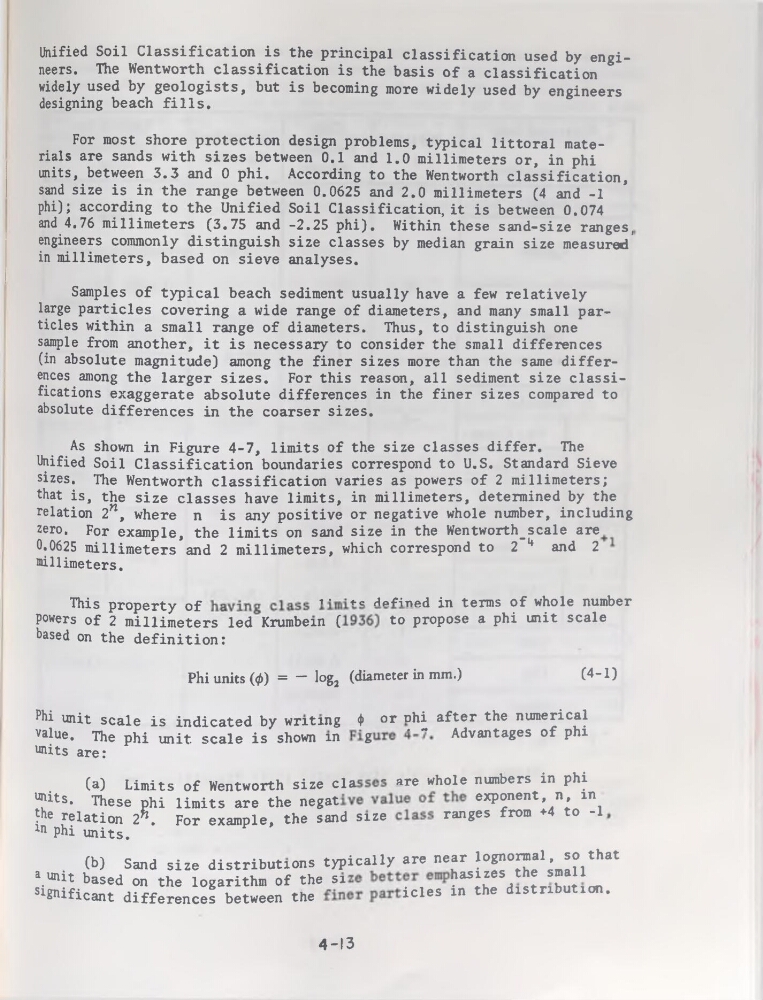
Phi units (0) = — log2 (diameter in mm.)
(4-1)
a, or ohi after the numerical
Phi unit scale is indicated by wnting *
. -
Advantages of phi
value. The phi unit scale is shown m
g
units are:
_ are whole nunbers in phi
(a) Limits of Wentworth size cia
exponent, n, in
units. These phi limits are the negat
ranges from +4 to -1
the relation 2*. For example, the sand size
in phi units.
tvnically are near lognormal, so that
(b) Sand size distributions typical y
hasizes the small
a unit based on the logarithm of the si
icles in the distribution,
significant différences between the
4-13
widely used by geologists, but is becoming more widely used by engineers
designing beach fi 11 s.
For most shore protection design problems, typical littoral materials are sands with sizes between 0.1 and 1.0 millimeters or, in phi
units, between 3.3 and 0 phi. According to the Wentworth classification,
sand size is in the range between 0.0625 and 2.0 millimeters (4 and -1
phi); according to the Unified Soil Classification, it is between 0.074
and 4.76 millimeters (3.75 and -2.25 phi). Within these sand-size ranges,
engineers commonly distinguish size classes by médian grain size measured
in millimeters, based on sieve analyses.
Samples of typical beach sédiment usually hâve a few relatively
large particles covering a wide range of diameters, and many small particles within a small range of diameters. Thus, to distinguish one
sample from another, it is necessary to consider the small différences
(in absolute magnitude) among the finer sizes more than the same différences among the larger sizes. For this reason, ail sédiment size classifications exaggerate absolute différences in the finer sizes compared to
absolute différences in the coarser sizes.
As shown in Figure 4-7, limits of the size classes differ. The
Unified Soil Classification boundaries correspond to U.S. Standard Sieve
sizes. The Wentworth classification varies as powers of 2 millimeters;
that is, the size classes hâve limits, in millimeters, determined by the
relation 2n, where n is any positive or négative whole number, including
zéro. For example, the limits on sand size in the Wentworth_scale are
0.0625 millimeters and 2 millimeters, which correspond to 2 u and 2
millimeters.
,. + c riA-fined in terms of whole number
This property of
t0 propose a phi unit scale
powers of 2 millimeters led Krumbein (
based on the définition:
Phi units (0) = — log2 (diameter in mm.)
(4-1)
a, or ohi after the numerical
Phi unit scale is indicated by wnting *
. -
Advantages of phi
value. The phi unit scale is shown m
g
units are:
_ are whole nunbers in phi
(a) Limits of Wentworth size cia
exponent, n, in
units. These phi limits are the negat
ranges from +4 to -1
the relation 2*. For example, the sand size
in phi units.
tvnically are near lognormal, so that
(b) Sand size distributions typical y
hasizes the small
a unit based on the logarithm of the si
icles in the distribution,
significant différences between the
4-13