

the bottom contours for valid computations. The above assumption also
implies that there is no flooding landward of the shore; thus, there is
a deficiency in the method when substantial flooding occurs.
The bottom contours of the actual seabed are rarely straight and parallel; however, the traverse line can often be oriented so that it is nearly
perpendicular to the contours in an average way. For complex offshore
bathymetry, such an approximation would be invalid. For storms moving
more or less perpendicular to a coastline, the traverse line can be taken
through, or anywhere to the right of, the région of maximum winds, but
never to the left of this région. Many other factors such as the angle
of approach of a storm, the coastline configuration, and inertial effects,
limit the use of such a simple approach.
The computation model given here is based on Bathystrophic Storm Tide
Theory as described by Bodine (1971). Although Bodine applied both manual
and digital computer calculation methods to the open coast storm surge
problem, only the manual method is presented.
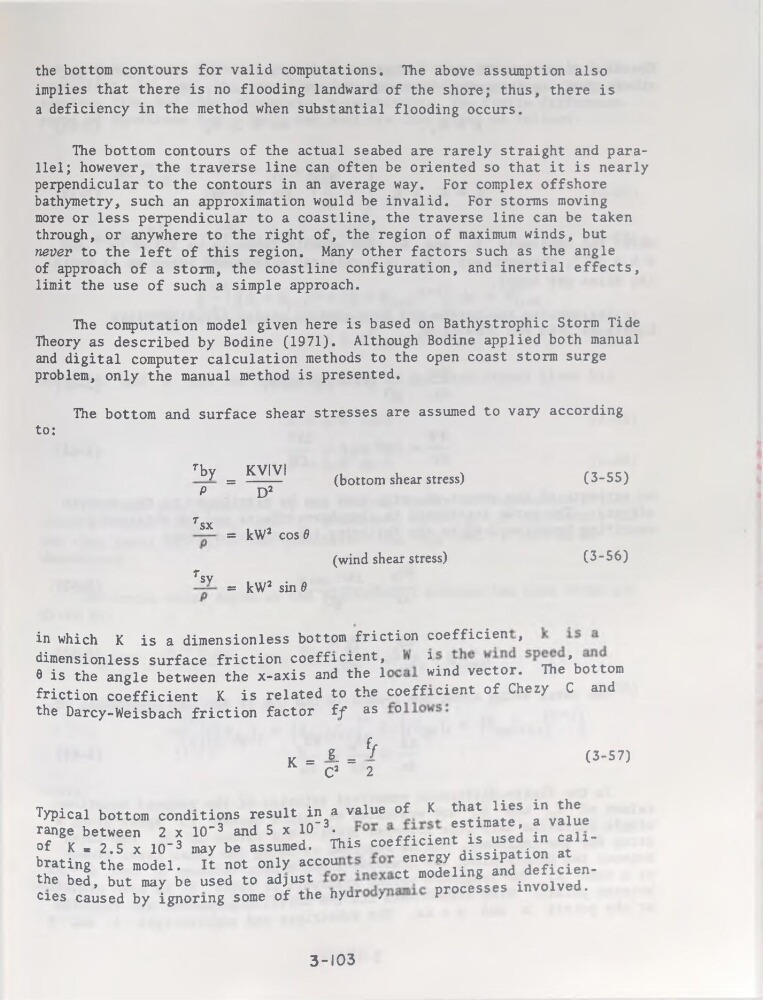
The bottom and surface shear stresses are assumed to vary according
to:
Tby _ KVIVI
P ~ D2
^sx
= kW2 cos 6
rsv = kW2 sin G
(bottom shear stress)
(wind shear stress)
(3-55)
(3-56)
in which K is a dimensionless bottom friction coefficien ,
dimensionless surface friction ?oeffJC^tJ
J,ind vector. The’bottom
6 is the angle between the x-axis and t
.
rh v C and
friction coefficient K is related to the coefficient of Chezy C
the Darcy-Weisbach friction factor ff as 0
v = g. _ {f
(3-57)
K
C’
2
-10"3 and 5 x 10"3.
range between 2 x
.
it in a value of K that lies in the
Typical bottom conditions resuit in,
estimate, a value
□
This coefficient is used in caliof K - 2.5 x 10‘3 may be assumed. Thi
energy dissipation at
brating the model. It not only accou •
ct modeling and deficienthe bed, but may be used to adjust
procJSes involved.
cies caused by ignonng some of the nyai y
3-103
implies that there is no flooding landward of the shore; thus, there is
a deficiency in the method when substantial flooding occurs.
The bottom contours of the actual seabed are rarely straight and parallel; however, the traverse line can often be oriented so that it is nearly
perpendicular to the contours in an average way. For complex offshore
bathymetry, such an approximation would be invalid. For storms moving
more or less perpendicular to a coastline, the traverse line can be taken
through, or anywhere to the right of, the région of maximum winds, but
never to the left of this région. Many other factors such as the angle
of approach of a storm, the coastline configuration, and inertial effects,
limit the use of such a simple approach.
The computation model given here is based on Bathystrophic Storm Tide
Theory as described by Bodine (1971). Although Bodine applied both manual
and digital computer calculation methods to the open coast storm surge
problem, only the manual method is presented.
The bottom and surface shear stresses are assumed to vary according
to:
Tby _ KVIVI
P ~ D2
^sx
= kW2 cos 6
rsv = kW2 sin G
(bottom shear stress)
(wind shear stress)
(3-55)
(3-56)
in which K is a dimensionless bottom friction coefficien ,
dimensionless surface friction ?oeffJC^tJ
J,ind vector. The’bottom
6 is the angle between the x-axis and t
.
rh v C and
friction coefficient K is related to the coefficient of Chezy C
the Darcy-Weisbach friction factor ff as 0
v = g. _ {f
(3-57)
K
C’
2
-10"3 and 5 x 10"3.
range between 2 x
.
it in a value of K that lies in the
Typical bottom conditions resuit in,
estimate, a value
□
This coefficient is used in caliof K - 2.5 x 10‘3 may be assumed. Thi
energy dissipation at
brating the model. It not only accou •
ct modeling and deficienthe bed, but may be used to adjust
procJSes involved.
cies caused by ignonng some of the nyai y
3-103