

observations are insufficient to provide quantitative trends. (Savage,
1957; Fairchild, 1958; Dorrestein, 1962; Galvin and Eagleson, 1965.) À
laboratory study by Saville (1961) indicated that for waves breaking on
a slope there would be a decrease in the mean water level relative to the
stillwater level just prier to breaking, with a maximum dépréssion or setdown at about the breaking point. This study also indicated that from the
breaking point the mean water surface slopes upward to the point of intersection with the shore and has been termed wave setup. Wave setup is
defined as that super--élévation of the mean water level caused by wave
action alone. This phenomenon is related to a conversion of kinetic
energy of wave motion to a quasi-steady potential energy.
Theoretical studies of wave setup hâve been made by Dorrestein (W62),
Fortak (1962), Longuet-Higgins and Stewart (1960, 1962, 1963, 1964), Bowen,
Inman, and Simmons (1968), and Hwang and Divoky (1970). Theoretical developments can account for many of the principal processes, but contain
factors that are often difficult to specify in practical problems.
R.O. Reid (personal communication) has suggested the following approach
for estimating the wave setup at shore, using Longuet-Higgins and Stewart
(1963) theory for the setdown at the breaking zone and solitary wave theory
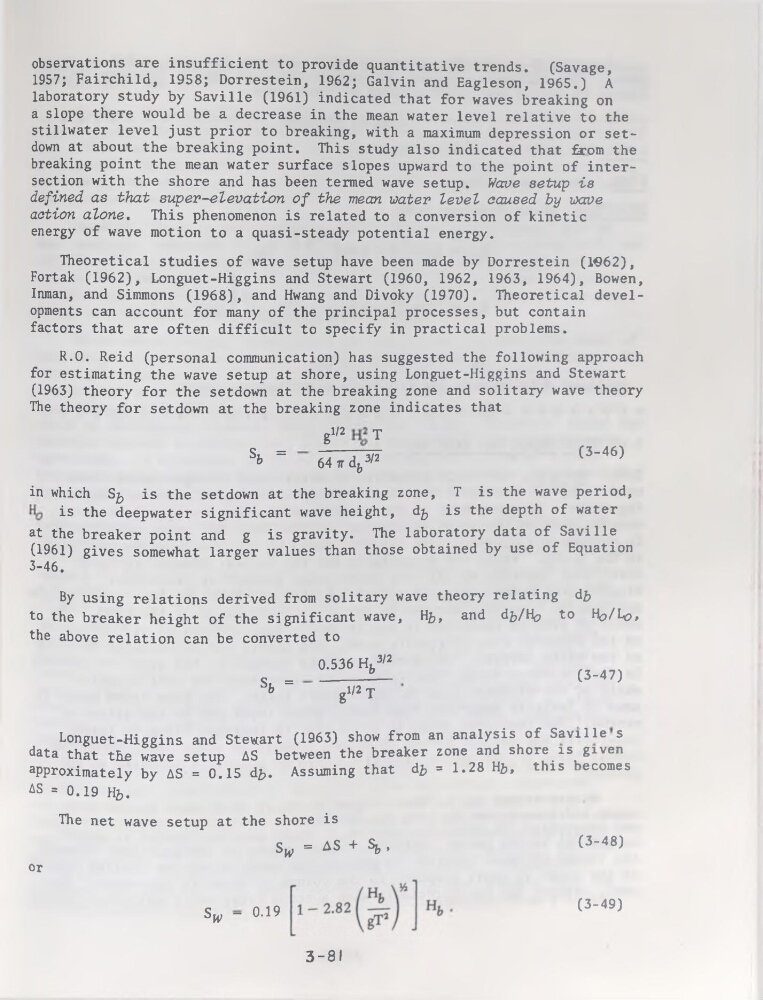
The theory for setdown at the breaking zone indicates that
g1/2
T
S> =
3 3/2
(3-46)
b
64 7rdÎJJ/2
in which S^ is the setdown at the breaking zone, T is the wave period,
is the deepwater significant wave height, dj> is the depth of water
at the breaker point and g is gravity. The laboratory data of Saville
(1961) gives somewhat larger values than those obtained by use of Equation
3-46.
By using relations derîved from solitary wave theory relating db
to the breaker height of the significant wave, Hb, and db/H^ to H^/Lo,
the above relation can be converted to
0.536 Hb312
Sb =
gi/2 T
(3-47)
Longuet-Higgins and Stewart (1963) show from an analysis of Saville s
data that the wave setup AS between the breaker zone and shore is given
approximately by AS = 0.15 dfr. Assuming that db = 1.28 Hb, this becomes
△S = 0.19 Hb.
The net wave setup at the shore is
or
0.19
(3-48)
(3-49)
Sw = AS + % ,
SH> -
3-81
1957; Fairchild, 1958; Dorrestein, 1962; Galvin and Eagleson, 1965.) À
laboratory study by Saville (1961) indicated that for waves breaking on
a slope there would be a decrease in the mean water level relative to the
stillwater level just prier to breaking, with a maximum dépréssion or setdown at about the breaking point. This study also indicated that from the
breaking point the mean water surface slopes upward to the point of intersection with the shore and has been termed wave setup. Wave setup is
defined as that super--élévation of the mean water level caused by wave
action alone. This phenomenon is related to a conversion of kinetic
energy of wave motion to a quasi-steady potential energy.
Theoretical studies of wave setup hâve been made by Dorrestein (W62),
Fortak (1962), Longuet-Higgins and Stewart (1960, 1962, 1963, 1964), Bowen,
Inman, and Simmons (1968), and Hwang and Divoky (1970). Theoretical developments can account for many of the principal processes, but contain
factors that are often difficult to specify in practical problems.
R.O. Reid (personal communication) has suggested the following approach
for estimating the wave setup at shore, using Longuet-Higgins and Stewart
(1963) theory for the setdown at the breaking zone and solitary wave theory
The theory for setdown at the breaking zone indicates that
g1/2
T
S> =
3 3/2
(3-46)
b
64 7rdÎJJ/2
in which S^ is the setdown at the breaking zone, T is the wave period,
is the deepwater significant wave height, dj> is the depth of water
at the breaker point and g is gravity. The laboratory data of Saville
(1961) gives somewhat larger values than those obtained by use of Equation
3-46.
By using relations derîved from solitary wave theory relating db
to the breaker height of the significant wave, Hb, and db/H^ to H^/Lo,
the above relation can be converted to
0.536 Hb312
Sb =
gi/2 T
(3-47)
Longuet-Higgins and Stewart (1963) show from an analysis of Saville s
data that the wave setup AS between the breaker zone and shore is given
approximately by AS = 0.15 dfr. Assuming that db = 1.28 Hb, this becomes
△S = 0.19 Hb.
The net wave setup at the shore is
or
0.19
(3-48)
(3-49)
Sw = AS + % ,
SH> -
3-81