

the Great Lakes, is subject to greater wind-induced surface fluctuations,
that is, wind setup, than any other Lake. Wind setup is discussed in
Section 3.86, Storm Surge and Wind Setup.
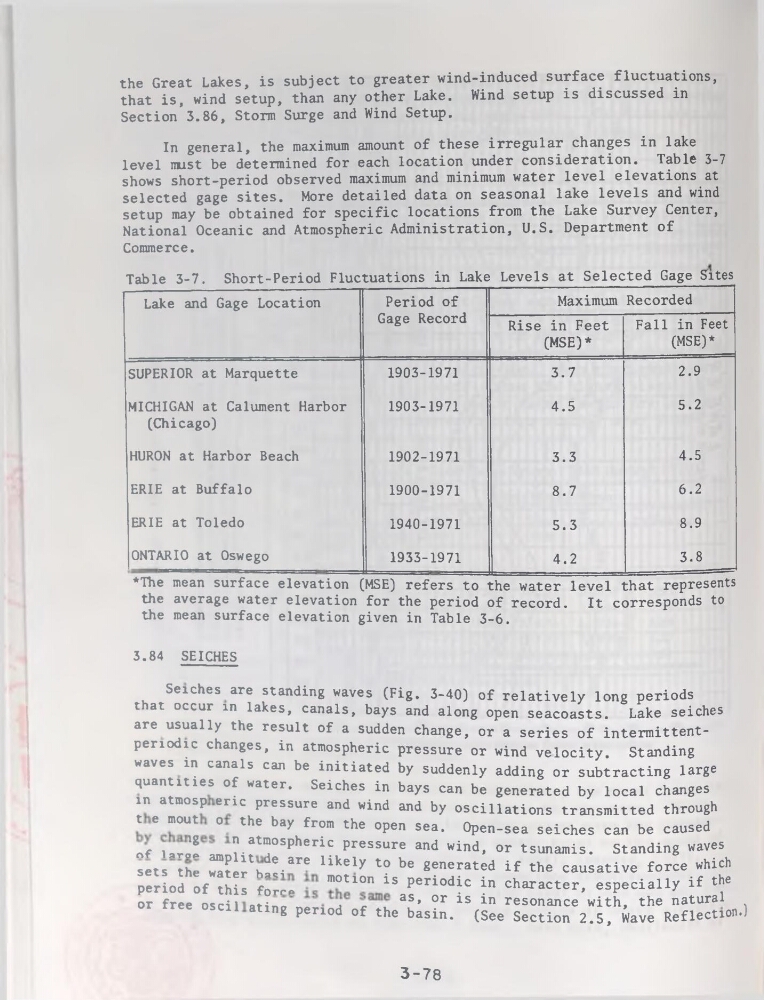
In general, the maximum amount of these irregular changes in lake
level must be determined for each location under considération. Table 3-7
shows short-period observed maximum and minimum water level élévations at
selected gage sites. More detailed data on seasonal lake levels and wind
setup may be obtained for spécifie locations from the Lake Survey Center,
National Oceanic and Atmospheric Administration, U.S. Department of
Commerce.
Table 3-7. Short-Period Fluctuations in Lake Levels at Selected Gage Sites
Lake and Gage Location
Period of
Gage Record
Maximum Recorded
Rise in Feet
(MSE)*
Fall in Feet
(MSE)*
SUPERIOR at Marquette
1903-1971
3.7
2.9
MICHIGAN at Calument Harbor
(Chicago)
1903-1971
4.5
5.2
HURON at Harbor Beach
1902-1971
3.3
4.5
ERIE at Buffalo
1900-1971
8.7
6.2
ERIE at Toledo
1940-1971
5.3
8.9
ONTARIO at Oswego
1933-1971
4.2
3.8
*The mean surface élévation (MSE) refers to the water level that represents
the average water élévation for the period of record. It corresponds to
the mean surface élévation given in Table 3-6.
3.84 SEICHES
Standing
Seiches are standing waves (Fig. 3-40) of relatively long periods
that occur in lakes, canals, bays and along open seacoasts. Lake seiches
are usually the resuit of a sudden change, or a sériés of intermittentperiodic changes, in atmospheric pressure or wind velocity. Standing
waves in canals can be initiated by suddenly adding or subtracting large
quantities of water. Seiches in bays can be generated by local changes
in atmosp eric pressure and wind and by oscillations transmitted through
t e moût o the bay from the open sea. Open-sea seiches can be caused
nf iar ?• atmospheric pressure and wind, or tsunamis. Standing waves
sets the ^Lith^are likely t0 be generated if the causative force which
period of this forcp
m°tl0n is Periodic in character, especially if the
or free oscH atïna
aS’ °r is in résonance with, the natural
‘ ng period of the basin. (See Section 2.5, Wave Réfaction.)
3-78
that is, wind setup, than any other Lake. Wind setup is discussed in
Section 3.86, Storm Surge and Wind Setup.
In general, the maximum amount of these irregular changes in lake
level must be determined for each location under considération. Table 3-7
shows short-period observed maximum and minimum water level élévations at
selected gage sites. More detailed data on seasonal lake levels and wind
setup may be obtained for spécifie locations from the Lake Survey Center,
National Oceanic and Atmospheric Administration, U.S. Department of
Commerce.
Table 3-7. Short-Period Fluctuations in Lake Levels at Selected Gage Sites
Lake and Gage Location
Period of
Gage Record
Maximum Recorded
Rise in Feet
(MSE)*
Fall in Feet
(MSE)*
SUPERIOR at Marquette
1903-1971
3.7
2.9
MICHIGAN at Calument Harbor
(Chicago)
1903-1971
4.5
5.2
HURON at Harbor Beach
1902-1971
3.3
4.5
ERIE at Buffalo
1900-1971
8.7
6.2
ERIE at Toledo
1940-1971
5.3
8.9
ONTARIO at Oswego
1933-1971
4.2
3.8
*The mean surface élévation (MSE) refers to the water level that represents
the average water élévation for the period of record. It corresponds to
the mean surface élévation given in Table 3-6.
3.84 SEICHES
Standing
Seiches are standing waves (Fig. 3-40) of relatively long periods
that occur in lakes, canals, bays and along open seacoasts. Lake seiches
are usually the resuit of a sudden change, or a sériés of intermittentperiodic changes, in atmospheric pressure or wind velocity. Standing
waves in canals can be initiated by suddenly adding or subtracting large
quantities of water. Seiches in bays can be generated by local changes
in atmosp eric pressure and wind and by oscillations transmitted through
t e moût o the bay from the open sea. Open-sea seiches can be caused
nf iar ?• atmospheric pressure and wind, or tsunamis. Standing waves
sets the ^Lith^are likely t0 be generated if the causative force which
period of this forcp
m°tl0n is Periodic in character, especially if the
or free oscH atïna
aS’ °r is in résonance with, the natural
‘ ng period of the basin. (See Section 2.5, Wave Réfaction.)
3-78