

Theoretical and applied research dealing with tsunami problems has
been greatly intensified since 1960. Preisendorfer (1971) lists more than
60 significant theoretical papers published since 1960. The list does not
include observational papers concemed with the waming System.
3.83 LAKE LEVEES
Lakes hâve insignificant tidal variations, but are subject to seasonal and annual hydrologie changes in water level and to water level
changes caused by wind setup, barometric pressure variations, and seiches.
Additionally some lakes are subject to occasional water level changes by
regulatory control works.
Water surface élévations of the Great Lakes vary irregularly from
year to year. During each year, the water surfaces consistently fall to
their lowest stages during the winter and rise to their highest stages
during the summer. Nearly ail précipitation in the watershed areas during
the winter is snow or rainfall transformed to ice. When the température
begins to rise there is substantial runoff - thus the higher stages in the
summer. Typical seasonal and yearly changes in water levels for Lake Erie
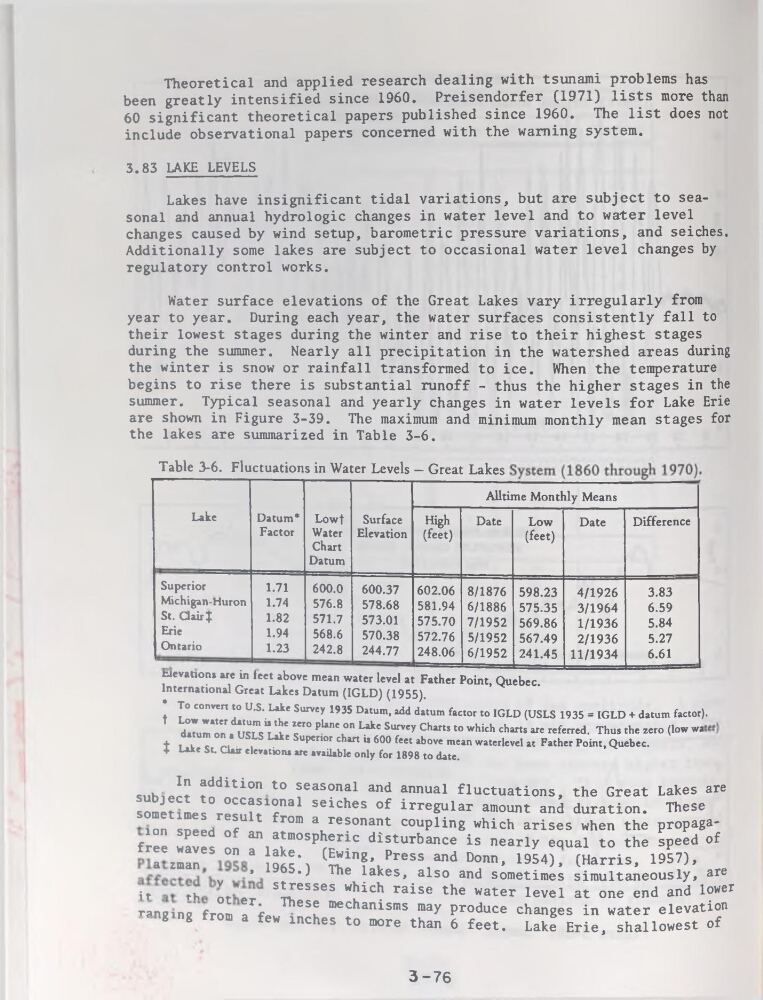
are shown in Figure 3-39. The maximum and minimum monthly mean stages for
the lakes are summarized in Table 3-6.
Table 3-6. Fluctuations in Water Levels — Great Lakes
Lake
Datum*
Factor
Lowf
Water
Chart
Datum
Surface
Elévation
Alltime Monthly Means
High
(feet)
Date
Low
(feet)
Date
Différence
Superior
1.71
600.0
600.37 602.06 8/1876 598.23
4/1926
3.83
Michigan-Huron
1.74
576.8
578.68
581.94 6/1886 575.35
3/1964
6.59
St. Clair J
1.82
571.7
573.01
575.70 7/1952 569.86
1/1936
5.84
Erie
1.94
568.6
570.38
572.76 5/1952 567.49
2/1936
5.27
Ontario
1.23
242.8
244.77
248.06 6/1952 241.45 11/1934
6.61
élévations are in feet above mean water level at Father Point, Quebec.
International Great Lakes Datum (IGLD) (1955).
* To convert to U.S. Lake Survey 1935 Datum, add datum factor to IGLD (USLS 1935 = IGLD + datum factor),
f Low water datum ù the zéro plane on Lake Survey Charts to which charts are referred. Thus the zéro (low wa
datum on a USLS Lake Superior ch art is 600 feet above mean waterlevel at Father Point, Quebec.
t Lake St. Clair élévations are available only for 1898 to date.
Lakes are
These
propagaIn addition to seasonal and annual fluctuations, the Great
subject to occasional seiches of irregular amount and duration,
sometimes resuit from a résonant coupling which arises when the
ion speed of an atmospheric disturbance is nearly equal to the speed of
free waves on a lake. (Ewing, Press and Donn, 1954), (Harris, 1957),
a zman
,1965.) The lakes, also and sometimes simultaneously, are
it
th V
stresses which raise the water level at one end and lower
mnoinn r Ot eri- ^ese nechanisms may produce changes in water élévation
-nging from a few mehes to more than 6 feet. Lake Erie, shallowest of
3-76
been greatly intensified since 1960. Preisendorfer (1971) lists more than
60 significant theoretical papers published since 1960. The list does not
include observational papers concemed with the waming System.
3.83 LAKE LEVEES
Lakes hâve insignificant tidal variations, but are subject to seasonal and annual hydrologie changes in water level and to water level
changes caused by wind setup, barometric pressure variations, and seiches.
Additionally some lakes are subject to occasional water level changes by
regulatory control works.
Water surface élévations of the Great Lakes vary irregularly from
year to year. During each year, the water surfaces consistently fall to
their lowest stages during the winter and rise to their highest stages
during the summer. Nearly ail précipitation in the watershed areas during
the winter is snow or rainfall transformed to ice. When the température
begins to rise there is substantial runoff - thus the higher stages in the
summer. Typical seasonal and yearly changes in water levels for Lake Erie
are shown in Figure 3-39. The maximum and minimum monthly mean stages for
the lakes are summarized in Table 3-6.
Table 3-6. Fluctuations in Water Levels — Great Lakes
Lake
Datum*
Factor
Lowf
Water
Chart
Datum
Surface
Elévation
Alltime Monthly Means
High
(feet)
Date
Low
(feet)
Date
Différence
Superior
1.71
600.0
600.37 602.06 8/1876 598.23
4/1926
3.83
Michigan-Huron
1.74
576.8
578.68
581.94 6/1886 575.35
3/1964
6.59
St. Clair J
1.82
571.7
573.01
575.70 7/1952 569.86
1/1936
5.84
Erie
1.94
568.6
570.38
572.76 5/1952 567.49
2/1936
5.27
Ontario
1.23
242.8
244.77
248.06 6/1952 241.45 11/1934
6.61
élévations are in feet above mean water level at Father Point, Quebec.
International Great Lakes Datum (IGLD) (1955).
* To convert to U.S. Lake Survey 1935 Datum, add datum factor to IGLD (USLS 1935 = IGLD + datum factor),
f Low water datum ù the zéro plane on Lake Survey Charts to which charts are referred. Thus the zéro (low wa
datum on a USLS Lake Superior ch art is 600 feet above mean waterlevel at Father Point, Quebec.
t Lake St. Clair élévations are available only for 1898 to date.
Lakes are
These
propagaIn addition to seasonal and annual fluctuations, the Great
subject to occasional seiches of irregular amount and duration,
sometimes resuit from a résonant coupling which arises when the
ion speed of an atmospheric disturbance is nearly equal to the speed of
free waves on a lake. (Ewing, Press and Donn, 1954), (Harris, 1957),
a zman
,1965.) The lakes, also and sometimes simultaneously, are
it
th V
stresses which raise the water level at one end and lower
mnoinn r Ot eri- ^ese nechanisms may produce changes in water élévation
-nging from a few mehes to more than 6 feet. Lake Erie, shallowest of
3-76