

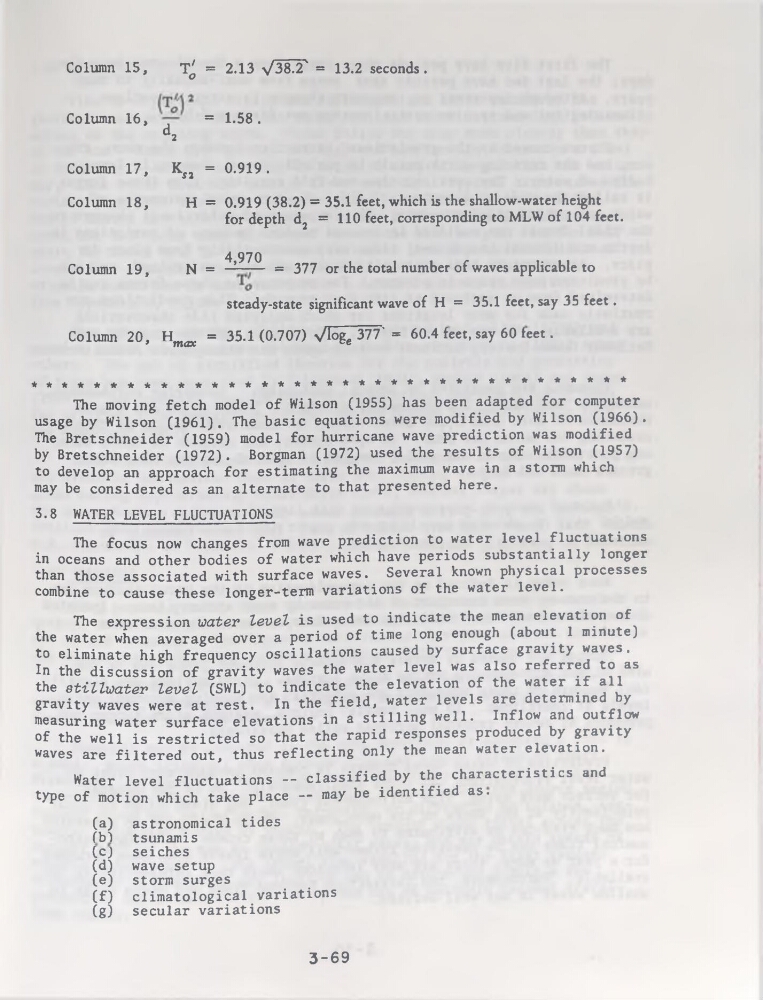
Column 15,
Tô = 2.13 x/38.2^ = 13.2 seconds.
Column 16,
=
d2
1.58.
Column 17,
K» = 0.919.
Column 18,
H = 0.919 (38.2) = 35.1 feet, which is the shallow-water height
for depth d2 = 110 feet, corresponding to MLW of 104 feet.
Column 19,
N =
4 970
—L—— = 377 Or the total number of waves applicable to
steady-state significant wave of H = 35.1 feet, say 35 feet.
Column 20, H
=
max
35.1 (0.707) >/logc 377' = 60.4 feet, say 60 feet.
*************************************
The moving fetch model of Wilson (1955) has been adapted for computer
usage by Wilson (1961). The basic équations were modified by Wilson (1966).
The Bretschneider (1959) model for hurricane wave prédiction was modified
by Bretschneider (1972). Borgman (1972) used the results of Wilson (1957)
to develop an approach for estimating the maximum wave in a storm which
may be considered as an altemate to that presented here.
3.8 WATER LEVEL FLUCTUATIONS
The focus now changes from wave prédiction to water level fluctuations
in océans and other bodies of water which hâve periods substantially longer
than those associated with surface waves. Several known physical processes
combine to cause these longer-term variations of the water level.
The expression water level is used to indicate the mean élévation of
the water when averaged over a period of time long enough (about 1 minute)
to eliminate high frequency oscillations caused by surface gravity waves.
In the discussion of gravity waves the water level was also referred to as
the stillwater level (SWL) to indicate the élévation of the water if ail
gravity waves were at rest. In the field, water levels are determined by
measuring water surface élévations in a stilling well. Inflow and outflow
of the well is restricted so that the rapid responses produced by gravity
waves are filtered out, thus reflecting only the mean water élévation.
Water level fluctuations -- classified by the characteristies and
type of motion which take place — may be identified as.
(a) astronomical tides
(b) tsunamis
(c) seiches
(d) wave setup
(e) storm surges
(f) climatological variations
(g) secular variations
3-69
Tô = 2.13 x/38.2^ = 13.2 seconds.
Column 16,
=
d2
1.58.
Column 17,
K» = 0.919.
Column 18,
H = 0.919 (38.2) = 35.1 feet, which is the shallow-water height
for depth d2 = 110 feet, corresponding to MLW of 104 feet.
Column 19,
N =
4 970
—L—— = 377 Or the total number of waves applicable to
steady-state significant wave of H = 35.1 feet, say 35 feet.
Column 20, H
=
max
35.1 (0.707) >/logc 377' = 60.4 feet, say 60 feet.
*************************************
The moving fetch model of Wilson (1955) has been adapted for computer
usage by Wilson (1961). The basic équations were modified by Wilson (1966).
The Bretschneider (1959) model for hurricane wave prédiction was modified
by Bretschneider (1972). Borgman (1972) used the results of Wilson (1957)
to develop an approach for estimating the maximum wave in a storm which
may be considered as an altemate to that presented here.
3.8 WATER LEVEL FLUCTUATIONS
The focus now changes from wave prédiction to water level fluctuations
in océans and other bodies of water which hâve periods substantially longer
than those associated with surface waves. Several known physical processes
combine to cause these longer-term variations of the water level.
The expression water level is used to indicate the mean élévation of
the water when averaged over a period of time long enough (about 1 minute)
to eliminate high frequency oscillations caused by surface gravity waves.
In the discussion of gravity waves the water level was also referred to as
the stillwater level (SWL) to indicate the élévation of the water if ail
gravity waves were at rest. In the field, water levels are determined by
measuring water surface élévations in a stilling well. Inflow and outflow
of the well is restricted so that the rapid responses produced by gravity
waves are filtered out, thus reflecting only the mean water élévation.
Water level fluctuations -- classified by the characteristies and
type of motion which take place — may be identified as.
(a) astronomical tides
(b) tsunamis
(c) seiches
(d) wave setup
(e) storm surges
(f) climatological variations
(g) secular variations
3-69