

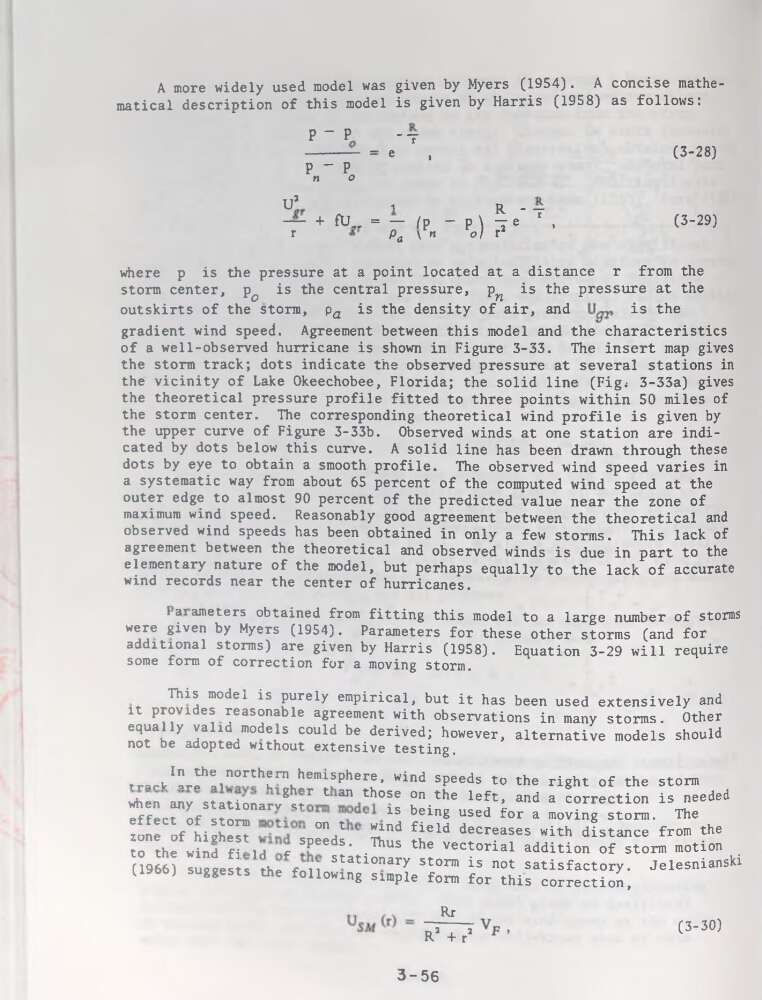
A more widely used model was given by Myers (1954). A concise mathematical description of this model is given by Harris (1958) as follows:
P "P
'T
---------- -- = e
,
(3-28)
P “ P
n
o
U3
1
R - -
— + fü„ = - Zp - P \ -î e ' ,
(3-29)
r
pa \n
o)
r2
where p is the pressure at a point located at a distance r from the
storm center, p$ is the central pressure, p^ is the pressure at the
outskirts of the storm, pa is the density of air, and
is the
gradient wind speed. Agreement between this model and the characteristics
of a well-observed hurricane is shown in Figure 3-33. The insert map gives
the storm track; dots indicate the observed pressure at several stations in
the vicinity of Lake Okeechobee, Florida; the solid line (Fig; 3-33a) gives
the theoretical pressure profile fitted to three points within 50 miles of
the storm center. The corresponding theoretical wind profile is given by
the upper curve of Figure 3-33b. Observed winds at one station are indicated by dots below this curve. A solid line has been drawn through these
dots by eye to obtain a smooth profile. The observed wind speed varies in
a systematic way from about 65 percent of the computed wind speed at the
outer edge to almost 90 percent of the predicted value near the zone of
maximum wind speed. Reasonably good agreement between the theoretical and
observed wind speeds has been obtained in only a few storms. This lack of
agreement between the theoretical and observed winds is due in part to the
elementary nature of the model, but perhaps equally to the lack of accurate
wind records near the center of hurricanes.
laiameters obtained from fitting this model to a large number of storms
were given by Myers (1954). Parameters for these other storms (and for
additional storms) are given by Harris (1958). Equation 3-29 will require
some form of correction for a moving storm.
This model is purely empirical, but it has been used extensively and
it provides reasonable agreement with observations in many storms. Other
equally valid models could be derived; however, alternative models should
not be adopted without extensive testing.
,„rvIh!hLnOrth!rn?eml. 5phere- wind sPeeds to the right of the storm
when any stationarv^t* 1 “ those on the left, and a correction is needed
effect"of sto»
15 bein8 used for a moving storm. The
zone of hieîe«
°V
^nd field decreasea with distance from the
to the wind f Id F SPeeds’ .^us the vectorial addition of storm motion
(1966) suegests the Fnii stationary storm is not satisfactory. Jelesnianski
(1966) suggests the followmg simple form for this correction,
Rr
R3 + r3
(3-30)
3-56
P "P
'T
---------- -- = e
,
(3-28)
P “ P
n
o
U3
1
R - -
— + fü„ = - Zp - P \ -î e ' ,
(3-29)
r
pa \n
o)
r2
where p is the pressure at a point located at a distance r from the
storm center, p$ is the central pressure, p^ is the pressure at the
outskirts of the storm, pa is the density of air, and
is the
gradient wind speed. Agreement between this model and the characteristics
of a well-observed hurricane is shown in Figure 3-33. The insert map gives
the storm track; dots indicate the observed pressure at several stations in
the vicinity of Lake Okeechobee, Florida; the solid line (Fig; 3-33a) gives
the theoretical pressure profile fitted to three points within 50 miles of
the storm center. The corresponding theoretical wind profile is given by
the upper curve of Figure 3-33b. Observed winds at one station are indicated by dots below this curve. A solid line has been drawn through these
dots by eye to obtain a smooth profile. The observed wind speed varies in
a systematic way from about 65 percent of the computed wind speed at the
outer edge to almost 90 percent of the predicted value near the zone of
maximum wind speed. Reasonably good agreement between the theoretical and
observed wind speeds has been obtained in only a few storms. This lack of
agreement between the theoretical and observed winds is due in part to the
elementary nature of the model, but perhaps equally to the lack of accurate
wind records near the center of hurricanes.
laiameters obtained from fitting this model to a large number of storms
were given by Myers (1954). Parameters for these other storms (and for
additional storms) are given by Harris (1958). Equation 3-29 will require
some form of correction for a moving storm.
This model is purely empirical, but it has been used extensively and
it provides reasonable agreement with observations in many storms. Other
equally valid models could be derived; however, alternative models should
not be adopted without extensive testing.
,„rvIh!hLnOrth!rn?eml. 5phere- wind sPeeds to the right of the storm
when any stationarv^t* 1 “ those on the left, and a correction is needed
effect"of sto»
15 bein8 used for a moving storm. The
zone of hieîe«
°V
^nd field decreasea with distance from the
to the wind f Id F SPeeds’ .^us the vectorial addition of storm motion
(1966) suegests the Fnii stationary storm is not satisfactory. Jelesnianski
(1966) suggests the followmg simple form for this correction,
Rr
R3 + r3
(3-30)
3-56