

in which wave energy is added due to wind stress and subtracted due to
bottom friction and percolation. This method uses deepwater forecasting
relationships originally developed by Sverdrup and Munk (1947) and revised
by Bretschneider (1951) to détermine the energy added due to wind stress.
Wave energy lost due to bottom friction and percolation is determined from
the relationships developed by Bretschneider and Reid (1953) . Résultant
wave heights and periods are obtained by combining the above relationships
by numerical methods. The basic assumptions applicable to development of
deepwater wave-génération relationships (Bretschneider, 1952b) as well as
development of relationships for bottom friction loss (Putnam and Johnsqn,
1949) and percolation loss (Putnam, 1949) apply.
The choice of an appropriate bottom friction factor f^* for use in
the forecasting technique is a matter of judgement; a value of fy? = 0.01
has been used for the préparation of Figures 3-21 through 3-30 which are
forecasting curves for shallow-water areas of constant depth. These curves,
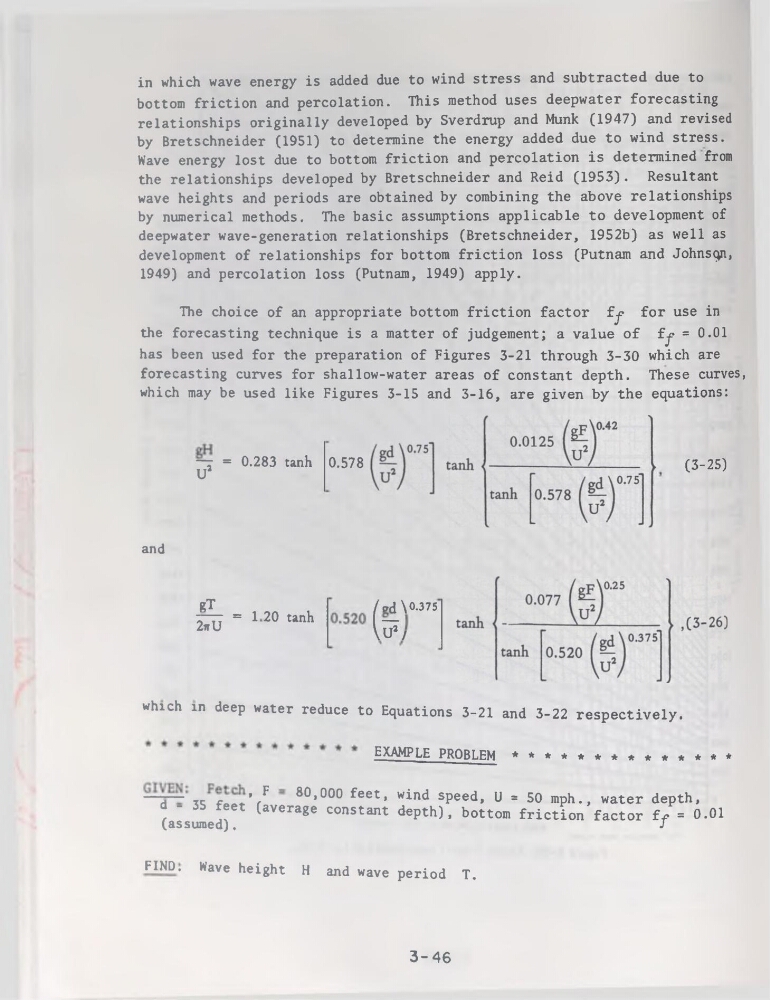
which may be used like Figures 3-15 and 3-16, are given by the équations:
— = 0.283 tanh
U1
0.578
(3-25)
and
gT
T77 = 12°
2n U
tanh
(
pd \0.375
—
U2/
which in deep water reduce to Equations 3-21 and 3-22 respectively.
EXAMPLE PROBLEM **************
—’ J
80>000 feet, wind speed, U = 50 mph., water depth,
d - 35 feet (average constant depth), bottom friction factor fr = 0.01
(assumed).
J
HND. Wave height H and wave period T.
3-46
bottom friction and percolation. This method uses deepwater forecasting
relationships originally developed by Sverdrup and Munk (1947) and revised
by Bretschneider (1951) to détermine the energy added due to wind stress.
Wave energy lost due to bottom friction and percolation is determined from
the relationships developed by Bretschneider and Reid (1953) . Résultant
wave heights and periods are obtained by combining the above relationships
by numerical methods. The basic assumptions applicable to development of
deepwater wave-génération relationships (Bretschneider, 1952b) as well as
development of relationships for bottom friction loss (Putnam and Johnsqn,
1949) and percolation loss (Putnam, 1949) apply.
The choice of an appropriate bottom friction factor f^* for use in
the forecasting technique is a matter of judgement; a value of fy? = 0.01
has been used for the préparation of Figures 3-21 through 3-30 which are
forecasting curves for shallow-water areas of constant depth. These curves,
which may be used like Figures 3-15 and 3-16, are given by the équations:
— = 0.283 tanh
U1
0.578
(3-25)
and
gT
T77 = 12°
2n U
tanh
(
pd \0.375
—
U2/
which in deep water reduce to Equations 3-21 and 3-22 respectively.
EXAMPLE PROBLEM **************
—’ J
80>000 feet, wind speed, U = 50 mph., water depth,
d - 35 feet (average constant depth), bottom friction factor fr = 0.01
(assumed).
J
HND. Wave height H and wave period T.
3-46