

(c)
Waves are completely absorbed at shorelines.
Fetch distances determined in this manner usually are less than those
based on maximum straight-line distances over open water. This is true
because the width of the fetch places restrictions on the total amount of
energy transferred from wind to water until the fetch width exceeds twice
the fetch length.
While 6° spacing of the radiais is used in this example, any other
angular spacing could be used in the same procedure.
3.5 SIMPLIFIED WAVE-PREDICTION MODELS
Use of the wave-prediction models discussed in Section 3.3, Wave
Field, requires an enormous computational effort and more meteorological
data than one is likely to find outside of a major forecasting center.
The Fleet Numerical Weather Center, Monterey, California began using this
model on an experimental basis for a small part of the globe early in 1972.
Expansion to larger régions is planned. Wave prédiction begins with a computation of the existing wave field (often called a zero-time prédiction),
and continues with a calculation of the effects of predicted winds on the
waves. A few years after this System is operational, it should be possible
to supply the needs for wave-hindcast statistics by compilations of zerotime prédictions. In the meantime, engineers who require wave statistics
derived by hindcasting techniques for design considération must accept
simpler techniques.
Computational effort required for the model discussed in Section 3.31,
Development of a Wave Field, can be greatly reduced by the use of simplified assumptions with only a slight loss in accuracy for wave height calculations, but sometimes with significant loss of detail on the distribution of wave energy with frequency. One commonly used approach is to
assume that both duration and fetch are large enough to permit an equilibrium State between the mean wind, turbulence, and waves. If this
condition exists, ail other variables are determined by the wind speed.
Pierson and Moskowitz (1964) consider three analytic expressions which
satisfy ail of the theoretical constraints for an equilibrium spectrum.
Empirical data, described by Moskowitz (1964) were used to show that the
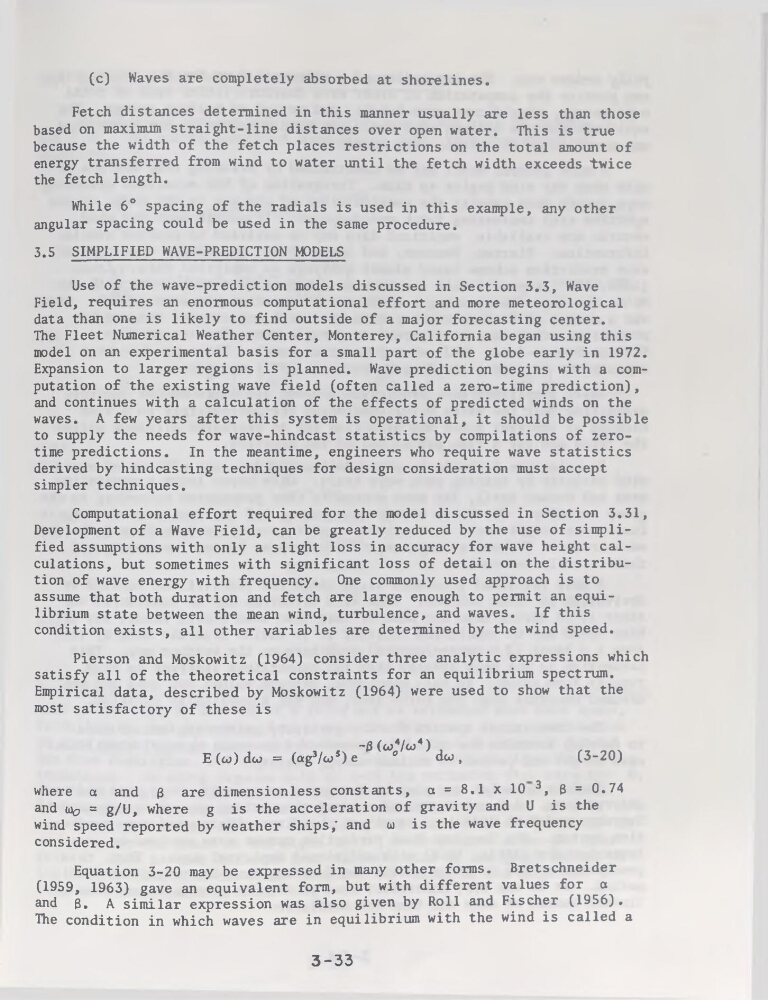
most satisfactory of these is
-0 (o>4/cü4 )
E (cü) da> = (ag3/cos) e
0
dw ,
(3-20)
where a and g are dimensionless constants, a = 8.1 x 10 3, B = 0.74
and (üq = g/U, where g is the accélération of gravity and U is the
wind speed reported by weather ships,' and œ is the wave frequency
considered.
Equation 3-20 may be expressed in many other forms. Bretschneider
(1959, 1963) gave an équivalent form, but with different values for a
and B. A similar expression was also given by Roll and Fischer (1956).
The condition in which waves are in equilibrium with the wind is called a
3-33
Waves are completely absorbed at shorelines.
Fetch distances determined in this manner usually are less than those
based on maximum straight-line distances over open water. This is true
because the width of the fetch places restrictions on the total amount of
energy transferred from wind to water until the fetch width exceeds twice
the fetch length.
While 6° spacing of the radiais is used in this example, any other
angular spacing could be used in the same procedure.
3.5 SIMPLIFIED WAVE-PREDICTION MODELS
Use of the wave-prediction models discussed in Section 3.3, Wave
Field, requires an enormous computational effort and more meteorological
data than one is likely to find outside of a major forecasting center.
The Fleet Numerical Weather Center, Monterey, California began using this
model on an experimental basis for a small part of the globe early in 1972.
Expansion to larger régions is planned. Wave prédiction begins with a computation of the existing wave field (often called a zero-time prédiction),
and continues with a calculation of the effects of predicted winds on the
waves. A few years after this System is operational, it should be possible
to supply the needs for wave-hindcast statistics by compilations of zerotime prédictions. In the meantime, engineers who require wave statistics
derived by hindcasting techniques for design considération must accept
simpler techniques.
Computational effort required for the model discussed in Section 3.31,
Development of a Wave Field, can be greatly reduced by the use of simplified assumptions with only a slight loss in accuracy for wave height calculations, but sometimes with significant loss of detail on the distribution of wave energy with frequency. One commonly used approach is to
assume that both duration and fetch are large enough to permit an equilibrium State between the mean wind, turbulence, and waves. If this
condition exists, ail other variables are determined by the wind speed.
Pierson and Moskowitz (1964) consider three analytic expressions which
satisfy ail of the theoretical constraints for an equilibrium spectrum.
Empirical data, described by Moskowitz (1964) were used to show that the
most satisfactory of these is
-0 (o>4/cü4 )
E (cü) da> = (ag3/cos) e
0
dw ,
(3-20)
where a and g are dimensionless constants, a = 8.1 x 10 3, B = 0.74
and (üq = g/U, where g is the accélération of gravity and U is the
wind speed reported by weather ships,' and œ is the wave frequency
considered.
Equation 3-20 may be expressed in many other forms. Bretschneider
(1959, 1963) gave an équivalent form, but with different values for a
and B. A similar expression was also given by Roll and Fischer (1956).
The condition in which waves are in equilibrium with the wind is called a
3-33