

Horizontal pressure gradients arise in the atmosphère primarily
because of density différences, which in tum are generated primarily by
température différences. Wind results from nature’s efforts to eliminate
the pressure gradients, but is modified by many other factors.
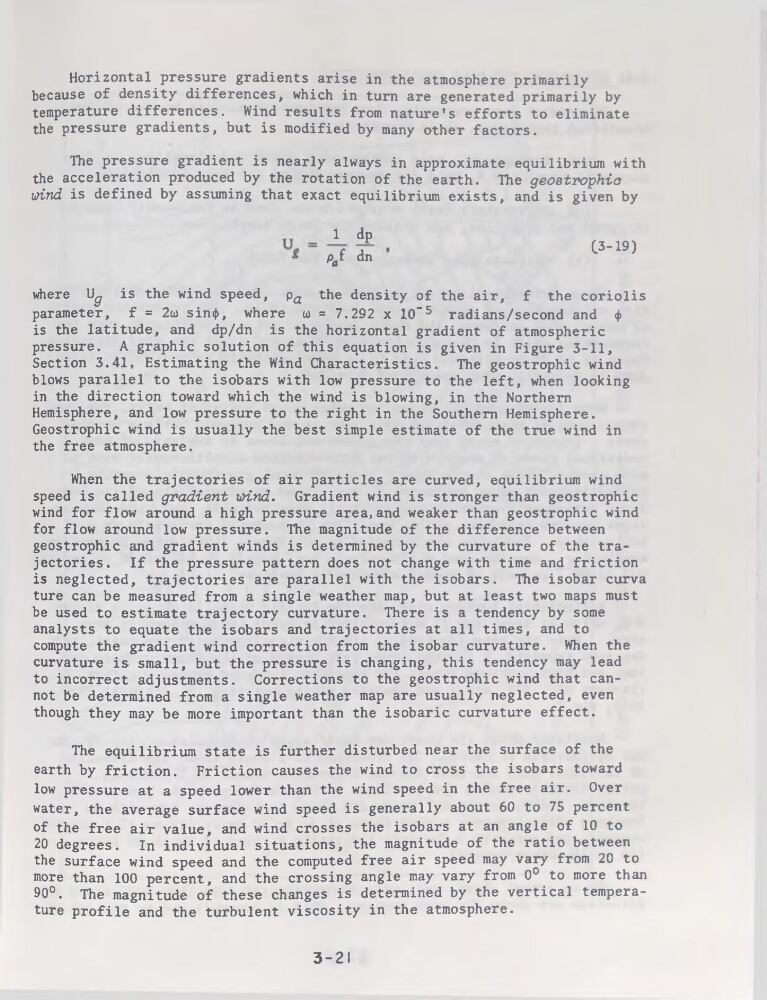
The pressure gradient is nearly always in approximate equilibrium with
the accélération produced by the rotation of the earth. The geostrophic
wind is defined by assuming that exact equilibrium exists, and is given by
1 dp
pof dn
C3-19)
where Ug is the wind speed, pa the density of the air, f the coriolis
parameter, f = 2œ sin<}>, where tü = 7.292 x 10"5 radians/second and 4»
is the latitude, and dp/dn is the horizontal gradient of atmospheric
pressure. A graphie solution of this équation is given in Figure 3-11,
Section 3.41, Estimating the Wind Characteristics. The geostrophic wind
blows parallel to the isobars with low pressure to the left, when looking
in the direction toward which the wind is blowing, in the Northern
Hemisphere, and low pressure to the right in the Southern Hemisphere.
Geostrophic wind is usually the best simple estimate of the true wind in
the free atmosphère.
When the trajectories of air particles are curved, equilibrium wind
speed is called gradient wind. Gradient wind is stronger than geostrophic
wind for flow around a high pressure area,and weaker than geostrophic wind
for flow around low pressure. The magnitude of the différence between
geostrophic and gradient winds is determined by the curvature of the trajectories. If the pressure pattern does not change with time and friction
is neglected, trajectories are parallel with the isobars. The isobar curva
ture can be measured from a single weather map, but at least two maps must
be used to estimate trajectory curvature. There is a tendency by some
analysts to equate the isobars and trajectories at ail times, and to
compute the gradient wind correction from the isobar curvature. When the
curvature is small, but the pressure is changing, this tendency may lead
to incorrect adjustments. Corrections to the geostrophic wind that cannot be determined from a single weather map are usually neglected, even
though they may be more important than the isobaric curvature effect.
The equilibrium State is further disturbed near the surface of the
earth by friction. Friction causes the wind to cross the isobars toward
low pressure at a speed lower than the wind speed in the free air. Over
water, the average surface wind speed is generally about 60 to 75 percent
of the free air value, and wind crosses the isobars at an angle of 10 to
20 degrees. In individual situations, the magnitude of the ratio between
the surface wind speed and the computed free air speed may vary from 20 to
more than 100 percent, and the Crossing angle may vary from 0° to more than
90°. The magnitude of these changes is determined by the vertical température profile and the turbulent viscosity in the atmosphère.
3-21
because of density différences, which in tum are generated primarily by
température différences. Wind results from nature’s efforts to eliminate
the pressure gradients, but is modified by many other factors.
The pressure gradient is nearly always in approximate equilibrium with
the accélération produced by the rotation of the earth. The geostrophic
wind is defined by assuming that exact equilibrium exists, and is given by
1 dp
pof dn
C3-19)
where Ug is the wind speed, pa the density of the air, f the coriolis
parameter, f = 2œ sin<}>, where tü = 7.292 x 10"5 radians/second and 4»
is the latitude, and dp/dn is the horizontal gradient of atmospheric
pressure. A graphie solution of this équation is given in Figure 3-11,
Section 3.41, Estimating the Wind Characteristics. The geostrophic wind
blows parallel to the isobars with low pressure to the left, when looking
in the direction toward which the wind is blowing, in the Northern
Hemisphere, and low pressure to the right in the Southern Hemisphere.
Geostrophic wind is usually the best simple estimate of the true wind in
the free atmosphère.
When the trajectories of air particles are curved, equilibrium wind
speed is called gradient wind. Gradient wind is stronger than geostrophic
wind for flow around a high pressure area,and weaker than geostrophic wind
for flow around low pressure. The magnitude of the différence between
geostrophic and gradient winds is determined by the curvature of the trajectories. If the pressure pattern does not change with time and friction
is neglected, trajectories are parallel with the isobars. The isobar curva
ture can be measured from a single weather map, but at least two maps must
be used to estimate trajectory curvature. There is a tendency by some
analysts to equate the isobars and trajectories at ail times, and to
compute the gradient wind correction from the isobar curvature. When the
curvature is small, but the pressure is changing, this tendency may lead
to incorrect adjustments. Corrections to the geostrophic wind that cannot be determined from a single weather map are usually neglected, even
though they may be more important than the isobaric curvature effect.
The equilibrium State is further disturbed near the surface of the
earth by friction. Friction causes the wind to cross the isobars toward
low pressure at a speed lower than the wind speed in the free air. Over
water, the average surface wind speed is generally about 60 to 75 percent
of the free air value, and wind crosses the isobars at an angle of 10 to
20 degrees. In individual situations, the magnitude of the ratio between
the surface wind speed and the computed free air speed may vary from 20 to
more than 100 percent, and the Crossing angle may vary from 0° to more than
90°. The magnitude of these changes is determined by the vertical température profile and the turbulent viscosity in the atmosphère.
3-21