

The significant wave period obtained by Visual observations of waves
is likely to be the average period of 10 to 15 successive prominent waves.
When determined from gage records, the significant period is apt to be the
average period of the subjectively estimated most prominent waves, or the
average period of ail waves whose troughs are below and whose crest& are
above the mean water level, (zéro up Crossing method).
3.22 WAVE HEIGHT VARIABILITY
When the heights of individual waves on a wave record are ranked from
the highest to lowest, the frequency of occurrence of waves above any given
value is given to a close approximation by the cumulative form of the
Rayleigh distribution. This fact can be used to estimate the average
height of the one-third highest waves from measurements of a few of the
highest waves, or to estimate the height of a wave of any arbitrary
frequency from a knowledge of the significant wave height. According to
the Rayleigh distribution function, the probability that the^wave height
H is more than some arbitrary value of H referred to as H is given
by
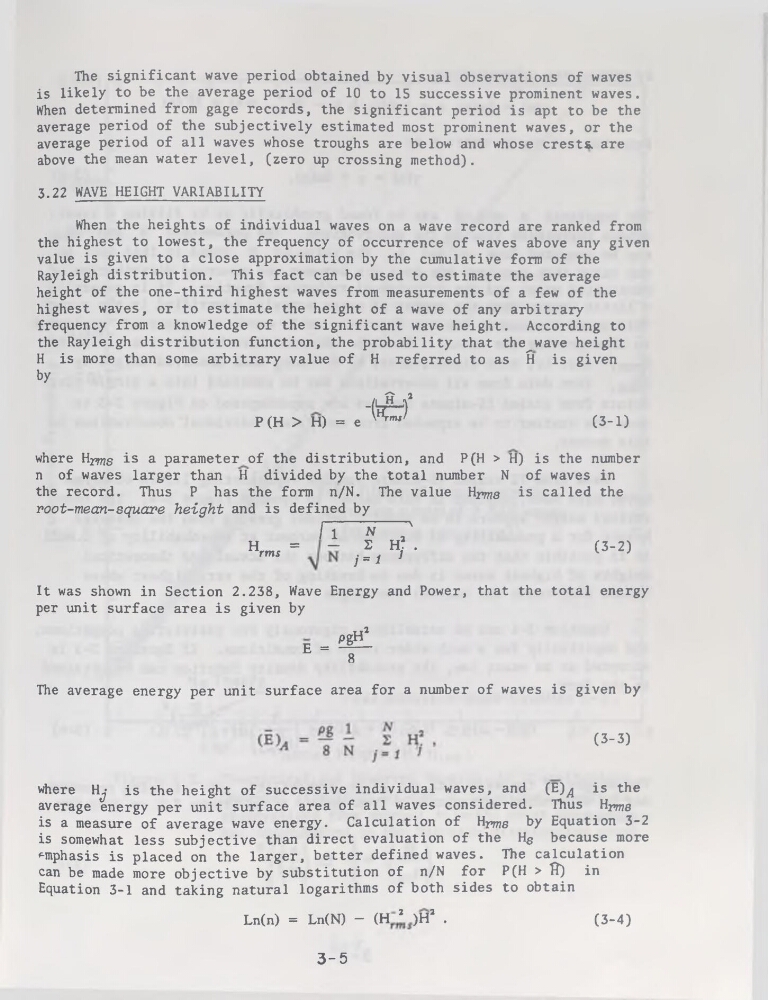
-feS-l’
P (H > H) = e Wrm,/
(3-1)
where H^g is a parameter of the distribution, and P (H > H) is the number
n of waves larger than H divided by the total number N of waves in
the record. Thus P has the form n/N. The value Hp^g is called the
root-mean-square height and is defined by
rï n 7
H
=
— S H? .
(3-2)
rms
j=i J
1
J
It was shown in Section 2.238, Wave Energy and Power, that the total energy
per unit surface area is given by
‘-’ -f
The average energy per unit surface area for a number of waves is given by
(3-3)
where Hj is the height of successive individual waves, and (E)^ is the
average energy per unit surface area of ail waves considered. Thus Hprns
is a measure of average wave energy. Calculation of H^g by Equation 3-2
is somewhat less subjective than direct évaluation of the Hg because more
Hnphasis is placed on the larger, better defined waves. The calculation
can be made more objective by substitution of n/N for P(H > fî) in
Equation 3-1 and taking natural logarithms of both sides to obtain
Ln(n) = Ln(N) - (H’)H2 .
(3-4)
3-5
is likely to be the average period of 10 to 15 successive prominent waves.
When determined from gage records, the significant period is apt to be the
average period of the subjectively estimated most prominent waves, or the
average period of ail waves whose troughs are below and whose crest& are
above the mean water level, (zéro up Crossing method).
3.22 WAVE HEIGHT VARIABILITY
When the heights of individual waves on a wave record are ranked from
the highest to lowest, the frequency of occurrence of waves above any given
value is given to a close approximation by the cumulative form of the
Rayleigh distribution. This fact can be used to estimate the average
height of the one-third highest waves from measurements of a few of the
highest waves, or to estimate the height of a wave of any arbitrary
frequency from a knowledge of the significant wave height. According to
the Rayleigh distribution function, the probability that the^wave height
H is more than some arbitrary value of H referred to as H is given
by
-feS-l’
P (H > H) = e Wrm,/
(3-1)
where H^g is a parameter of the distribution, and P (H > H) is the number
n of waves larger than H divided by the total number N of waves in
the record. Thus P has the form n/N. The value Hp^g is called the
root-mean-square height and is defined by
rï n 7
H
=
— S H? .
(3-2)
rms
j=i J
1
J
It was shown in Section 2.238, Wave Energy and Power, that the total energy
per unit surface area is given by
‘-’ -f
The average energy per unit surface area for a number of waves is given by
(3-3)
where Hj is the height of successive individual waves, and (E)^ is the
average energy per unit surface area of ail waves considered. Thus Hprns
is a measure of average wave energy. Calculation of H^g by Equation 3-2
is somewhat less subjective than direct évaluation of the Hg because more
Hnphasis is placed on the larger, better defined waves. The calculation
can be made more objective by substitution of n/N for P(H > fî) in
Equation 3-1 and taking natural logarithms of both sides to obtain
Ln(n) = Ln(N) - (H’)H2 .
(3-4)
3-5