

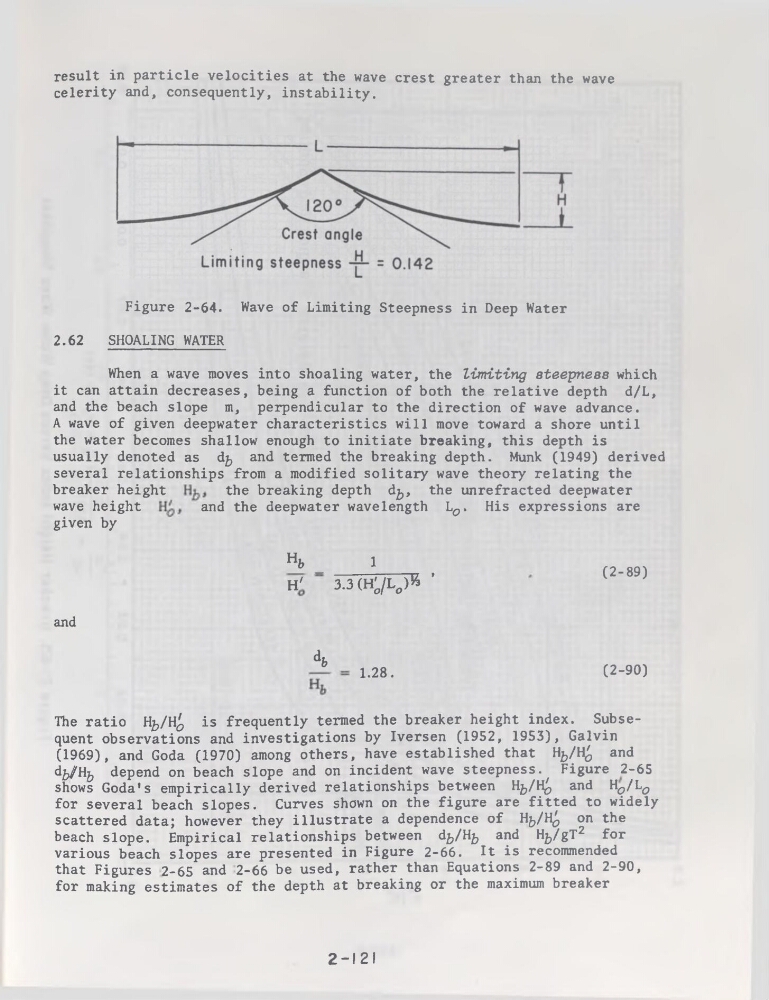
resuit in particle velocities at the wave crest greater than the wave
celerity and, consequently, instability.
Figure 2-64. Wave of Limiting Steepness in Deep Water
2.62 SHQALING WATER
When a wave moves into shoaling water, the limiting steepness which
it can attain decreases, being a function of both the relative depth d/L,
and the beach slope m, perpendicular to the direction of wave advance.
A wave of given deepwater characteristics will move toward a shore until
the water becomes shallow enough to initiate breaking, this depth is
usually denoted as d^ and termed the breaking depth. Munk (1949) derived
several relationships from a modified solitary wave theory relating the
breaker height
the breaking depth d^, the unrefracted deepwater
wave height
and the deepwater wavelength Lo. His expressions are
given by
Hb _
1
H'
3.3(h;/L„)H ’
(2-89)
and
db
1.28.
(2-90)
The ratio H^/H^ is frequently termed the breaker height index. Subséquent observations and investigations by Iversen (1952, 1953), Galvin
(1969), and Goda (1970) among others, hâve established that H^/H^ and
d^/Hj, dépend on beach slope and on incident wave steepness. Figure 2-65
shows Goda*s empirically derived relationships between H^/H^ and H^/L^
for several beach slopes. Curves shown on the figure are fitted to widely
scattered data; however they illustrate a dependence of H^/H^ on the
beach slope. Empirical relationships between d^/H^ and H^/gT2 for
various beach slopes are presented in Figure 2-66. It is recommended
that Figures 2-65 and 2-66 be used, rather than Equations 2-89 and 2-90,
for making estimâtes of the depth at breaking or the maximum breaker
2-121
celerity and, consequently, instability.
Figure 2-64. Wave of Limiting Steepness in Deep Water
2.62 SHQALING WATER
When a wave moves into shoaling water, the limiting steepness which
it can attain decreases, being a function of both the relative depth d/L,
and the beach slope m, perpendicular to the direction of wave advance.
A wave of given deepwater characteristics will move toward a shore until
the water becomes shallow enough to initiate breaking, this depth is
usually denoted as d^ and termed the breaking depth. Munk (1949) derived
several relationships from a modified solitary wave theory relating the
breaker height
the breaking depth d^, the unrefracted deepwater
wave height
and the deepwater wavelength Lo. His expressions are
given by
Hb _
1
H'
3.3(h;/L„)H ’
(2-89)
and
db
1.28.
(2-90)
The ratio H^/H^ is frequently termed the breaker height index. Subséquent observations and investigations by Iversen (1952, 1953), Galvin
(1969), and Goda (1970) among others, hâve established that H^/H^ and
d^/Hj, dépend on beach slope and on incident wave steepness. Figure 2-65
shows Goda*s empirically derived relationships between H^/H^ and H^/L^
for several beach slopes. Curves shown on the figure are fitted to widely
scattered data; however they illustrate a dependence of H^/H^ on the
beach slope. Empirical relationships between d^/H^ and H^/gT2 for
various beach slopes are presented in Figure 2-66. It is recommended
that Figures 2-65 and 2-66 be used, rather than Equations 2-89 and 2-90,
for making estimâtes of the depth at breaking or the maximum breaker
2-121