

to 0.6 has been recommended for rough slopes and step-faced structures.
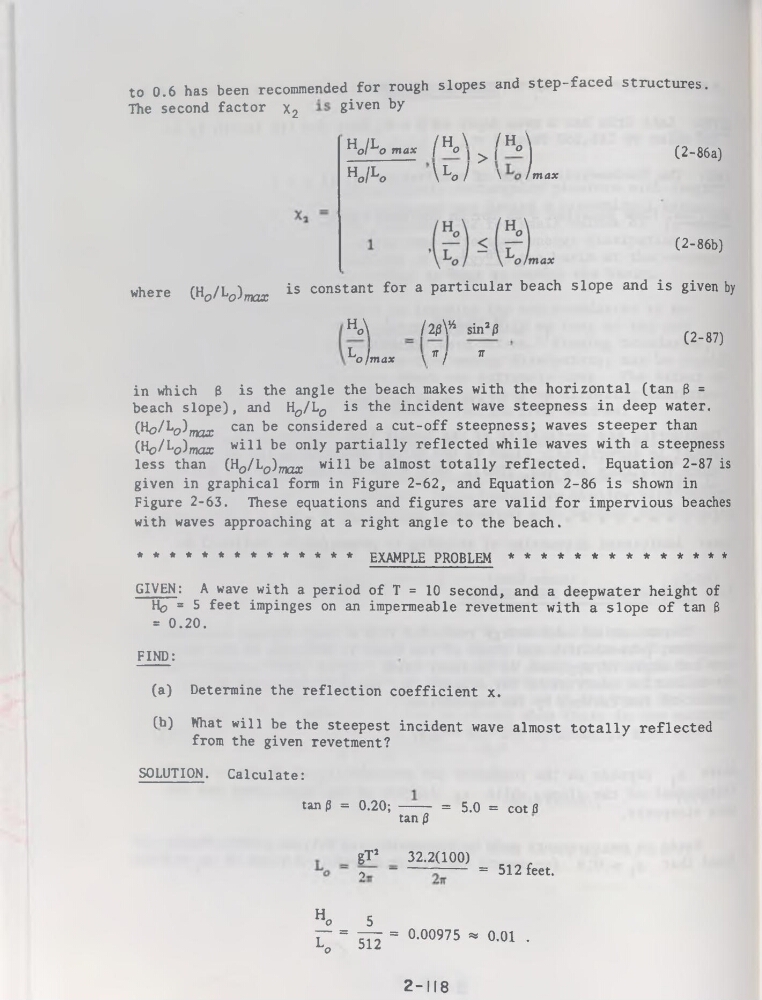
The second factor x2
8^ven by
H IL
/H \
/H \
ol ° max I ° I > i ° |
Ho/Lo
\ LO /
\
/max
(2-86a)
where ^o^o^max
(2-86b)
is constant for a particular beach slope and is given by
Ho\
/2j3\^ sin20
Lo /max \ 77 /
77
(2-87)
in which B is the angle the beach makes with the horizontal (tan B =
beach slope), and H^/L^ is the incident wave steepness in deep water.
(Ho/L^)max can be considered a cut-off steepness; waves steeper than
(Ho/Lo)max will be only partially reflected while waves with a steepness
less than (H^/L^)^^ will be almost totally reflected. Equation 2-87 is
given in graphical form in Figure 2-62, and Equation 2-86 is shown in
Figure 2-63. These équations and figures are valid for impervious beaches
with waves approaching at a right angle to the beach.
************** EXAMPLE PROBLEM **************
GIVEN: A wave with a period of T = 10 second, and a deepwater height of
Ho = 5 feet impinges on an imperméable revetment with a slope of tan B
= 0.20.
FIND:
(a) Détermine the reflection coefficient x.
(b)
What will be the steepest incident wave almost totally reflected
from the given revetment?
SOLUTION. Calculate:
tan P = 0.20; ------ = 5.0 = cot B
tan B
gT2
32.2(100)
o
—
------ = 512 feet.
Ho
5
ro = ïïï = °-00975 ’ °-01 •
2-118
The second factor x2
8^ven by
H IL
/H \
/H \
ol ° max I ° I > i ° |
Ho/Lo
\ LO /
\
/max
(2-86a)
where ^o^o^max
(2-86b)
is constant for a particular beach slope and is given by
Ho\
/2j3\^ sin20
Lo /max \ 77 /
77
(2-87)
in which B is the angle the beach makes with the horizontal (tan B =
beach slope), and H^/L^ is the incident wave steepness in deep water.
(Ho/L^)max can be considered a cut-off steepness; waves steeper than
(Ho/Lo)max will be only partially reflected while waves with a steepness
less than (H^/L^)^^ will be almost totally reflected. Equation 2-87 is
given in graphical form in Figure 2-62, and Equation 2-86 is shown in
Figure 2-63. These équations and figures are valid for impervious beaches
with waves approaching at a right angle to the beach.
************** EXAMPLE PROBLEM **************
GIVEN: A wave with a period of T = 10 second, and a deepwater height of
Ho = 5 feet impinges on an imperméable revetment with a slope of tan B
= 0.20.
FIND:
(a) Détermine the reflection coefficient x.
(b)
What will be the steepest incident wave almost totally reflected
from the given revetment?
SOLUTION. Calculate:
tan P = 0.20; ------ = 5.0 = cot B
tan B
gT2
32.2(100)
o
—
------ = 512 feet.
Ho
5
ro = ïïï = °-00975 ’ °-01 •
2-118