

remains at the SWL for ail values of t and other points (antinodes) where
the water particle excursion at the surface is 2
or twice the incident
wave height. The équations describing the water particle motion show that
the velocity is always horizontal under the nodes and always vertical under
the antinodes. At intermediate points, the water particles move along
diagonal lines as shown in Figure 2-61. Since water motion at the antinodes is purely vertical, the presence of a vertical wall at any antinode
will not change the flow pattern described since there is no flow across
the vertical barrier and equivalently, there is no flow across a vertical
line passing through an antinode. (For the linear theory discussion here,
the water contained between any two antinodes will remain between those
two antinodes.) Consequently, the flow described here is valid for a
barrier at 2ttx/L = 0 (x = 0) since there is an antinode at that location.
2.53 REELECTIONS IN AN ENCLOSED BASIN
Some insight can be obtained about the phenomenon of the résonant
behavior of harbors and other enclosed bodies of water by examining the
standing wave System previously described. The possible résonant oscinattions between two vertical walls can be described by locating the two
barriers so that they are both at antinodes; for example, barriers at
x = 0 and tt or x = 0 and 2tt, etc. represent possible modes of oscillation.
If the barriers are taken at x = 0 and x = tt, there is one-half of a wave
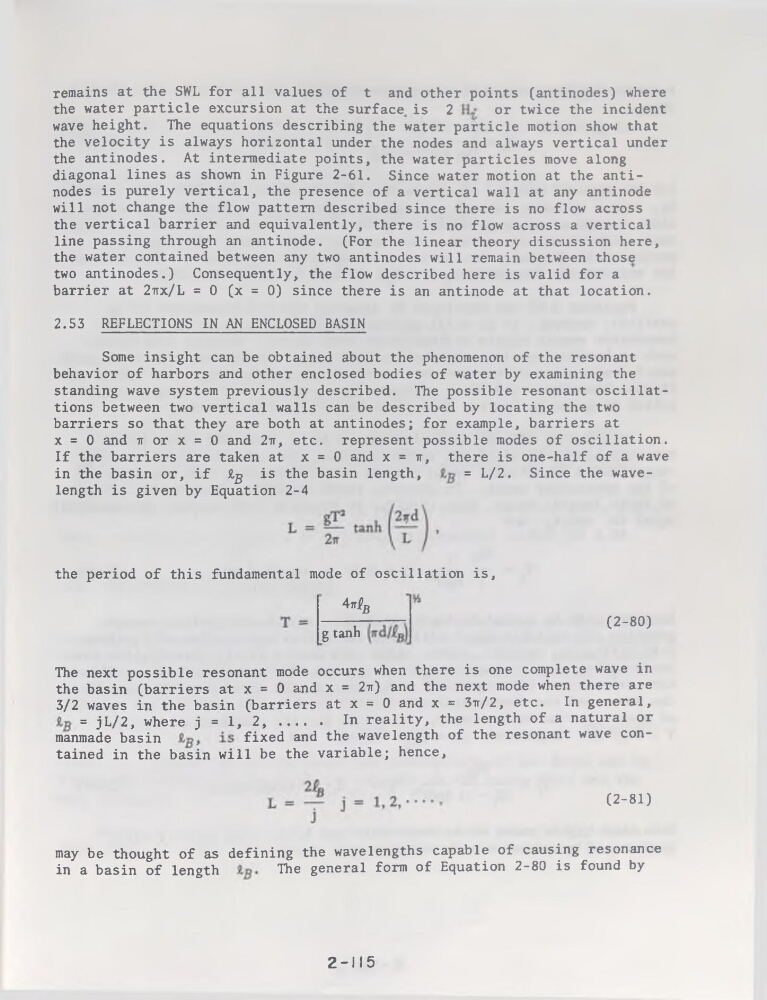
in the basin or, if £$ is the basin length,
= L/2. Since the wavelength is given by Equation 2-4
the period of this fundamental mode of oscillation is,
Mb
g tanh
(2-80)
The next possible résonant mode occurs when there is one complété wave in
the basin (barriers at x = 0 and x = 2tt) and the next mode when there are
3/2 waves in the basin (barriers at x = 0 and x = 3ir/2, etc. In general,
= jL/2, where j = 1, 2, ..... In reality, the length of a natural or
manmade basin
fixed and the wavelength of the résonant wave contained in the basin will be the variable; hence,
(2-81)
may be thought of as defining the wavelengths capable of causing résonance
in a basin of length
The general form of Equation 2-80 is found by
2-115
the water particle excursion at the surface is 2
or twice the incident
wave height. The équations describing the water particle motion show that
the velocity is always horizontal under the nodes and always vertical under
the antinodes. At intermediate points, the water particles move along
diagonal lines as shown in Figure 2-61. Since water motion at the antinodes is purely vertical, the presence of a vertical wall at any antinode
will not change the flow pattern described since there is no flow across
the vertical barrier and equivalently, there is no flow across a vertical
line passing through an antinode. (For the linear theory discussion here,
the water contained between any two antinodes will remain between those
two antinodes.) Consequently, the flow described here is valid for a
barrier at 2ttx/L = 0 (x = 0) since there is an antinode at that location.
2.53 REELECTIONS IN AN ENCLOSED BASIN
Some insight can be obtained about the phenomenon of the résonant
behavior of harbors and other enclosed bodies of water by examining the
standing wave System previously described. The possible résonant oscinattions between two vertical walls can be described by locating the two
barriers so that they are both at antinodes; for example, barriers at
x = 0 and tt or x = 0 and 2tt, etc. represent possible modes of oscillation.
If the barriers are taken at x = 0 and x = tt, there is one-half of a wave
in the basin or, if £$ is the basin length,
= L/2. Since the wavelength is given by Equation 2-4
the period of this fundamental mode of oscillation is,
Mb
g tanh
(2-80)
The next possible résonant mode occurs when there is one complété wave in
the basin (barriers at x = 0 and x = 2tt) and the next mode when there are
3/2 waves in the basin (barriers at x = 0 and x = 3ir/2, etc. In general,
= jL/2, where j = 1, 2, ..... In reality, the length of a natural or
manmade basin
fixed and the wavelength of the résonant wave contained in the basin will be the variable; hence,
(2-81)
may be thought of as defining the wavelengths capable of causing résonance
in a basin of length
The general form of Equation 2-80 is found by
2-115