

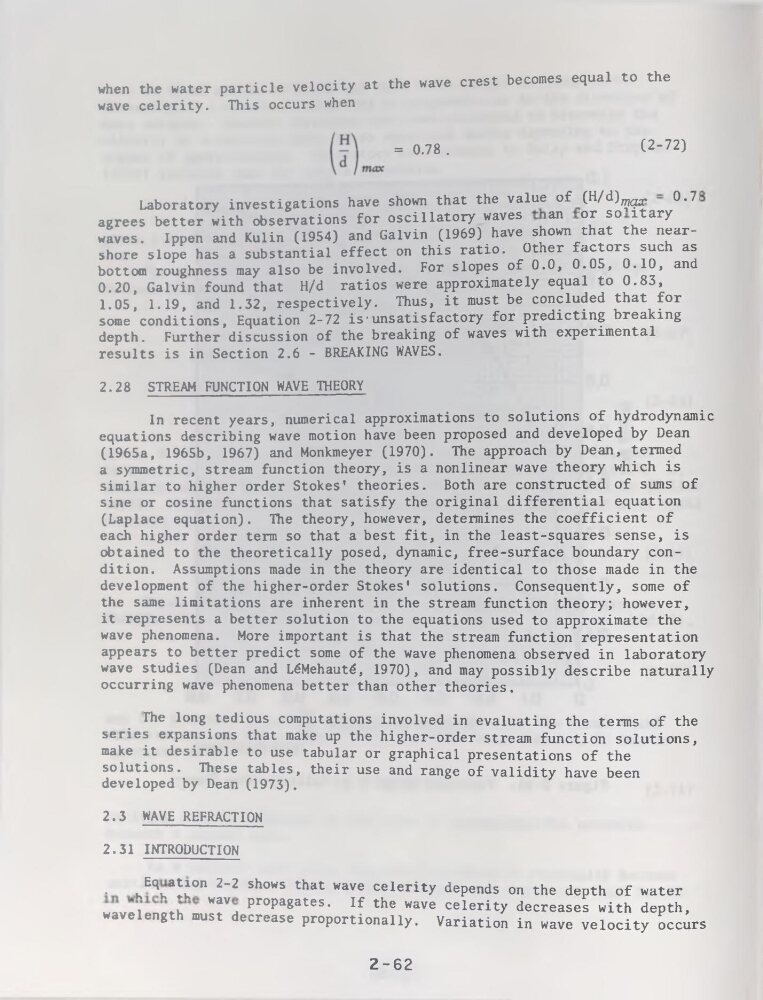
when the water particle velocity at the wave
wave celerity. This occurs when
crest becomes equal to the
= 0.78 .
(2-72)
Laboratory investigations hâve shown that the value of (H/d)^.
0.7:
agréés better with observations for oscillatory waves
an or so itary
waves. Ippen and Kulin (1954) and Galvin (1969) hâve shown that the nearshore slope has a substantial effect on this ratio. Other factors such as
bottom roughness may also be involved. For slopes of 0.0, 0.05, 0.10, and
0.20, Galvin found that H/d ratios were approximately equal to 0.83,
1.05, 1.19, and 1.32, respectively. Thus, it must be concluded that for
some conditions, Equation 2-72 is• unsatisfactory for predicting breaking
depth. Further discussion of the breaking of waves with experimental
results is in Section 2.6 - BREAKING WAVES.
2.28 STREAM FUNCTION WAVE THEORY
In recent years, numerical approximations to solutions of hydrodynamic
équations describing wave motion hâve been proposed and developed by Dean
(1965a, 1965b, 1967) and Monkmeyer (1970). The approach by Dean, termed
a symmetric, stream function theory, is a nonlinear wave theory which is
similar to higher order Stokes' théories. Both are constructed of sums of
sine or cosine fonctions that satisfy the original differential équation
(Laplace équation). The theory, however, détermines the coefficient of
each higher order tenu so that a best fit, in the least-squares sense, is
obtained to the theoretically posed, dynamic, free-surface boundary condition. Assomptions made in the theory are identical to those made in the
development of the higher-order Stokes’ solotions. Conseqoently, some of
the same limitations are inhérent in the stream fonction theory; however,
it represents a better solotion to the eqoations osed to approximate the
wave phenomena. More important is that the stream function représentation
appears to better predict some of the wave phenomena observed in laboratory
wave studies (Dean and LéMehauté, 1970), and may possibly describe naturally
occurring wave phenomena better than other théories.
Fhe long tedious computations involved in evaluating the terms of the
scries expansions that make up the higher-order stream function solutions,
make it désirable to use tabular or graphical présentations of the
solutions. These tables, their use and range of validity hâve been
developed by Dean (1973).
2.3 WAVE REFRACTION
2.31 INTRODUCTION
•
wEqwa!i°n 2'2 Sh°WS that Wave celerity dépends on the depth of water
Ta propa8ates- If th* wave celerity decreases with depth,
wavelength must decrease proportionally. Variation in wave velocity occurs
2-62
wave celerity. This occurs when
crest becomes equal to the
= 0.78 .
(2-72)
Laboratory investigations hâve shown that the value of (H/d)^.
0.7:
agréés better with observations for oscillatory waves
an or so itary
waves. Ippen and Kulin (1954) and Galvin (1969) hâve shown that the nearshore slope has a substantial effect on this ratio. Other factors such as
bottom roughness may also be involved. For slopes of 0.0, 0.05, 0.10, and
0.20, Galvin found that H/d ratios were approximately equal to 0.83,
1.05, 1.19, and 1.32, respectively. Thus, it must be concluded that for
some conditions, Equation 2-72 is• unsatisfactory for predicting breaking
depth. Further discussion of the breaking of waves with experimental
results is in Section 2.6 - BREAKING WAVES.
2.28 STREAM FUNCTION WAVE THEORY
In recent years, numerical approximations to solutions of hydrodynamic
équations describing wave motion hâve been proposed and developed by Dean
(1965a, 1965b, 1967) and Monkmeyer (1970). The approach by Dean, termed
a symmetric, stream function theory, is a nonlinear wave theory which is
similar to higher order Stokes' théories. Both are constructed of sums of
sine or cosine fonctions that satisfy the original differential équation
(Laplace équation). The theory, however, détermines the coefficient of
each higher order tenu so that a best fit, in the least-squares sense, is
obtained to the theoretically posed, dynamic, free-surface boundary condition. Assomptions made in the theory are identical to those made in the
development of the higher-order Stokes’ solotions. Conseqoently, some of
the same limitations are inhérent in the stream fonction theory; however,
it represents a better solotion to the eqoations osed to approximate the
wave phenomena. More important is that the stream function représentation
appears to better predict some of the wave phenomena observed in laboratory
wave studies (Dean and LéMehauté, 1970), and may possibly describe naturally
occurring wave phenomena better than other théories.
Fhe long tedious computations involved in evaluating the terms of the
scries expansions that make up the higher-order stream function solutions,
make it désirable to use tabular or graphical présentations of the
solutions. These tables, their use and range of validity hâve been
developed by Dean (1973).
2.3 WAVE REFRACTION
2.31 INTRODUCTION
•
wEqwa!i°n 2'2 Sh°WS that Wave celerity dépends on the depth of water
Ta propa8ates- If th* wave celerity decreases with depth,
wavelength must decrease proportionally. Variation in wave velocity occurs
2-62