

73
Composition of the Major Components of Seawater
of g T = 0.121 and can be compared to the earlier results of Lyman and Fleming of g T = 0.073.
This increase over the past 60 years is largely due to increases in Ca 2+ and HCO 3
– . The SO 4
2–
has decreased apparently because of the waters becoming more anoxic (see Figure 2.13). A
comparison of Baltic river water and world river water is shown in Figure 2.14. Since the
flow rate of the major rivers entering the Baltic has decreased (Figure 2.15), the increase in
g T can be attributed to less rainfall diluting the groundwater (which has a fixed concentration of Ca 2+ and HCO 3
– ). It is interesting to note that the flow rate is cyclic (with a cycle
nearing that of the sunspot cycle of 11 years). This would lead to cycling of the input of
solids into the estuary and cause a pulsing rate for the renewal of the deep waters (from
the North Sea). One could postulate that the banding of FeS in the Baltic Sea sediments is
caused by the pulsing flow rate of the rivers, which is caused, in turn, by sunspot activity.
The examination of a deep basin in the Baltic (Figure 2.16) as a function of time shows a
pulsing pattern (oxic to anoxic); however, the periods are quite short.
The practical salinity scale is frequently used to characterize the composition of estuarine waters. Since the composition of these waters is different from those used in setting
up the scale (i.e., sea water diluted with pure water), it is appropriate to discuss its limitations. A typical estuarine solution can be formed by mixing world river with average seawater (Table 2.7). If the SiO 2 is left out of the river end member, the total grams of salts in
1 kg of solution are related to Cl by
g(E) = 0.092 + 1.80271 Cl(‰)
(2.31)
Since salts are lost when sea water is evaporated, the true salinity (S T = g T /1.0049) is given by
S T = 0.092 + 1.80183 Cl(‰)
(2.32)
pH
6.8
7.2
7.6
8.0
8.4
Depth (m)
0
50
100
150
200
250
300
O 2 (µM)
0
100
200
300
400
500
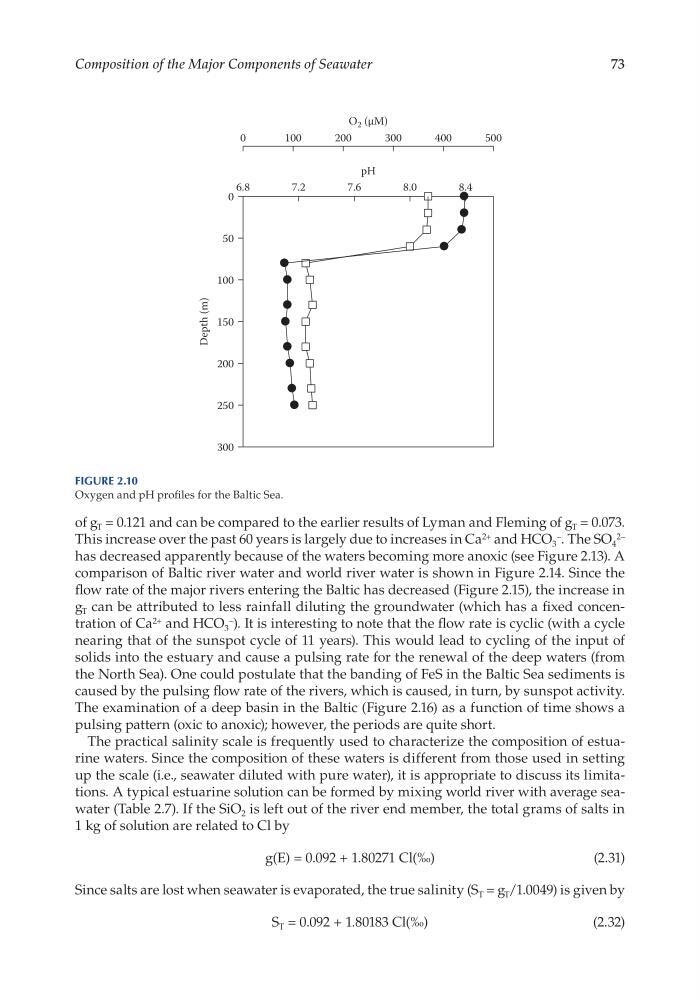
Figure 2.10
Oxygen and pH profiles for the Baltic Sea.
Composition of the Major Components of Seawater
of g T = 0.121 and can be compared to the earlier results of Lyman and Fleming of g T = 0.073.
This increase over the past 60 years is largely due to increases in Ca 2+ and HCO 3
– . The SO 4
2–
has decreased apparently because of the waters becoming more anoxic (see Figure 2.13). A
comparison of Baltic river water and world river water is shown in Figure 2.14. Since the
flow rate of the major rivers entering the Baltic has decreased (Figure 2.15), the increase in
g T can be attributed to less rainfall diluting the groundwater (which has a fixed concentration of Ca 2+ and HCO 3
– ). It is interesting to note that the flow rate is cyclic (with a cycle
nearing that of the sunspot cycle of 11 years). This would lead to cycling of the input of
solids into the estuary and cause a pulsing rate for the renewal of the deep waters (from
the North Sea). One could postulate that the banding of FeS in the Baltic Sea sediments is
caused by the pulsing flow rate of the rivers, which is caused, in turn, by sunspot activity.
The examination of a deep basin in the Baltic (Figure 2.16) as a function of time shows a
pulsing pattern (oxic to anoxic); however, the periods are quite short.
The practical salinity scale is frequently used to characterize the composition of estuarine waters. Since the composition of these waters is different from those used in setting
up the scale (i.e., sea water diluted with pure water), it is appropriate to discuss its limitations. A typical estuarine solution can be formed by mixing world river with average seawater (Table 2.7). If the SiO 2 is left out of the river end member, the total grams of salts in
1 kg of solution are related to Cl by
g(E) = 0.092 + 1.80271 Cl(‰)
(2.31)
Since salts are lost when sea water is evaporated, the true salinity (S T = g T /1.0049) is given by
S T = 0.092 + 1.80183 Cl(‰)
(2.32)
pH
6.8
7.2
7.6
8.0
8.4
Depth (m)
0
50
100
150
200
250
300
O 2 (µM)
0
100
200
300
400
500
Figure 2.10
Oxygen and pH profiles for the Baltic Sea.