

69
Composition of the Major Components of Seawater
mind that the trace metal impurities in most reagent- grade salts are higher than in natural sea water. Thus, care must be taken when using artificial sea water solutions in biological studies.
2.5 Methods of Determining Salinity
As discussed, the salinity of sea water is normally determined by a conductance measurement using the practical salinity scale. Although this method yields very precise results,
they are not always accurate since the conductance responds only to ionic components.
In practice, any physical property (density, refractive index, sound speed, etc.) at a fixed
temperature and pressure can be used to determine the salinity. Before we discuss these
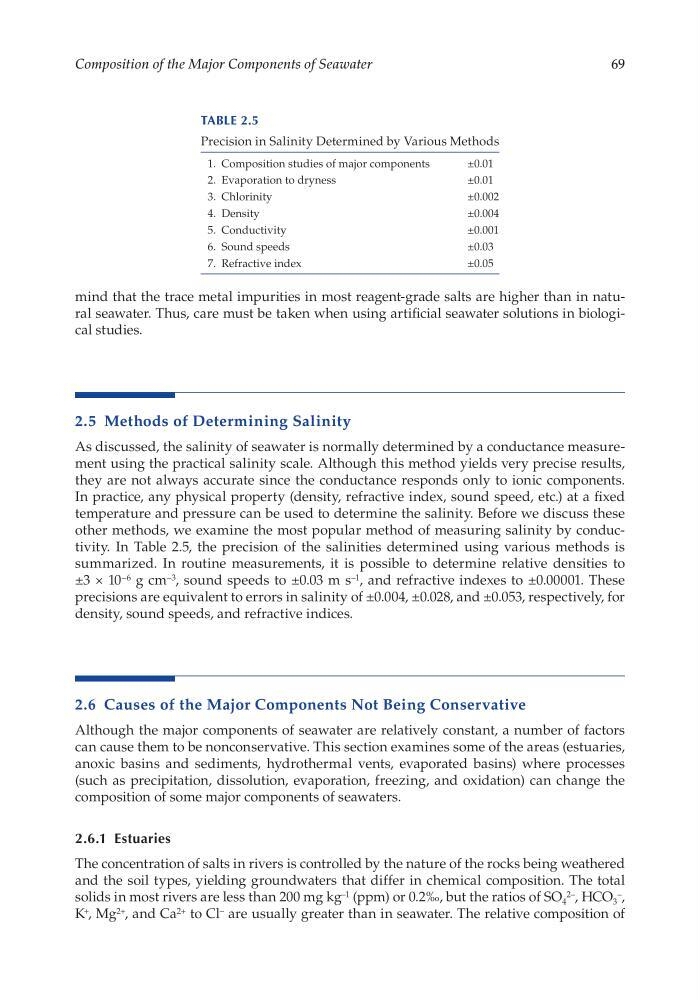
other methods, we examine the most popular method of measuring salinity by conductivity. In Table 2.5, the precision of the salinities determined using various methods is
summarized. In routine measurements, it is possible to determine relative densities to
±3 × 10 –6 g cm –3 , sound speeds to ±0.03 m s –1 , and refractive indexes to ±0.00001. These
precisions are equivalent to errors in salinity of ±0.004, ±0.028, and ±0.053, respectively, for
density, sound speeds, and refractive indices.
2.6 Causes of the Major Components Not Being Conservative
Although the major components of sea water are relatively constant, a number of factors
can cause them to be nonconservative. This section examines some of the areas (estuaries,
anoxic basins and sediments, hydrothermal vents, evaporated basins) where processes
(such as precipitation, dissolution, evaporation, freezing, and oxidation) can change the
composition of some major components of sea waters.
2.6.1 estuaries
The concentration of salts in rivers is controlled by the nature of the rocks being weathered
and the soil types, yielding groundwaters that differ in chemical composition. The total
solids in most rivers are less than 200 mg kg –1 (ppm) or 0.2‰, but the ratios of SO 4
2– , HCO 3
– ,
K + , Mg 2+ , and Ca 2+ to Cl – are usually greater than in sea water. The relative composition of
Table 2.5
Precision in Salinity Determined by Various Methods
1. Composition studies of major components
±0.01
2. Evaporation to dryness
±0.01
3. Chlorinity
±0.002
4. Density
±0.004
5. Conductivity
±0.001
6. Sound speeds
±0.03
7. Refractive index
±0.05
Composition of the Major Components of Seawater
mind that the trace metal impurities in most reagent- grade salts are higher than in natural sea water. Thus, care must be taken when using artificial sea water solutions in biological studies.
2.5 Methods of Determining Salinity
As discussed, the salinity of sea water is normally determined by a conductance measurement using the practical salinity scale. Although this method yields very precise results,
they are not always accurate since the conductance responds only to ionic components.
In practice, any physical property (density, refractive index, sound speed, etc.) at a fixed
temperature and pressure can be used to determine the salinity. Before we discuss these
other methods, we examine the most popular method of measuring salinity by conductivity. In Table 2.5, the precision of the salinities determined using various methods is
summarized. In routine measurements, it is possible to determine relative densities to
±3 × 10 –6 g cm –3 , sound speeds to ±0.03 m s –1 , and refractive indexes to ±0.00001. These
precisions are equivalent to errors in salinity of ±0.004, ±0.028, and ±0.053, respectively, for
density, sound speeds, and refractive indices.
2.6 Causes of the Major Components Not Being Conservative
Although the major components of sea water are relatively constant, a number of factors
can cause them to be nonconservative. This section examines some of the areas (estuaries,
anoxic basins and sediments, hydrothermal vents, evaporated basins) where processes
(such as precipitation, dissolution, evaporation, freezing, and oxidation) can change the
composition of some major components of sea waters.
2.6.1 estuaries
The concentration of salts in rivers is controlled by the nature of the rocks being weathered
and the soil types, yielding groundwaters that differ in chemical composition. The total
solids in most rivers are less than 200 mg kg –1 (ppm) or 0.2‰, but the ratios of SO 4
2– , HCO 3
– ,
K + , Mg 2+ , and Ca 2+ to Cl – are usually greater than in sea water. The relative composition of
Table 2.5
Precision in Salinity Determined by Various Methods
1. Composition studies of major components
±0.01
2. Evaporation to dryness
±0.01
3. Chlorinity
±0.002
4. Density
±0.004
5. Conductivity
±0.001
6. Sound speeds
±0.03
7. Refractive index
±0.05