

51
Descriptive Oceanography
and storms in the North Atlantic. The PDO is related to surface temperature anomalies in
the Pacific. The warm or positive phase has high sea surface temperatures in the Eastern
Equatorial Pacific and cold waters in the northern Pacific. Anomalies are also observed
in the sea- level pressures. The values in the east are lower than in the west. The warm
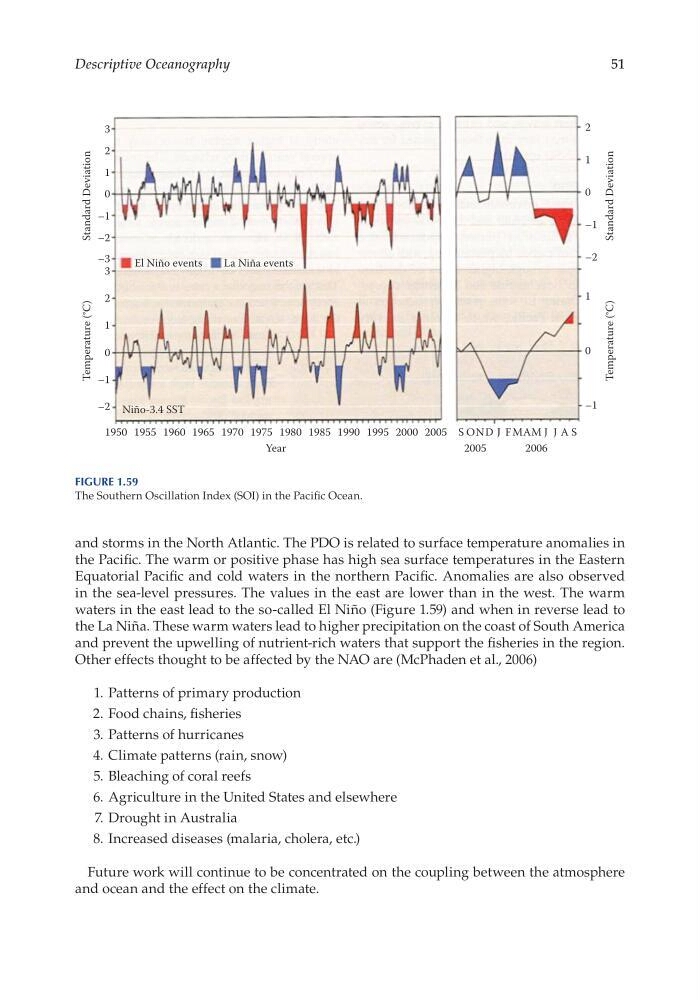
waters in the east lead to the so- called El Niño (Figure 1.59) and when in reverse lead to
the La Niña. These warm waters lead to higher precipitation on the coast of South America
and prevent the upwelling of nutrient- rich waters that support the fisheries in the region.
Other effects thought to be affected by the NAO are (McPhaden et al., 2006)
1. Patterns of primary production
2. Food chains, fisheries
3. Patterns of hurricanes
4. Climate patterns (rain, snow)
5. Bleaching of coral reefs
6. Agriculture in the United States and elsewhere
7. Drought in Australia
8. Increased diseases (malaria, cholera, etc.)
Future work will continue to be concentrated on the coupling between the atmosphere
and ocean and the effect on the climate.
El Niño events
Niño-3.4 SST
La Niña events
3
2
1
0
–1
–2
–3
3
Standard Deviation
Temperature (°C)
Temperature (°C)
Standard Deviation
2
1
0
–1
–2
1950 1955 1960 1965 1970 1975
Year
2005
2006
1980 1985 1990 1995 2000 2005 S OND J F MAM J J A S
–1
0
1
–2
–1
0
1
2
Figure 1.59
The Southern Oscillation Index (SOI) in the Pacific Ocean.
Descriptive Oceanography
and storms in the North Atlantic. The PDO is related to surface temperature anomalies in
the Pacific. The warm or positive phase has high sea surface temperatures in the Eastern
Equatorial Pacific and cold waters in the northern Pacific. Anomalies are also observed
in the sea- level pressures. The values in the east are lower than in the west. The warm
waters in the east lead to the so- called El Niño (Figure 1.59) and when in reverse lead to
the La Niña. These warm waters lead to higher precipitation on the coast of South America
and prevent the upwelling of nutrient- rich waters that support the fisheries in the region.
Other effects thought to be affected by the NAO are (McPhaden et al., 2006)
1. Patterns of primary production
2. Food chains, fisheries
3. Patterns of hurricanes
4. Climate patterns (rain, snow)
5. Bleaching of coral reefs
6. Agriculture in the United States and elsewhere
7. Drought in Australia
8. Increased diseases (malaria, cholera, etc.)
Future work will continue to be concentrated on the coupling between the atmosphere
and ocean and the effect on the climate.
El Niño events
Niño-3.4 SST
La Niña events
3
2
1
0
–1
–2
–3
3
Standard Deviation
Temperature (°C)
Temperature (°C)
Standard Deviation
2
1
0
–1
–2
1950 1955 1960 1965 1970 1975
Year
2005
2006
1980 1985 1990 1995 2000 2005 S OND J F MAM J J A S
–1
0
1
–2
–1
0
1
2
Figure 1.59
The Southern Oscillation Index (SOI) in the Pacific Ocean.