

496
Chemical Oceanography, 4th Edition
abundant oxidant for hydrogen sulfide in natural waters, followed by MnO 2 and Fe 2 O 3 .
This oxidation involves a complex mechanism that results in the formation of several
reduced sulfur species (i.e., thiosulfate, sulfite, elemental sulfur, and polysulfide) as well
as sulfate. A number of studies of the oxidation of H 2 S (Millero et al., 1987; Zhang and
Millero, 1993a,b) and H 2 SO 3 (Zhang and Millero, 1991) with O 2 in natural waters have been
conducted in the laboratory and in the field. My research group has attempted to characterize how the rates and distributions of products are affected by trace metals and developed a kinetic model that can be used to predict the rates of oxidation and formation of
products. The results of these studies are briefly reviewed in this section.
The overall rate equation for the oxidation of sulfide can be represented by
–d[H 2 S]/dt = k[H 2 S][O 2 ]
(10.74)
where the brackets represent concentrations. When oxygen is in excess, the rate of disappearance of H 2 S can be simplified to
–d[H 2 S]/dt = k′[H 2 S]
(10.75)
where k′ = k[O 2 ]. Plots of ln[H 2 S] versus time during the oxidation will give a straight line with
a slope of k′ (Figure 10.61). At a pH of 8.0, the rate constant (k, kg H 2 O mol –1 h –1 ) is given by (T, K)
log k = 11.78 – (3.0 × 10 3 )/T + 0.44 I 1/2
(10.76)
At 25°C, the half- time for the oxidation of H 2 S with O 2 was found to be t 1/2 = ln 2/k′ = 50
± 16 h in water and 26 ± 9 h in Gulf Stream seawater. The effect of pH in water is given by
200
Sulfate
Sulfide
[SO 4 ] meas.
[SO 4 ] initial
[H 2 S] meas.
H 2 S(g)
FeS
&
FeS 2
150
100
Depth (m)
50
0
0
5
10
Sulfur (mmol kg
–1 )
15
20
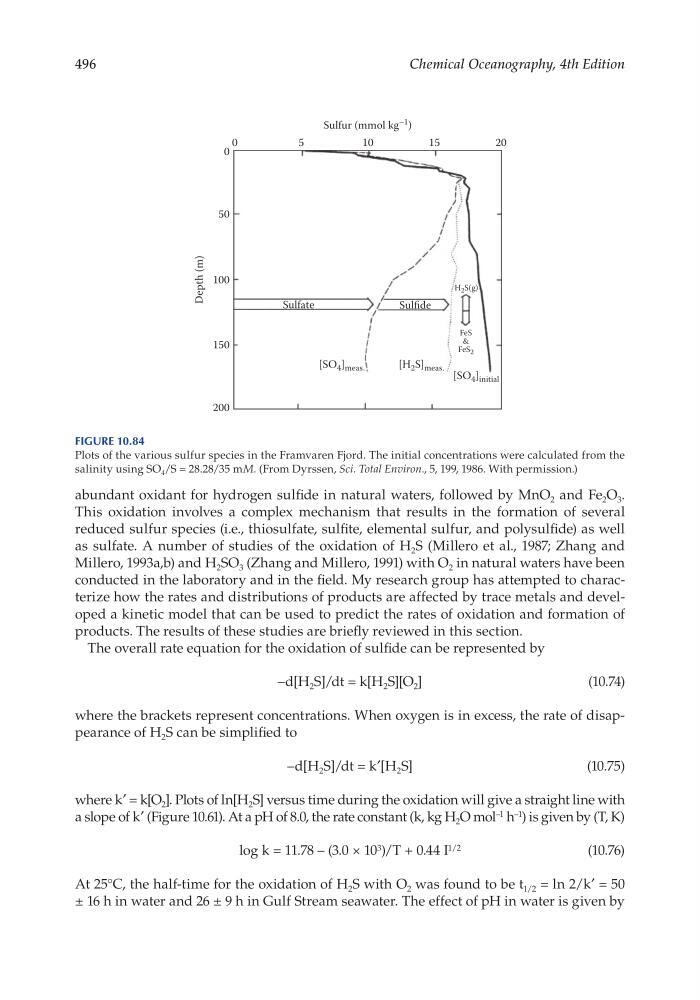
Figure 10.84
Plots of the various sulfur species in the Framvaren Fjord. The initial concentrations were calculated from the
salinity using SO 4 /S = 28.28/35 mM. (From Dyrssen, Sci. Total Environ., 5, 199, 1986. With permission.)
Chemical Oceanography, 4th Edition
abundant oxidant for hydrogen sulfide in natural waters, followed by MnO 2 and Fe 2 O 3 .
This oxidation involves a complex mechanism that results in the formation of several
reduced sulfur species (i.e., thiosulfate, sulfite, elemental sulfur, and polysulfide) as well
as sulfate. A number of studies of the oxidation of H 2 S (Millero et al., 1987; Zhang and
Millero, 1993a,b) and H 2 SO 3 (Zhang and Millero, 1991) with O 2 in natural waters have been
conducted in the laboratory and in the field. My research group has attempted to characterize how the rates and distributions of products are affected by trace metals and developed a kinetic model that can be used to predict the rates of oxidation and formation of
products. The results of these studies are briefly reviewed in this section.
The overall rate equation for the oxidation of sulfide can be represented by
–d[H 2 S]/dt = k[H 2 S][O 2 ]
(10.74)
where the brackets represent concentrations. When oxygen is in excess, the rate of disappearance of H 2 S can be simplified to
–d[H 2 S]/dt = k′[H 2 S]
(10.75)
where k′ = k[O 2 ]. Plots of ln[H 2 S] versus time during the oxidation will give a straight line with
a slope of k′ (Figure 10.61). At a pH of 8.0, the rate constant (k, kg H 2 O mol –1 h –1 ) is given by (T, K)
log k = 11.78 – (3.0 × 10 3 )/T + 0.44 I 1/2
(10.76)
At 25°C, the half- time for the oxidation of H 2 S with O 2 was found to be t 1/2 = ln 2/k′ = 50
± 16 h in water and 26 ± 9 h in Gulf Stream seawater. The effect of pH in water is given by
200
Sulfate
Sulfide
[SO 4 ] meas.
[SO 4 ] initial
[H 2 S] meas.
H 2 S(g)
FeS
&
FeS 2
150
100
Depth (m)
50
0
0
5
10
Sulfur (mmol kg
–1 )
15
20
Figure 10.84
Plots of the various sulfur species in the Framvaren Fjord. The initial concentrations were calculated from the
salinity using SO 4 /S = 28.28/35 mM. (From Dyrssen, Sci. Total Environ., 5, 199, 1986. With permission.)