

494
Chemical Oceanography, 4th Edition
The classic work of Redfield introduced the concept of nearly parallel C, N, and P
changes in aquatic ecosystems. Nutrients are taken up by phytoplankton and released
during organic matter degradation according to a simple and constant stoichiometry.
The Redfield model gives a nitrate:phosphate ratio of 16:1 and suggests that the nitrogen
and phosphorus are incorporated into living plankton and released from decomposing plankton in the same ratio. However, the ratio of C:P in marine detritus has been
suggested by Peng and Broecker (1987) to be 127 instead of 106. Based on chemical data
from isopycnal surfaces of the Atlantic and Indian oceans, Takahashi, Broecker, and
Langer (1985) yielded a C:N:P ratio of 103:16:1 if the carbon value was represented by
the observed increase in the TCO 2 concentration and a ratio of 140:16:1 if the carbon
value was assumed to be represented by the oxygen utilization minus the oxygen used
for oxidation of NH 3 with 2 moles of O 2 per nitrogen atom. The C:P and N:P ratios are
more variable for lake particles but generally higher than the Redfield ratio of 106:16:1.
Terrestrial soils and vegetation are rich in C and N with high C:N, C:P, and N:P ratios.
One could expect that C, N, and P in those marine environments such as basins and
fjords, which are influenced by terrestrial input, might not have Redfield behavior.
The major input of terrestrial origin organic matter is tree leaves, which have high C:N
and C:P ratios. Part of these tree leaves are difficult to decompose. The C:N:P ratio of bacteria is unknown, and the bacteria might contribute significantly to the carbon flux. The
linear correlation between concentrations of NH 4
+ and concentrations of PO 4
3– for samples
collected below the oxic layer give an N:P slope of 16.0 (±0.3), which is the same as the
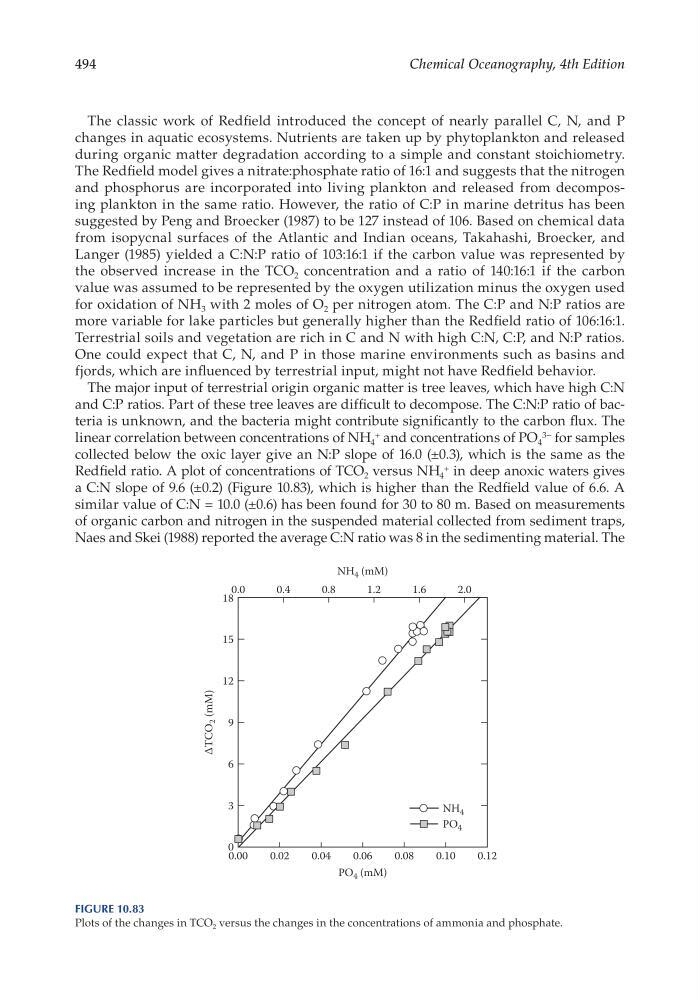
Redfield ratio. A plot of concentrations of TCO 2 versus NH 4
+ in deep anoxic waters gives
a C:N slope of 9.6 (±0.2) (Figure 10.83), which is higher than the Redfield value of 6.6. A
similar value of C:N = 10.0 (±0.6) has been found for 30 to 80 m. Based on measurements
of organic carbon and nitrogen in the suspended material collected from sediment traps,
Naes and Skei (1988) reported the average C:N ratio was 8 in the sedimenting material. The
0.0
0.4
0.8
1.2
1.6
2.0
∆TCO
2 (mM)
NH 4 (mM)
PO 4 (mM)
0.00
0.02
0.04
0.06
0.08
0.10
0.12
0
3
6
9
12
15
18
PO 4
NH 4
Figure 10.83
Plots of the changes in TCO 2 versus the changes in the concentrations of ammonia and phosphate.
Chemical Oceanography, 4th Edition
The classic work of Redfield introduced the concept of nearly parallel C, N, and P
changes in aquatic ecosystems. Nutrients are taken up by phytoplankton and released
during organic matter degradation according to a simple and constant stoichiometry.
The Redfield model gives a nitrate:phosphate ratio of 16:1 and suggests that the nitrogen
and phosphorus are incorporated into living plankton and released from decomposing plankton in the same ratio. However, the ratio of C:P in marine detritus has been
suggested by Peng and Broecker (1987) to be 127 instead of 106. Based on chemical data
from isopycnal surfaces of the Atlantic and Indian oceans, Takahashi, Broecker, and
Langer (1985) yielded a C:N:P ratio of 103:16:1 if the carbon value was represented by
the observed increase in the TCO 2 concentration and a ratio of 140:16:1 if the carbon
value was assumed to be represented by the oxygen utilization minus the oxygen used
for oxidation of NH 3 with 2 moles of O 2 per nitrogen atom. The C:P and N:P ratios are
more variable for lake particles but generally higher than the Redfield ratio of 106:16:1.
Terrestrial soils and vegetation are rich in C and N with high C:N, C:P, and N:P ratios.
One could expect that C, N, and P in those marine environments such as basins and
fjords, which are influenced by terrestrial input, might not have Redfield behavior.
The major input of terrestrial origin organic matter is tree leaves, which have high C:N
and C:P ratios. Part of these tree leaves are difficult to decompose. The C:N:P ratio of bacteria is unknown, and the bacteria might contribute significantly to the carbon flux. The
linear correlation between concentrations of NH 4
+ and concentrations of PO 4
3– for samples
collected below the oxic layer give an N:P slope of 16.0 (±0.3), which is the same as the
Redfield ratio. A plot of concentrations of TCO 2 versus NH 4
+ in deep anoxic waters gives
a C:N slope of 9.6 (±0.2) (Figure 10.83), which is higher than the Redfield value of 6.6. A
similar value of C:N = 10.0 (±0.6) has been found for 30 to 80 m. Based on measurements
of organic carbon and nitrogen in the suspended material collected from sediment traps,
Naes and Skei (1988) reported the average C:N ratio was 8 in the sedimenting material. The
0.0
0.4
0.8
1.2
1.6
2.0
∆TCO
2 (mM)
NH 4 (mM)
PO 4 (mM)
0.00
0.02
0.04
0.06
0.08
0.10
0.12
0
3
6
9
12
15
18
PO 4
NH 4
Figure 10.83
Plots of the changes in TCO 2 versus the changes in the concentrations of ammonia and phosphate.