

450
Chemical Oceanography, 4th Edition
to Fe(III), Johnson, Beehler, and Sakamoto- Arnold determined the age of the plume waters
at a specific distance from their source. Most of the Fe was lost by precipitation of Fe(III)
within a few days. Studies by German et al. (1991) of the chemistry of hydrothermal vents
have concentrated on the formation of particulate matter largely from the precipitation
of Fe 2+ from the vents. The formation of reactive iron oxides results in the scavenging of
metals and nonmetals (phosphate) from seawater and removal to the sediments. By measuring the concentration of various elements on the particles formed from the oxidation of
Fe(II), it is possible to study the uptake and removal of elements from seawater. The mixing lines for some metals as a function of particulate iron are shown in Figure 10.40 and
Mg (mmol kg
–1 )
0
10
20
30
40
50
60
Ca (mmol kg
–1
)
8
12
16
20
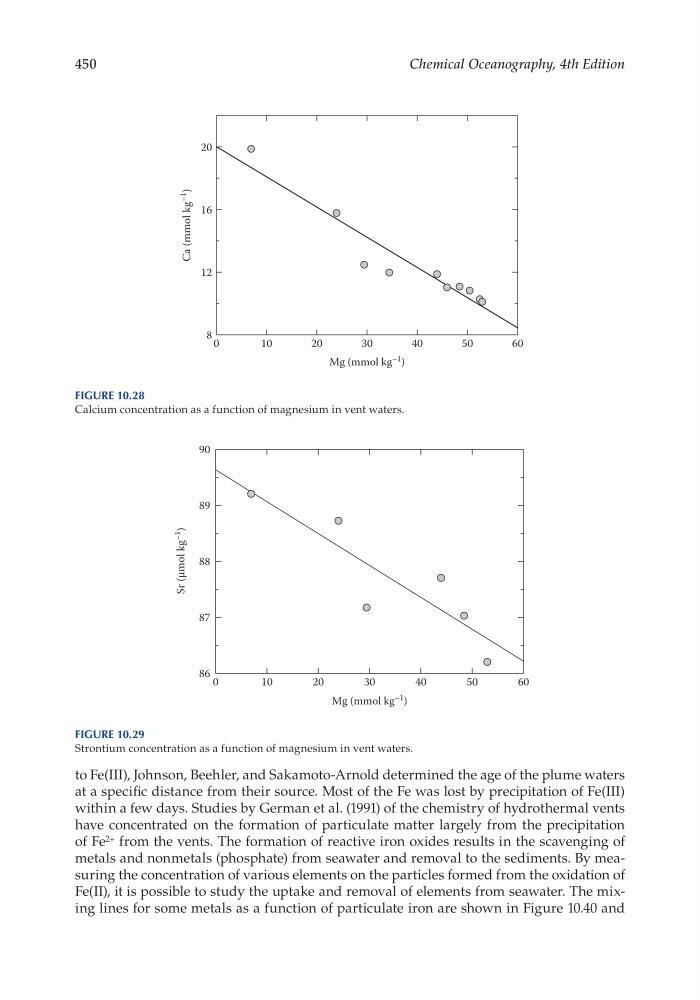
Figure 10.28
Calcium concentration as a function of magnesium in vent waters.
Mg (mmol kg
–1 )
0
10
20
30
40
50
60
Sr (µmol kg
–1
)
86
87
88
89
90
Figure 10.29
Strontium concentration as a function of magnesium in vent waters.
Chemical Oceanography, 4th Edition
to Fe(III), Johnson, Beehler, and Sakamoto- Arnold determined the age of the plume waters
at a specific distance from their source. Most of the Fe was lost by precipitation of Fe(III)
within a few days. Studies by German et al. (1991) of the chemistry of hydrothermal vents
have concentrated on the formation of particulate matter largely from the precipitation
of Fe 2+ from the vents. The formation of reactive iron oxides results in the scavenging of
metals and nonmetals (phosphate) from seawater and removal to the sediments. By measuring the concentration of various elements on the particles formed from the oxidation of
Fe(II), it is possible to study the uptake and removal of elements from seawater. The mixing lines for some metals as a function of particulate iron are shown in Figure 10.40 and
Mg (mmol kg
–1 )
0
10
20
30
40
50
60
Ca (mmol kg
–1
)
8
12
16
20
Figure 10.28
Calcium concentration as a function of magnesium in vent waters.
Mg (mmol kg
–1 )
0
10
20
30
40
50
60
Sr (µmol kg
–1
)
86
87
88
89
90
Figure 10.29
Strontium concentration as a function of magnesium in vent waters.