

426
Chemical Oceanography, 4th Edition
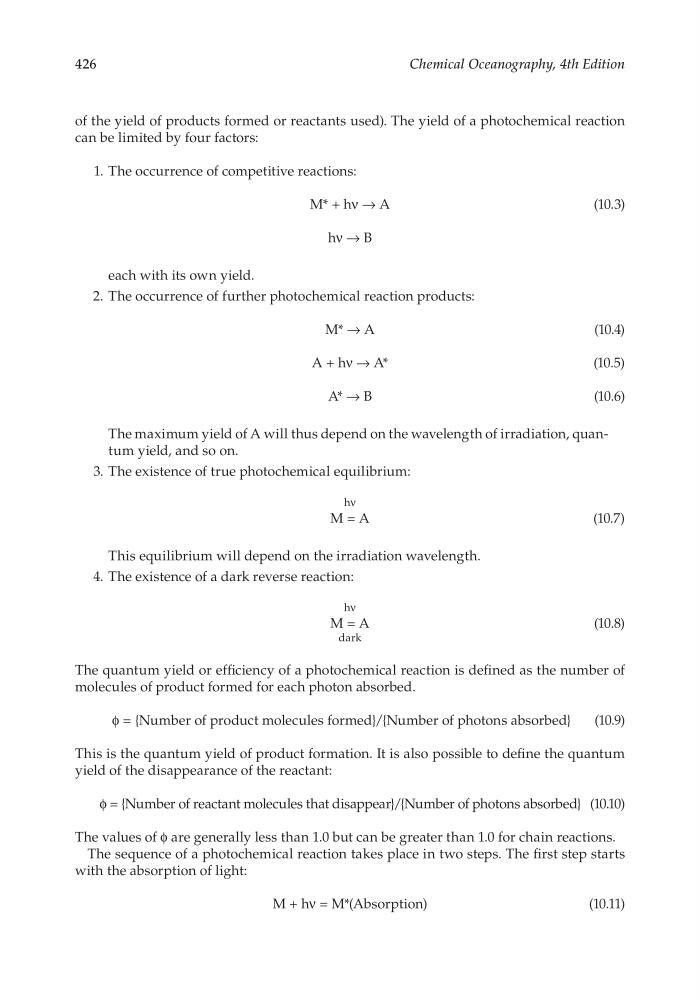
of the yield of products formed or reactants used). The yield of a photochemical reaction
can be limited by four factors:
1. The occurrence of competitive reactions:
M* + hν → A
(10.3)
hν → B
each with its own yield.
2. The occurrence of further photochemical reaction products:
M* → A
(10.4)
A + hν → A*
(10.5)
A* → B
(10.6)
The maximum yield of A will thus depend on the wavelength of irradiation, quantum yield, and so on.
3. The existence of true photochemical equilibrium:
hν
M = A
(10.7)
This equilibrium will depend on the irradiation wavelength.
4. The existence of a dark reverse reaction:
hν
M = A
(10.8)
dark
The quantum yield or efficiency of a photochemical reaction is defined as the number of
molecules of product formed for each photon absorbed.
ϕ = {Number of product molecules formed}/{Number of photons absorbed}
(10.9)
This is the quantum yield of product formation. It is also possible to define the quantum
yield of the disappearance of the reactant:
ϕ = {Number of reactant molecules that disappear}/{Number of photons absorbed} (10.10)
The values of ϕ are generally less than 1.0 but can be greater than 1.0 for chain reactions.
The sequence of a photochemical reaction takes place in two steps. The first step starts
with the absorption of light:
M + hν = M*(Absorption)
(10.11)
Chemical Oceanography, 4th Edition
of the yield of products formed or reactants used). The yield of a photochemical reaction
can be limited by four factors:
1. The occurrence of competitive reactions:
M* + hν → A
(10.3)
hν → B
each with its own yield.
2. The occurrence of further photochemical reaction products:
M* → A
(10.4)
A + hν → A*
(10.5)
A* → B
(10.6)
The maximum yield of A will thus depend on the wavelength of irradiation, quantum yield, and so on.
3. The existence of true photochemical equilibrium:
hν
M = A
(10.7)
This equilibrium will depend on the irradiation wavelength.
4. The existence of a dark reverse reaction:
hν
M = A
(10.8)
dark
The quantum yield or efficiency of a photochemical reaction is defined as the number of
molecules of product formed for each photon absorbed.
ϕ = {Number of product molecules formed}/{Number of photons absorbed}
(10.9)
This is the quantum yield of product formation. It is also possible to define the quantum
yield of the disappearance of the reactant:
ϕ = {Number of reactant molecules that disappear}/{Number of photons absorbed} (10.10)
The values of ϕ are generally less than 1.0 but can be greater than 1.0 for chain reactions.
The sequence of a photochemical reaction takes place in two steps. The first step starts
with the absorption of light:
M + hν = M*(Absorption)
(10.11)