

413
Primary Production in the Oceans
the lowest DOC. These older waters have a loss of DOC due to bacterial oxidation over
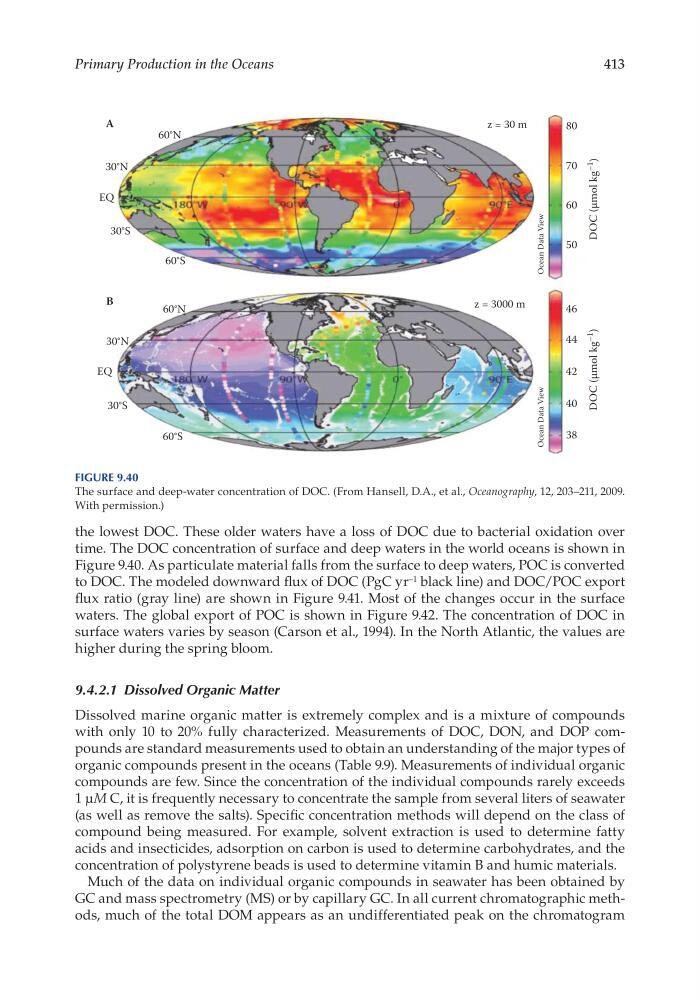
time. The DOC concentration of surface and deep waters in the world oceans is shown in
Figure 9.40. As particulate material falls from the surface to deep waters, POC is converted
to DOC. The modeled downward flux of DOC (PgC yr –1 black line) and DOC/ POC export
flux ratio (gray line) are shown in Figure 9.41. Most of the changes occur in the surface
waters. The global export of POC is shown in Figure 9.42. The concentration of DOC in
surface waters varies by season (Carson et al., 1994). In the North Atlantic, the values are
higher during the spring bloom.
9.4.2.1 Dissolved Organic Matter
Dissolved marine organic matter is extremely complex and is a mixture of compounds
with only 10 to 20% fully characterized. Measurements of DOC, DON, and DOP compounds are standard measurements used to obtain an understanding of the major types of
organic compounds present in the oceans (Table 9.9). Measurements of individual organic
compounds are few. Since the concentration of the individual compounds rarely exceeds
1 μM C, it is frequently necessary to concentrate the sample from several liters of seawater
(as well as remove the salts). Specific concentration methods will depend on the class of
compound being measured. For example, solvent extraction is used to determine fatty
acids and insecticides, adsorption on carbon is used to determine carbohydrates, and the
concentration of polystyrene beads is used to determine vitamin B and humic materials.
Much of the data on individual organic compounds in seawater has been obtained by
GC and mass spectrometry (MS) or by capillary GC. In all current chromatographic methods, much of the total DOM appears as an undifferentiated peak on the chromatogram
38
Ocean Data View
Ocean Data View
40
DOC (µmol kg
–1
)
DOC (µmol kg
–1
)
42
44
46
z = 3000 m
z = 30 m
50
60
70
80
60°S
60°N
30°N
B
A
30°S
60°S
EQ
30°S
30°N
60°N
EQ
Figure 9.40
The surface and deep- water concentration of DOC. (From Hansell, D.A., et al., Oceanography, 12, 203–211, 2009.
With permission.)
Primary Production in the Oceans
the lowest DOC. These older waters have a loss of DOC due to bacterial oxidation over
time. The DOC concentration of surface and deep waters in the world oceans is shown in
Figure 9.40. As particulate material falls from the surface to deep waters, POC is converted
to DOC. The modeled downward flux of DOC (PgC yr –1 black line) and DOC/ POC export
flux ratio (gray line) are shown in Figure 9.41. Most of the changes occur in the surface
waters. The global export of POC is shown in Figure 9.42. The concentration of DOC in
surface waters varies by season (Carson et al., 1994). In the North Atlantic, the values are
higher during the spring bloom.
9.4.2.1 Dissolved Organic Matter
Dissolved marine organic matter is extremely complex and is a mixture of compounds
with only 10 to 20% fully characterized. Measurements of DOC, DON, and DOP compounds are standard measurements used to obtain an understanding of the major types of
organic compounds present in the oceans (Table 9.9). Measurements of individual organic
compounds are few. Since the concentration of the individual compounds rarely exceeds
1 μM C, it is frequently necessary to concentrate the sample from several liters of seawater
(as well as remove the salts). Specific concentration methods will depend on the class of
compound being measured. For example, solvent extraction is used to determine fatty
acids and insecticides, adsorption on carbon is used to determine carbohydrates, and the
concentration of polystyrene beads is used to determine vitamin B and humic materials.
Much of the data on individual organic compounds in seawater has been obtained by
GC and mass spectrometry (MS) or by capillary GC. In all current chromatographic methods, much of the total DOM appears as an undifferentiated peak on the chromatogram
38
Ocean Data View
Ocean Data View
40
DOC (µmol kg
–1
)
DOC (µmol kg
–1
)
42
44
46
z = 3000 m
z = 30 m
50
60
70
80
60°S
60°N
30°N
B
A
30°S
60°S
EQ
30°S
30°N
60°N
EQ
Figure 9.40
The surface and deep- water concentration of DOC. (From Hansell, D.A., et al., Oceanography, 12, 203–211, 2009.
With permission.)