

410
Chemical Oceanography, 4th Edition
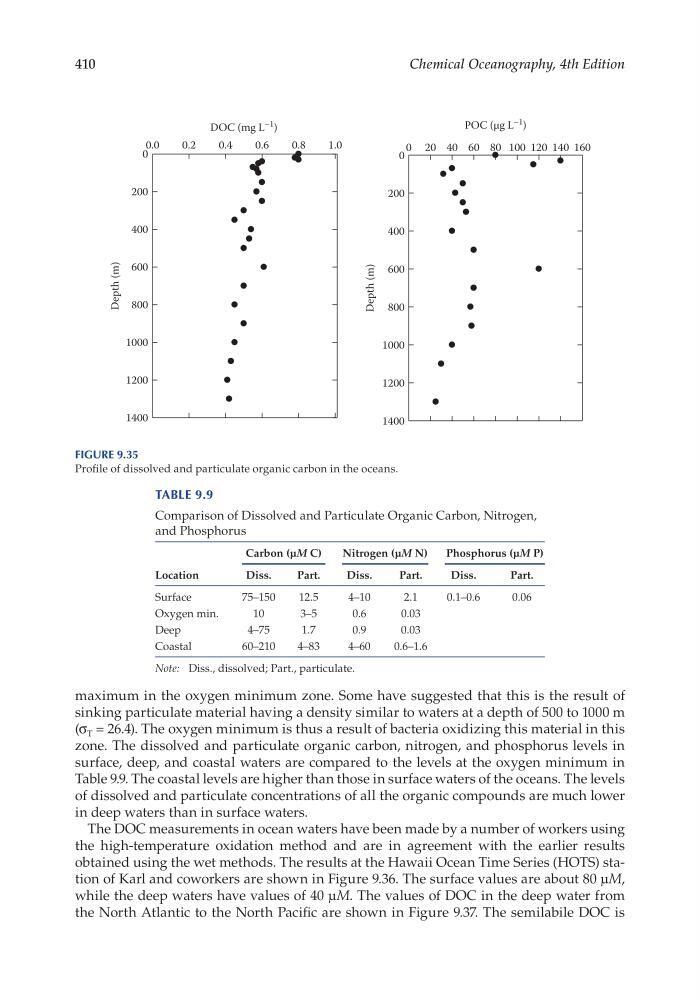
maximum in the oxygen minimum zone. Some have suggested that this is the result of
sinking particulate material having a density similar to waters at a depth of 500 to 1000 m
(σ T = 26.4). The oxygen minimum is thus a result of bacteria oxidizing this material in this
zone. The dissolved and particulate organic carbon, nitrogen, and phosphorus levels in
surface, deep, and coastal waters are compared to the levels at the oxygen minimum in
Table 9.9. The coastal levels are higher than those in surface waters of the oceans. The levels
of dissolved and particulate concentrations of all the organic compounds are much lower
in deep waters than in surface waters.
The DOC measurements in ocean waters have been made by a number of workers using
the high- temperature oxidation method and are in agreement with the earlier results
obtained using the wet methods. The results at the Hawaii Ocean Time Series (HOTS) station of Karl and coworkers are shown in Figure 9.36. The surface values are about 80 μM,
while the deep waters have values of 40 μM. The values of DOC in the deep water from
the North Atlantic to the North Pacific are shown in Figure 9.37. The semilabile DOC is
DOC (mg L –1 )
0.0
0.2
0.4
0.6
0.8
1.0
Depth (m)
0
200
400
600
800
1000
1200
1400
POC (µg L
–1 )
0 20 40 60 80 100 120 140 160
Depth (m)
0
200
400
600
800
1000
1200
1400
Figure 9.35
Profile of dissolved and particulate organic carbon in the oceans.
Table 9.9
Comparison of Dissolved and Particulate Organic Carbon, Nitrogen,
and Phosphorus
Location
Carbon (μM C)
Nitrogen (μM N)
Phosphorus (μM P)
Diss.
Part.
Diss.
Part.
Diss.
Part.
Surface
75–150
12.5
4–10
2.1
0.1–0.6
0.06
Oxygen min.
10
3–5
0.6
0.03
Deep
4–75
1.7
0.9
0.03
Coastal
60–210
4–83
4–60
0.6–1.6
Note: Diss., dissolved; Part., particulate.
Chemical Oceanography, 4th Edition
maximum in the oxygen minimum zone. Some have suggested that this is the result of
sinking particulate material having a density similar to waters at a depth of 500 to 1000 m
(σ T = 26.4). The oxygen minimum is thus a result of bacteria oxidizing this material in this
zone. The dissolved and particulate organic carbon, nitrogen, and phosphorus levels in
surface, deep, and coastal waters are compared to the levels at the oxygen minimum in
Table 9.9. The coastal levels are higher than those in surface waters of the oceans. The levels
of dissolved and particulate concentrations of all the organic compounds are much lower
in deep waters than in surface waters.
The DOC measurements in ocean waters have been made by a number of workers using
the high- temperature oxidation method and are in agreement with the earlier results
obtained using the wet methods. The results at the Hawaii Ocean Time Series (HOTS) station of Karl and coworkers are shown in Figure 9.36. The surface values are about 80 μM,
while the deep waters have values of 40 μM. The values of DOC in the deep water from
the North Atlantic to the North Pacific are shown in Figure 9.37. The semilabile DOC is
DOC (mg L –1 )
0.0
0.2
0.4
0.6
0.8
1.0
Depth (m)
0
200
400
600
800
1000
1200
1400
POC (µg L
–1 )
0 20 40 60 80 100 120 140 160
Depth (m)
0
200
400
600
800
1000
1200
1400
Figure 9.35
Profile of dissolved and particulate organic carbon in the oceans.
Table 9.9
Comparison of Dissolved and Particulate Organic Carbon, Nitrogen,
and Phosphorus
Location
Carbon (μM C)
Nitrogen (μM N)
Phosphorus (μM P)
Diss.
Part.
Diss.
Part.
Diss.
Part.
Surface
75–150
12.5
4–10
2.1
0.1–0.6
0.06
Oxygen min.
10
3–5
0.6
0.03
Deep
4–75
1.7
0.9
0.03
Coastal
60–210
4–83
4–60
0.6–1.6
Note: Diss., dissolved; Part., particulate.