

399
Primary Production in the Oceans
subantarctic (<3 μmol kg –1 , north patch) and the high Si(OH) 4 concentrations poleward of
the Antarctic circumpolar current (ACC), (~63 μmol kg –1 , southern patch). The limited iron
availability in these two regimes of the Southern Ocean prevents complete biological utilization of the ambient nutrients and influences phytoplankton species composition. The
uptake of the macronutrients silicic acid, phosphate, nitrate, and nitrite were measured
along with simultaneous measurements of the carbonate parameters TA, total inorganic
carbon (TCO 2 ), and pH from water sampled both inside and outside the iron- enriched
waters (Hiscock and Millero, 2005).
A summary of the change in nutrients and carbonate parameters is given in Table 9.5.
The observed maximum changes in the northern and southern patches were ΔNTCO 2 =
–14, –23 μmol kg –1 ; ΔNTA = 0 μmol kg –1 ; ΔpH = –0.032, –0.057; Δf CO 2 = –26, –36 μatm; ΔPO 4
= –0.09, –0.21 μmol kg –1 ; ΔSi(OH) 4 = –1.1, –4.0 μmol kg –1 ; and ΔNO 3 = –1.4, –3.5 μmol kg –1 ,
respectively. The changes in the southern patch were much greater than in the north
patch. The changes during SOFeX were the same order of magnitude as found during
the IRONEX II study. SOIREE (Southern Ocean Iron Release Experiment) and EisenEx
(experiment of the addition of iron to seawater) were preformed in the intermediate silica
concentrations of 9.5 μmol kg –1 and 14.2 μmol kg –1 , respectively. SOIREE was south of the
Antarctic polar front (APF) in the Australian sector (Boyd et al., 2000), and EisenEx (iron
experiment) within the Antarctic polar frontal zone (APFZ) of the Atlantic sector (Bozec
et al., 2004). The north patch results were in reasonable agreement with the results of the
SOIREE and EisenEx studies made at intermediate levels of Si.
175 E
180 E
Longitude
70 S
65 S
60 S
55 S
50 S
45 S
40 S
Latitude
175 W
170 W
South Patch
North Patch
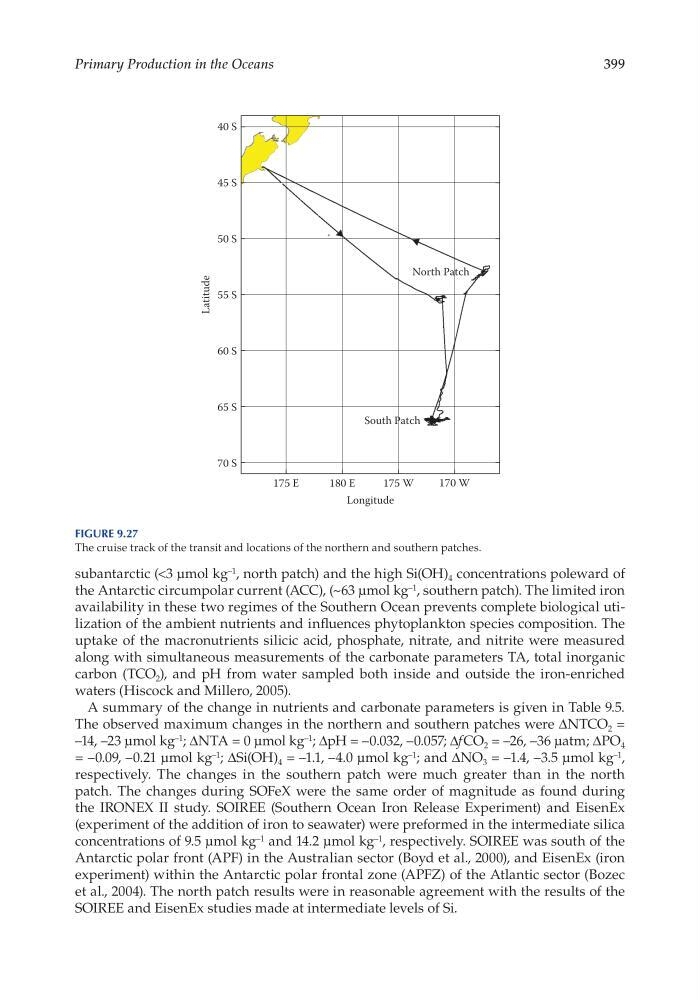
Figure 9.27
The cruise track of the transit and locations of the northern and southern patches.
Primary Production in the Oceans
subantarctic (<3 μmol kg –1 , north patch) and the high Si(OH) 4 concentrations poleward of
the Antarctic circumpolar current (ACC), (~63 μmol kg –1 , southern patch). The limited iron
availability in these two regimes of the Southern Ocean prevents complete biological utilization of the ambient nutrients and influences phytoplankton species composition. The
uptake of the macronutrients silicic acid, phosphate, nitrate, and nitrite were measured
along with simultaneous measurements of the carbonate parameters TA, total inorganic
carbon (TCO 2 ), and pH from water sampled both inside and outside the iron- enriched
waters (Hiscock and Millero, 2005).
A summary of the change in nutrients and carbonate parameters is given in Table 9.5.
The observed maximum changes in the northern and southern patches were ΔNTCO 2 =
–14, –23 μmol kg –1 ; ΔNTA = 0 μmol kg –1 ; ΔpH = –0.032, –0.057; Δf CO 2 = –26, –36 μatm; ΔPO 4
= –0.09, –0.21 μmol kg –1 ; ΔSi(OH) 4 = –1.1, –4.0 μmol kg –1 ; and ΔNO 3 = –1.4, –3.5 μmol kg –1 ,
respectively. The changes in the southern patch were much greater than in the north
patch. The changes during SOFeX were the same order of magnitude as found during
the IRONEX II study. SOIREE (Southern Ocean Iron Release Experiment) and EisenEx
(experiment of the addition of iron to seawater) were preformed in the intermediate silica
concentrations of 9.5 μmol kg –1 and 14.2 μmol kg –1 , respectively. SOIREE was south of the
Antarctic polar front (APF) in the Australian sector (Boyd et al., 2000), and EisenEx (iron
experiment) within the Antarctic polar frontal zone (APFZ) of the Atlantic sector (Bozec
et al., 2004). The north patch results were in reasonable agreement with the results of the
SOIREE and EisenEx studies made at intermediate levels of Si.
175 E
180 E
Longitude
70 S
65 S
60 S
55 S
50 S
45 S
40 S
Latitude
175 W
170 W
South Patch
North Patch
Figure 9.27
The cruise track of the transit and locations of the northern and southern patches.